
Roman Temple in Nin


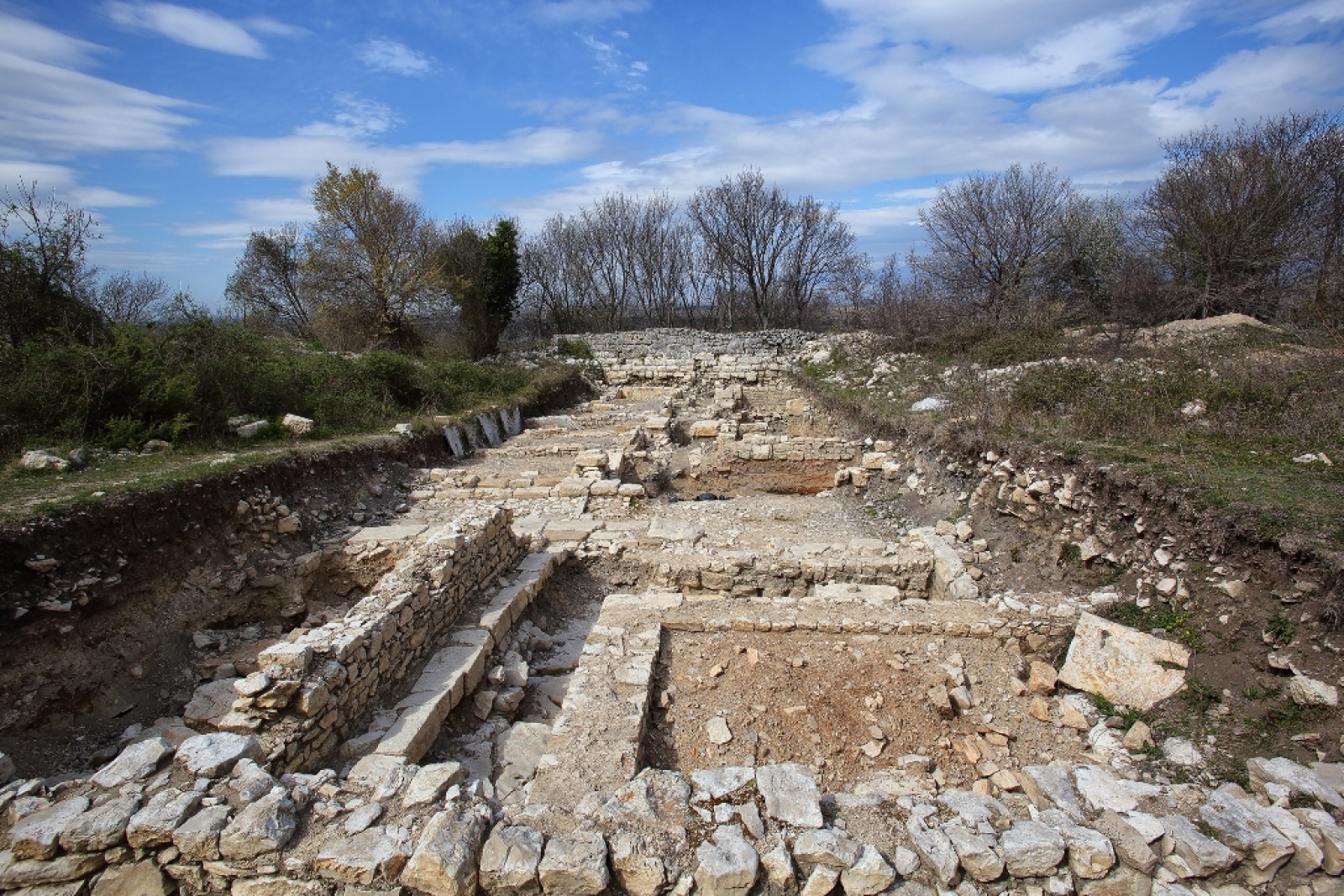
The Roman Temple in Nin (ancient Aenona) ranks among the largest structures of its kind on the eastern Adriatic coast. It was built by the Emperor Vespasian in the 1st century AD. The Roman Forum with its Capitolium represents the largest urban development project in the Roman structure of Nin.
The Roman Temple was erected on a massive, elevated podium. It was situated on the western part of the Roman Forum. This site was already a sanctuary even before the Romans arrived.
Access to the temple’s podium was via a monumental staircase on the facade, the foundations of which are still visible today. The name of Emperor Vespasian is inscribed on the frieze on the temple’s facade.
In front of the sanctuary was a spacious portico (or colonnade), which had six fluted columns on its eastern facade.
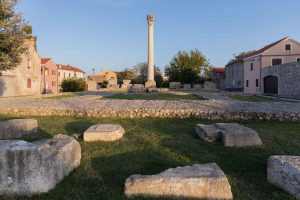
The sanctuary itself was divided internally into three chambers, separated from one another by two columns on each side. Statues of deities were likely placed inside these chambers. The central chamber was accessed from the portico through a portal, fragments of whose lintel and door jambs have been preserved. A Corinthian column, which originally stood 17 meters tall, has been re-erected at the temple site.
While the exact dimensions of the Roman Forum in Nin are not fully established, the dimensions of the temple are known: 33 meters in length and 23.5 meters in width. Its floor plan is clearly divided into two parts, both of roughly equal size: the sanctuary (cella) on the western side and the portico in front of it on the eastern side.
This is the largest known Roman temple on the eastern Adriatic coast, though the Temple of Augustus in Pula is the best-preserved one.
Location
Nin
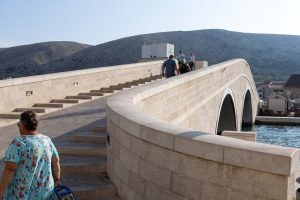
Nin (Aenona or Nona) is a town in the Zadar County of Croatia. Its historical center is located on an islet only 500 meters (yards) in diameter. It is situated in a lagoon on the eastern shore of the Adriatic Sea, surrounded by natural sandy beaches and linked to the mainland by two stone bridges from the 16th century. The present-day town on the islet was founded 3,000 years ago and is one of the oldest towns on the eastern Adriatic. The area of Nin was first colonized by ancient people of the Mediterranean.
ExploreAncient Rome
Romans subdued the Greek colonial cities in the 3rd century BC. They imposed an organization based on a military-economical system. Furthermore, the Romans subdued the Illyrians in the first century BC and organized the entire coastal territory by transforming the citadels into urban cities. After that, the history of these parts is the history of the Illyrian provinces of the Roman Empire. Numerous rustic villas, and new urban settlements (the most impressive are Verige in Brijuni, Pula, and Trogir – formerly Tragurion) demonstrate the high level of Roman urbanization. There were at least thirty urban cities in Istria, Liburnia and Dalmatia with Roman citizenship (civitas). The best-preserved networks of Roman streets (decumanus/cardo) are those in Epetion (Poreč) and Jader (Zadar). The most perfectly preserved Roman monuments are in Pola (Pula); founded in the first century dedicated to Julius Caesar. It is full of classical Roman art such as: stone walls, two city gates, two temples on the Forum, and remains of two theaters, as well as the Arch from the year 30 AD, and the temple of Augustus built in the years 2 to 14 AD, and finally the Fluvian Amphitheater (so called – Arena) from the 2nd century. In the 3rd century AD, the city of Salona became the largest (it had 40,000 inhabitants) and most important city of Dalmatia. Near the city emperor Diocletian, born in Salona, built Diocletian’s Palace around the year 300 AD, which is the largest and most important monument of late antique architecture in the world. On its pathways, cellars, domes, mausoleums, arcades and courtyards we can trace numerous different art influences from the entire Empire. In the 4th century, Salona became the center of Christianity for the entire western Balkans. It had numerous basilicas and necropolises, and even two saints: Domnius (Duje) and Anastasius (Stošija).
Explore







Reviews
There are no reviews yet.