
The Collegiate Church of the Assumption of the Blessed Virgin Mary in Pag


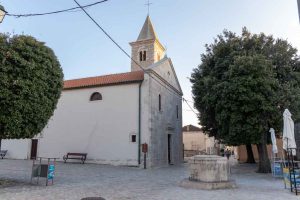
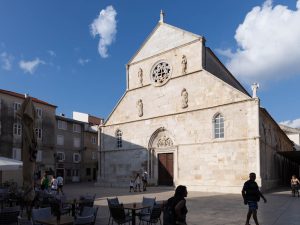
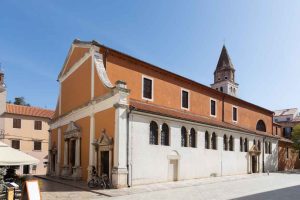
Right in the heart of the city, on the main square, stands the Collegiate Church of the Assumption of the Virgin Mary, locally known as the Vela Crikva (Great Church).
The Collegiate Church of the Assumption of the Blessed Virgin Mary (Zborna crkva Uznesenja Blažene Djevice Marije) is the largest and most beautiful church on the entire island, and is considered the most valuable monument of sacred architecture in the city of Pag. It is officially registered as a protected cultural asset.
History and Construction
The Collegiate Church was one of the first buildings established during the construction of the planned “New Pag,” a unique example of Renaissance urban planning on the Adriatic.
The foundation stone for this imposing structure was laid on May 18, 1443, marking the start of a long construction process that lasted until the beginning of the 16th century. Although the overall plans for the new city of Pag were prepared in Venice, the church itself was built by skilled masters from Šibenik and Zadar, including Pavao Juraj Dimitrov, Marko Andrijić, and Nikola Alegretti.
The famous Juraj Dalmatinac took over the construction in 1446 and served as a building contractor from 1449 until the mid-1460s. However, he was not the primary designer of the entire urban plan for the city or the original concept for the church.
The church tower was erected in 1562, but like the Romanesque Basilica of St. Krševan in Zadar, it remained unfinished. In building the Church of the Assumption, the people of Pag used the parish church in Stari Grad Pag (Old Town Pag) as their model, repeating its Romanesque-Gothic outline on the facade. This imitation reflected the citizens’ desire to maintain a spiritual continuity even after moving to the new city. The mother church from the Old Town had a floor plan modeled after the Zadar Cathedral.
Although the Collegiate Church is canonically a collegiate body with a choir of canons and is Pag’s most valuable sacred monument, its design did not stem from “classical” or “Renaissance ideal city” concepts. Instead, it was deeply rooted in the specific local conditions and traditionalism of the Pag environment.
Architectural Features and Artistic Treasure
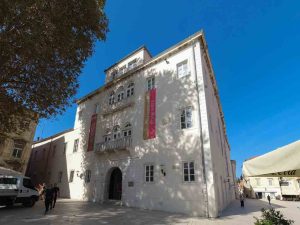
The church is situated on the main city square, forming its northern side. Its facade is unusually oriented toward the south, making it visible from the entire square. Together with the Rector’s Palace across the square, it symbolizes the balance of secular and ecclesiastical authority.
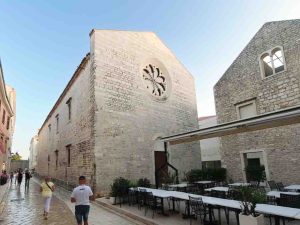
The facade is highlighted by a rich stone rosette, reliefs of Saints George and Michael, and a composition of the Annunciation. Of particular note is the lunette above the portal, which depicts the Virgin Mary protecting the pious people of Pag under her cloak. This piece is of high artistic value and is likely the work of Ivan Pribislavić or Petar Berčić. The lunette has a Romanesque shape with two semicircular arches and smooth door jambs.
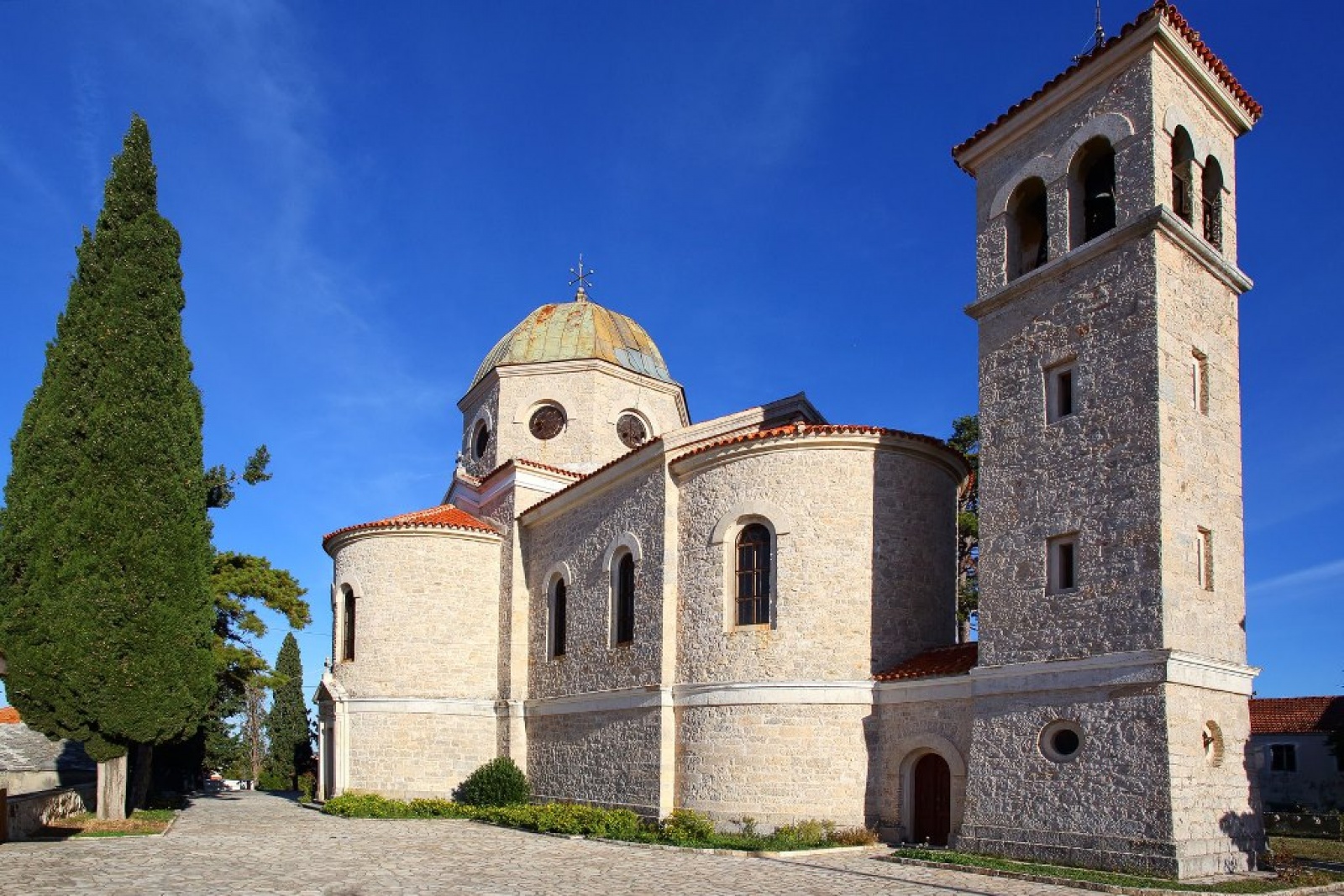
Stylistically, the church interweaves Late Gothic and Renaissance elements. The interior is a three-aisled basilica whose naves end in three square apses. The side apses and sacristy are covered with Gothic rib vaults. The arches in the nave have Renaissance features and were made in Marko Andrijić’s workshop.
It is adorned with five marble altars from the 18th and 19th centuries. Especially significant is the large altar painting, which depicts the Virgin, St. Dominic with St. Catherine of Siena, and figures from the Battle of Lepanto. This valuable painting is attributed to the famous Venetian painter Jacopo Tintoretto.
The church also houses the Holy Cross, a wooden Gothic crucifix from which, according to documents from the Pag Diplomatarium dating to 1413, blood flowed. The crucifix was transferred from the former Church of the Holy Cross in Stari Grad.
Spiritual Center and the Unfinished Cathedral
The Collegiate Church is a collegiate church with a chapter of canons, headed by the capitular archpriest who holds the title of mitred abbot of St. Peter, inherited from the ancient monastery of St. Peter the Apostle on Prosika.
The people of Pag fought for their own diocese for centuries. The desire for independence from Zadar’s dominance and the establishment of a local diocese was present as early as the 14th century, related to the construction of the Collegiate Church of St. Mary in Stari Grad.
In the plans for the “New Pag,” begun in 1443, an unfinished bishop’s residence or palace was envisioned for the main city square. This lavishly planned bishop’s palace was never completed because the bishop of Osor, Antun Palčić (a native of Pag), failed in his project to establish a Pag diocese.
The Collegiate Church continues to play a key role in the spiritual life of Pag. Every year, on the Feast of the Assumption (Velika Gospa, August 15), the people of Pag traditionally make a pilgrimage in procession from Stari Grad to the “Vela Crikva” (Great Church), carrying the statue of the Blessed Virgin Mary. The statue remains in the church for 22 days, until the Nativity of Mary (Mala Gospa), as a votive sign of gratitude and prayer for salvation from the cholera that ravaged the city in 1885.
Conflicts with Zadar
The people of Pag endured long and tumultuous conflicts with Zadar, which marked their history from the 12th to the early 15th century. These conflicts were driven by Zadar’s desire for dominance and its monopoly over Pag’s possessions and vital saltworks. Historical sources record that Zadar violently overthrew Venetian rule in Pag as many as fourteen times. Armed attacks often ended with the devastation of Pag, and the people of Pag were forced to supply oarsmen for Zadar’s galleys.
The decision to begin constructing the “New Pag” in 1443 was partly motivated by the need for a location that was better protected from Zadar’s assaults.
The bloody struggles between Zadar and Pag finally ended in 1409 when King Ladislaus of Naples sold Zadar, Novigrad, Vrana, and the island of Pag to Venice. Following this sale, Pag formally recognized the authority of the Venetian Republic, with which the Pag commune was officially put on the same footing as other Dalmatian communes and was granted limited autonomy.
Location
Gothic
Gothic appeared relatively late in Croatia. In addition to the 13th and 14th centuries, as long as it lasted in Europe, its influence is also visible in the 15th and 16th centuries – for example, on the Trogir and Sibenik cathedrals. Also on the territory of Croatia, you can often see admixtures of Romanesque and Renaissance in Gothic buildings. Gothic influence from European countries adapted to its possibilities and needs and thus created a “domestic artistic expression”. This mixture of styles is most pronounced in Dalmatia. The northern regions were exposed to the influences of Central Europe, while the coastal regions tied their artistic expression to Italian models.
ExploreRenaissance
In the 15th century, Croatia was divided between three states – northern Croatia was a part of the Austrian Empire, Dalmatia was under the rule of the Venetian Republic (with the exception of Dubrovnik), and Slavonia was under Ottoman occupation. Dalmatia was on the periphery of several influences, equidistant from Italy, Ottoman Bosnia, and Austria, so it drew influence from all. In those circumstances in Dalmatia flourished religious and public architecture with clear influences of the Italian Renaissance, but still original.
Explore









Reviews
There are no reviews yet.