
Zadar – Church of St Donatus


Named initially the Church of the Holy Trinity. It is an example of the centralized type of the Carolingian period in Europe.
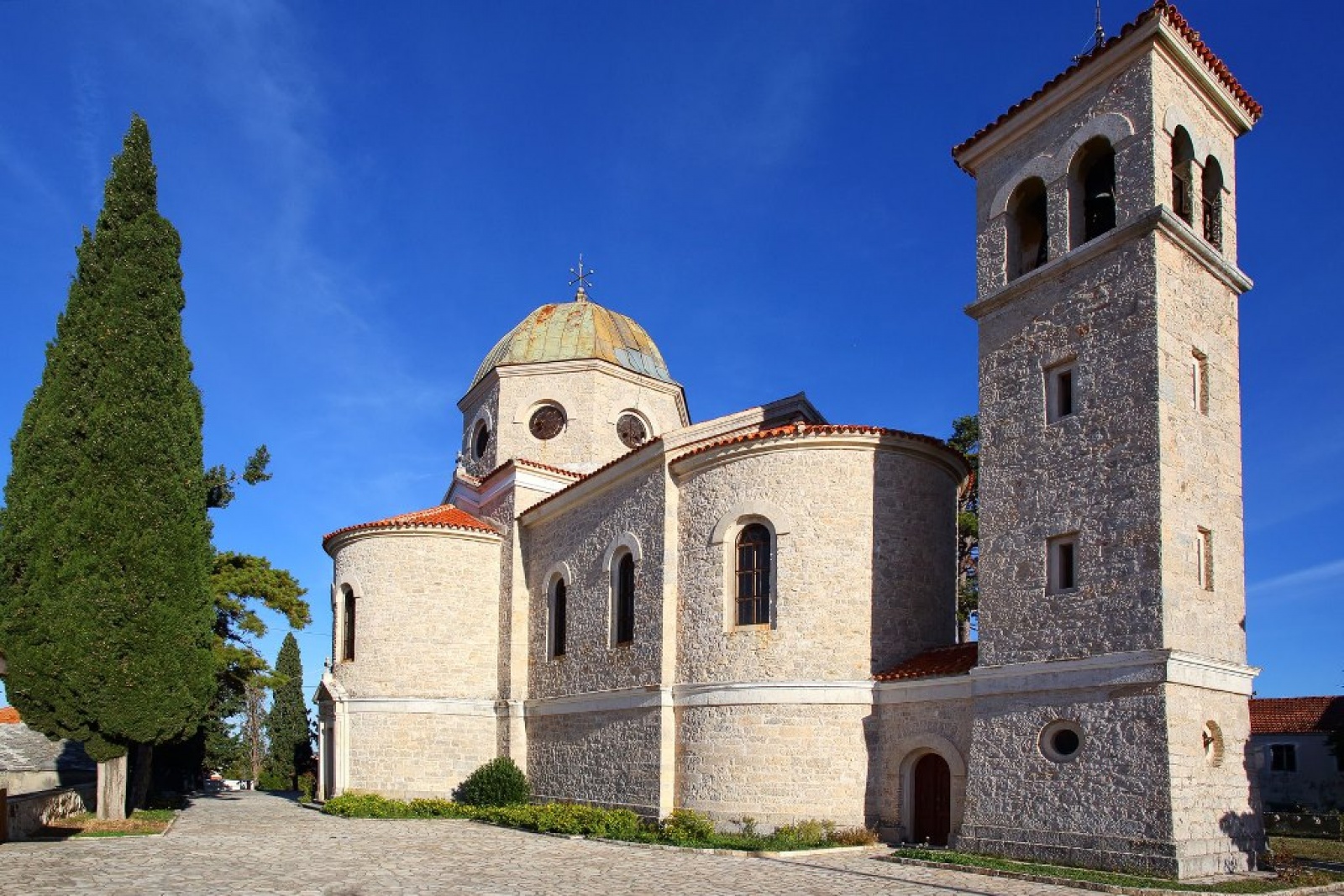
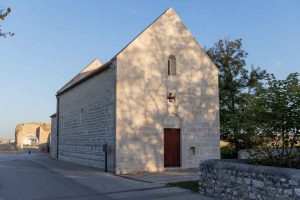
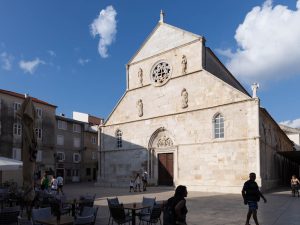
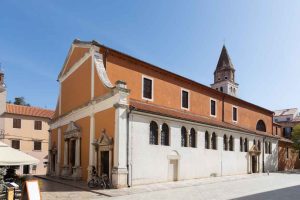
The Church of St. Donatus in Zadar is an important and impressive monument of Pre-Romanesque architecture. It was built during the 8th century and completed in the early 9th century. The church is considered one of the most significant monuments of early medieval architecture in Croatia.
The building of the Church of St. Donatus is credited to the Zadar bishop and diplomat Donatus of Zadar, who led the representations of the Dalmatian cities to the Byzantine emperor Nikephoros I in Constantinople and Charles the Great at the beginning of the 9th century. That is the reason the church bears a slight resemblance to Charlemagne’s court chapel in Aachen, today part of Aachen Cathedral, and also to the Basilica of San Vitale in Ravenna.

The church belongs to the Pre-Romanesque architectural period, and its circular shape was likely influenced by the Byzantine architecture tradition. The circular church, formerly domed, is 27 meters high and is characterized by simplicity and technical primitivism. It has three radially situated apses and an ambulatory around the central area, surmounted by a circular gallery.
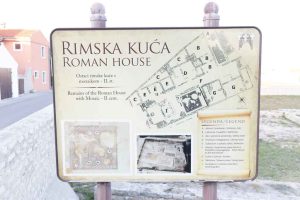
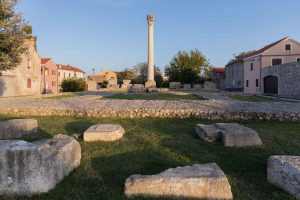
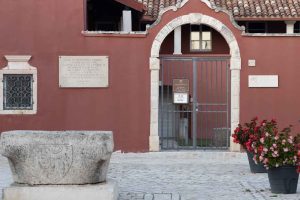
The church was built on the site of the Roman Forum, and it is possible to see different parts of the Roman remains at the base of the building. Among all of them, the most interesting is the remains of a sacrificial altar on which is written IVNONI AVGUSTE IIOVI AVGUSTO. There are also two Roman Columns in front of the main apse inside the church.

Over the centuries, the church has been used for various purposes. During the rule of the Republic of Venice, it was used as a warehouse, and it served the same purpose during the French/Napoleon (1806-1813) short period and under the Austrians. From 1893 to 1954, during the Austrians, Italian (1918-1943), and Yugoslavian periods, it housed the Zadar Archaeological Museum.
However, today, the building is used as the concert venue for the annual event, Musical Evenings in St. Donatus because of its exceptional acoustics.
Location
Zadar
Zadar is the oldest continuously inhabited city in Croatia. It is situated on the Adriatic Sea, at the northwestern part of Ravni Kotari region. Zadar serves as the seat of Zadar County and of the wider northern Dalmatian region. The city proper covers 25 km2 (9.7 sq mi) with a population of 71,000 in 2025, making it the second-largest city of the region of Dalmatia and the fifth-largest city in the country.
ExplorePre-Romanesque
In the 7th century, the Croats, with other Slavs and Avars, came from Northern Europe to the region where they live today. They were on the level of Iron Age nomadic culture, so they did not know how to enjoy the advantages of urban cities. This is why they first inhabited city boundaries on nearby rivers (like Jadro near Roman Salona).
Explore









Mate –
A masterpiece on a ruined masterpiece…👌