
Zadar’s City Loggia: A Medieval Hub of Power and Public Life


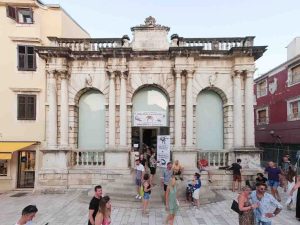
The City Loggia (Gradska loža) is a significant medieval structure that once served as a vital point of direct contact between the city’s citizens and its rulers.
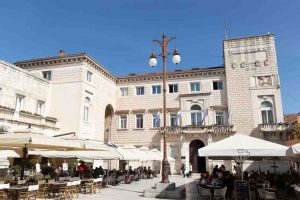
Records from as early as the 13th century mention the Loggia in the main square, highlighting its role as a venue for public political and legal gatherings. It even housed the official municipal standards for length, weight, and volume.
Much like a Roman basilica, the Loggia served multiple purposes. Within its walls, laws were proclaimed, judgments were delivered, and city councils convened. It was also a place for conducting trade and, importantly, for hosting civic celebrations, games, and entertainment.
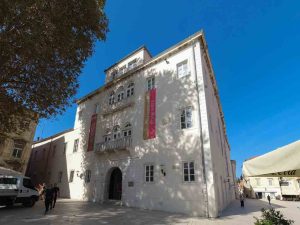
The Loggia’s present appearance is largely thanks to the Venetian architect Giangirolamo Sanmicheli. In 1565, following his designs, it was rebuilt in the style of the High Renaissance on the foundations of the 13th-century medieval loggia.
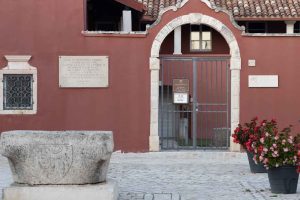
Two impressive facades face the square and the street, both dominated by three grand Renaissance arches. The central arch features steps and serves as the main entrance. Until the 19th century, there was also an entrance on the side facing the street. Inside, you can still find a judge’s table dating back to 1600 and a stone bench with a niche above it containing a statue of the Virgin Mary.
From 1855 to 1938, the City Loggia housed the Paravia Library. Since 1953, it has been used as an exhibition space, initially for the Art Gallery and, since 1962, as an exhibition pavilion of the National Museum Zadar (Narodni muzej Zadar – NMZ).
The Loggia underwent its latest adaptation in 1990, led by the renowned architect Nikola Bašić, who introduced elements of postmodern architecture.
Today, as part of the NMZ, the City Loggia is a vibrant center for the city’s artistic life. It hosts well-known international events during the summer months, including the “Man and the Sea” Photography Triennial and the “Blue Salon” Croatian Painting Triennial, continuing its long tradition as a focal point for public engagement and cultural activity in Zadar.
Location
Zadar
Zadar is the oldest continuously inhabited city in Croatia. It is situated on the Adriatic Sea, at the northwestern part of Ravni Kotari region. Zadar serves as the seat of Zadar County and of the wider northern Dalmatian region. The city proper covers 25 km2 (9.7 sq mi) with a population of 71,000 in 2025, making it the second-largest city of the region of Dalmatia and the fifth-largest city in the country.
ExploreRenaissance
In the 15th century, Croatia was divided between three states – northern Croatia was a part of the Austrian Empire, Dalmatia was under the rule of the Venetian Republic (with the exception of Dubrovnik), and Slavonia was under Ottoman occupation. Dalmatia was on the periphery of several influences, equidistant from Italy, Ottoman Bosnia, and Austria, so it drew influence from all. In those circumstances in Dalmatia flourished religious and public architecture with clear influences of the Italian Renaissance, but still original.
Explore









Reviews
There are no reviews yet.