
The Small Onofrio Fountain

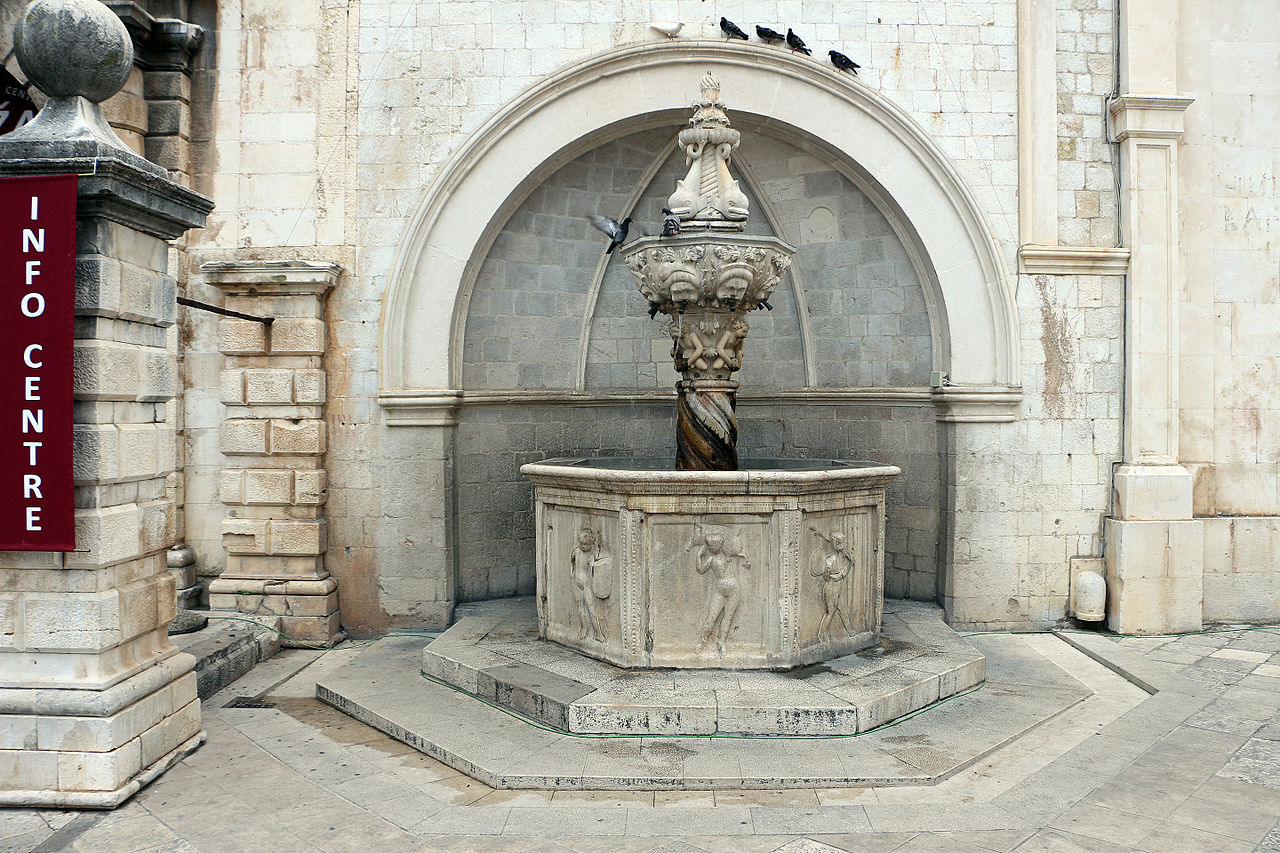

The Small Onofrio Fountain is located at the eastern end of Stradun on Luža Square, set into a wall niche of the former Main Guard building.
It is surrounded by Dubrovnik’s most prominent landmarks, including St. Blaise’s Church, Orlando’s Column, the Rector’s Palace, Sponza Palace, and the City Bell Tower.
It was erected in 1440 by the Neapolitan engineer Onofrio della Cava as part of the Republic of Ragusa’s water supply system designed in 1438. This system ensured an even distribution of water throughout the historic city center, complementing the existing Big Onofrio Fountain at the western entrance. Fresh drinking water was piped to the city from the Šumet spring, twelve kilometers away.
The Small Onofrio Fountain was damaged during the devastating earthquake of 1667, but it was later restored, preserving its core structure and decorative character.
Today, beyond its historical and civic importance, the fountain plays an active role in the city’s cultural identity: it serves as a stage setting for Marin Držić’s 16th-century Renaissance carnival play Novela od Stanca (The Story of Stanac).
Design of the Fountain
Unlike the more monumental Big Fountain, the Small Onofrio Fountain was crafted as a refined and highly decorative piece. Stone from the islet of Kamenjak near Korčula was used for its construction.
The stonework was executed by the Milanese sculptor Petar Martinov, and the fountain is renowned for its rich relief carvings: naked boys (putti) on the eight sides of the basin, dolphins holding shells, mascarons, and kneeling boys on the central column from which water flows.
Motifs such as boys, dolphins, and mascarons are typical Renaissance decorative elements, yet the carving technique still retains elements of the Gothic tradition, making this fountain a fine example of a transitional stylistic period.
Luža Square
Functionally, the fountain was a key water source for the eastern side of the city, particularly the area around Luža, which was the commercial and political heart of the Dubrovnik Republic.
The name “Luža” derives from the Latin word loggia. Towns along the Adriatic coast typically had a civic loggia—a covered space where merchants traded, citizens met, and news was shared—making it central to daily city life.
Nearby Attractions
- Stradun (Placa)
- St. Blaise’s Church (Crkva sv. Vlaha)
- Orlando’s Column (Orlandov stup)
- Rector’s Palace (Knežev dvor)
- Sponza Palace (Palača Sponza)
- City Bell Tower (Gradski zvonik)
- Ploče Gate (Vrata od Ploča)
Location
Dubrovnik
Dubrovnik is a stunning coastal city in southern Croatia, known for its beautiful architecture and rich history. The city’s old town is a UNESCO World Heritage Site, with its impressive walls, cobblestone streets, and Baroque buildings.
ExploreGothic
Gothic appeared relatively late in Croatia. In addition to the 13th and 14th centuries, as long as it lasted in Europe, its influence is also visible in the 15th and 16th centuries – for example, on the Trogir and Sibenik cathedrals. Also on the territory of Croatia, you can often see admixtures of Romanesque and Renaissance in Gothic buildings. Gothic influence from European countries adapted to its possibilities and needs and thus created a “domestic artistic expression”. This mixture of styles is most pronounced in Dalmatia. The northern regions were exposed to the influences of Central Europe, while the coastal regions tied their artistic expression to Italian models.
ExploreRenaissance
In the 15th century, Croatia was divided between three states – northern Croatia was a part of the Austrian Empire, Dalmatia was under the rule of the Venetian Republic (with the exception of Dubrovnik), and Slavonia was under Ottoman occupation. Dalmatia was on the periphery of several influences, equidistant from Italy, Ottoman Bosnia, and Austria, so it drew influence from all. In those circumstances in Dalmatia flourished religious and public architecture with clear influences of the Italian Renaissance, but still original.
Explore
Reviews
There are no reviews yet.