
Ivan Kožarić’s “Red Sign”

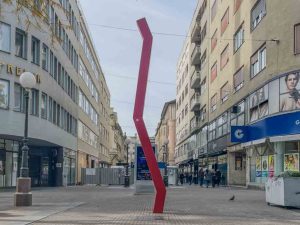
Ivan Kožarić generously donated the sculpture “Red Sign” (Crveni znak) to the city of Zagreb. Installed in the public space in 2013, this work had already been showcased back in 1976 at the prestigious 37th Venice Biennale.
The “Red Sign” is located at the corner of Gajeva and Bogovićeva Streets, directly in front of Hotel Dubrovnik. Its placement in 2013 was celebrated as one of the most positive developments for public sculpture in Zagreb since the installation of Kožarić’s iconic “Grounded Sun” in 1971.
The fractured, tall red line that looms over pedestrians in the city center is described by urbanist Niko Gamulin as an “exceptional urban work” that Zagreb deserves. Gamulin emphasized that the piece is noticeable without being arrogant, and its broken outlines look “fantastic.”
From Biennale to Bogovićeva Street
The “Red Sign” is categorized within Kožarić’s minimalist phase.
- Original Model: The original wooden model of the piece was created in 1969 and is preserved in the Gliptoteka HAZU (Croatian Academy of Sciences and Arts) in Zagreb. It measures in height.
- Venice Exhibition: Kožarić first exhibited the “Red Sign” in the Yugoslav pavilion at the Venice Biennale in 1976, where it served as a coloristic counterbalance to his other works.
- The Public Version: The version standing downtown is significantly taller than the original model and was executed as a metal object based on Kožarić’s sketches and smaller versions. Critically, because the artist donated the sculpture to the city, the installation of the “Red Sign” came at no cost to the City of Zagreb.
A Changing of the Guard
The placement of the “Red Sign” also signaled a significant visual change for the specific location.
The sculpture was installed in the exact spot previously occupied by a bronze bust of Croatian language reformer Ljudevit Gaj. That bust, by Macedonian sculptor Tome Serafimovski, was relocated a dozen meters away to the façade at the start of Gajeva Street. Art experts widely welcomed the change, as Gaj’s bust was often dismissed as a “paltry and shoddy” sculpture, and even called a “disgrace to the city and to sculpture.”
Kožarić’s Public Legacy in Zagreb
The “Red Sign” is a key piece in the body of work by Ivan Kožarić, an artist credited with changing the public perception of sculpture in Zagreb through works that actively communicate with the audience.
The “Red Sign” now stands near his beloved “Grounded Sun” on Bogovićeva Street and joins his figurative sculpture of writer A.G. Matoš on the Upper Town, which famously embraces tired passersby.
Location
Zagreb
Zagreb is the capital and largest city of Croatia. It is situated on the slopes of Medvednica mountain, in the Carpathian Basin, and on the banks of the Sava river. Zagreb has a rich and diverse history, culture, and architecture that reflect its long and turbulent past.
ExploreModernism
Yugoslav architecture emerged in the first decades of the 20th century before the establishment of the state; during this period several South Slavic creatives, enthused by the possibility of statehood, organized a series of art exhibitions in Serbia in the name of a shared Slavic identity. Following governmental centralization after the 1918 creation of the Kingdom of Yugoslavia, this initial bottom-up enthusiasm began to fade. Yugoslav architecture became more and more dictated by an increasingly concentrated national authority that sought to establish a unified state identity. Beginning in the 1920s, Yugoslav architects began to advocate for architectural modernism, viewing the style as the logical extension of progressive national narratives.
Explore




Reviews
There are no reviews yet.