
Zagreb – Museum of Contemporary Art
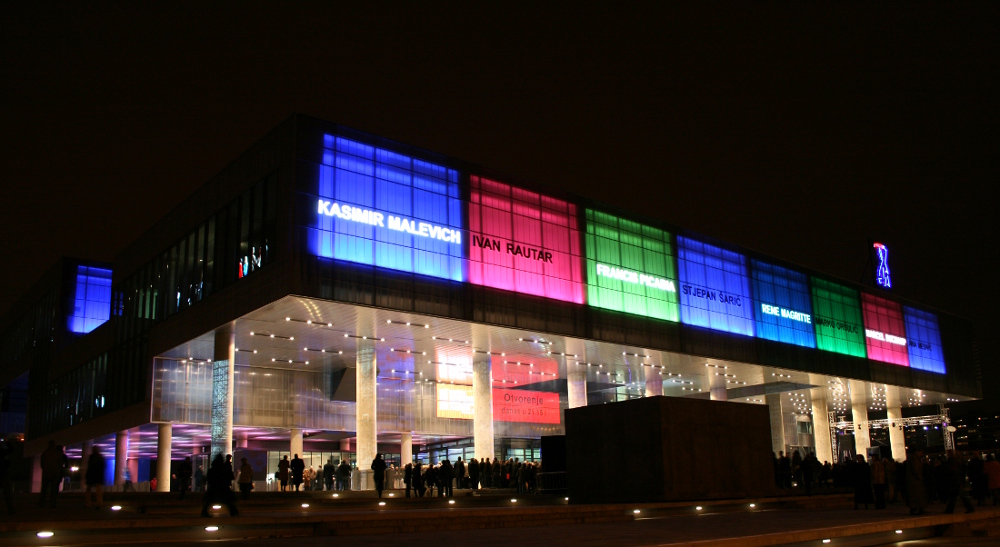
The museum’s holdings contain several collections and over 12,000 works by local and foreign artists, collected since its foundation in 1954 until today.
The museum was founded in 1954 with the establishment of the City Gallery of Contemporary Art, and it was located in the Kulmer Palace in Upper Town (Gornj Grad). Due to the small space, the museum did not have a permanent exhibition. It moved to its current location in Novi Zagreb in 2009, in a building built according to the winning project of architect Igor Franić.
The new building of the Museum of Contemporary Art has a little less than 15,000 square meters, of which 3,500 are for permanent exhibition, and 1,500 for occasional exhibitions of the most important authors and phenomena on the Croatian and international contemporary scene. A 90-meter-long LED screen covers most of the western side of the museum. On it, artistic video works are projected, through which the museum communicates with passers-by. The screen is among the largest in this part of Europe. The museum includes a library, multimedia hall, bookstore, VIP lounge, cafe, restaurant, teaching hall, and an apartment for visitors and curators.
In the desire to redefine the meaning of the permanent exhibition, the museum decided on the concept of “Collection in motion”, which highlights the shifts in the interpretation and presentation of the museum’s material. They contain a temporary character, flexibility, and changes in space and time. They are made up of several museum units such as “Art as Life”, “Project and Fate”, “Great Enigma of the World”, “Art about Art”, and “Words and Pictures”.
MSU contains and shows the beginnings and developments of contemporary artistic tendencies through collections of film and video, drawings, posters, prints, media arts, photographs, sculptures and paintings. The most significant part of the museum’s permanent exhibition is the archive of photographs by Tošo Dapac, the collection from the studio of Ivan Kožarić, the collection of Vjenceslav Richter, the collection of Benko Horvat and the donation of Silvana Seissel. It is also worth looking at other collections and current exhibitions.
Location
Zagreb
Zagreb is the capital and largest city of Croatia. It is situated on the slopes of Medvednica mountain, in the Carpathian Basin, and on the banks of the Sava river. Zagreb has a rich and diverse history, culture, and architecture that reflect its long and turbulent past.
Explore




Reviews
There are no reviews yet.