
Kallina House – Zagreb
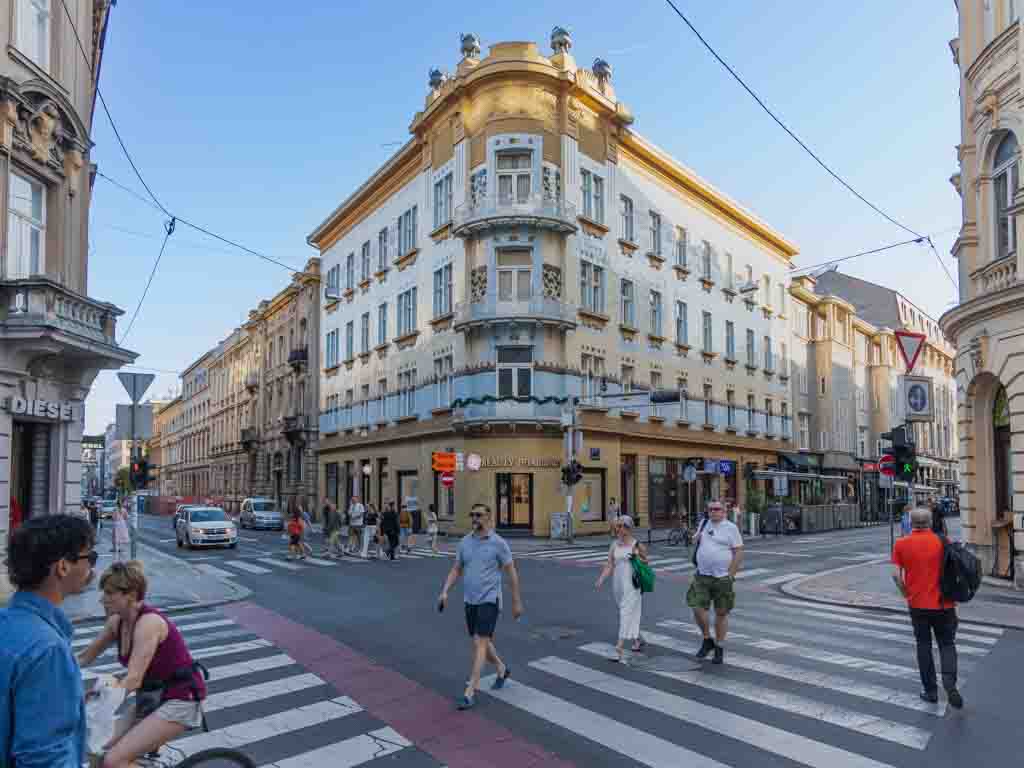
The Kallina house is considered “one of the most beautiful examples of art nouveau street architecture in Zagreb”.
Have you ever noticed the building on the corner of Masarykova and Gundulićeva streets in Zagreb covered with ceramic tiles? It is the Kallina House, a historic residential building built between 1903 and 1904 by the rich industrialist Josip Kallina for his family. The Kallina house is one of the most beautiful examples of Secession-style architecture in Zagreb.
The Kallina house is the work of the Croatian architect Vjekoslav Bastl, who worked for the Hönigsberg & Deutsch architectural office. Bastl studied at the Academy of Fine Arts in Vienna, where he was influenced by the Austrian architect Otto Wagner, one of the first proponents of Art Nouveau and one of the founders of the Vienna Secession art movement. Bastl designed a three-story building for Kuća Kallina, which is completely covered with decorative ceramic tiles produced by Josip Kallina’s factory. Thus, the building became a huge advertisement for his company, but also a way to show his wealth and taste. The building has decorative iron balconies overlooking the street intersection, displays of floral and geometric motifs typical of the Art Nouveau style of the period, and a bat-shaped pattern that surrounds the first floor of the facade.
Although many of Bastl‘s other projects in the Lower Town were considered examples of conservative Central European historicism, he allowed freer designs when working on private houses and villas, and the Kallina House is today described as “the most consistent example of how Art Nouveau architecture sought to reshape urban apartments and move away from conventional aesthetics”. The building has been included in the Register of Protected Cultural Properties of the Ministry of Culture of the Republic of Croatia since January 2004.
House Kallina should not be confused with Villa Kallina, a country house built by the same architect in another part of the city.
Location
Zagreb
Zagreb is the capital and largest city of Croatia. It is situated on the slopes of Medvednica mountain, in the Carpathian Basin, and on the banks of the Sava river. Zagreb has a rich and diverse history, culture, and architecture that reflect its long and turbulent past.
ExploreSecession
Till the end of World War I several art movements and styles coexisted in Croatia, but all avant-garde movements were absent. That is why the greatest artworks of that period were done in the spirit of 19th-century art, including the most important examples of Vienna Secession style: the Ethnographic Museum, Zagreb in 1901, Kallina House in 1903, the National Library in 1912 were built in Zagreb, while Sulphurous Bath in 1903, and the Croatian National Theatre in 1908, were built in Split.
Explore


Reviews
There are no reviews yet.