
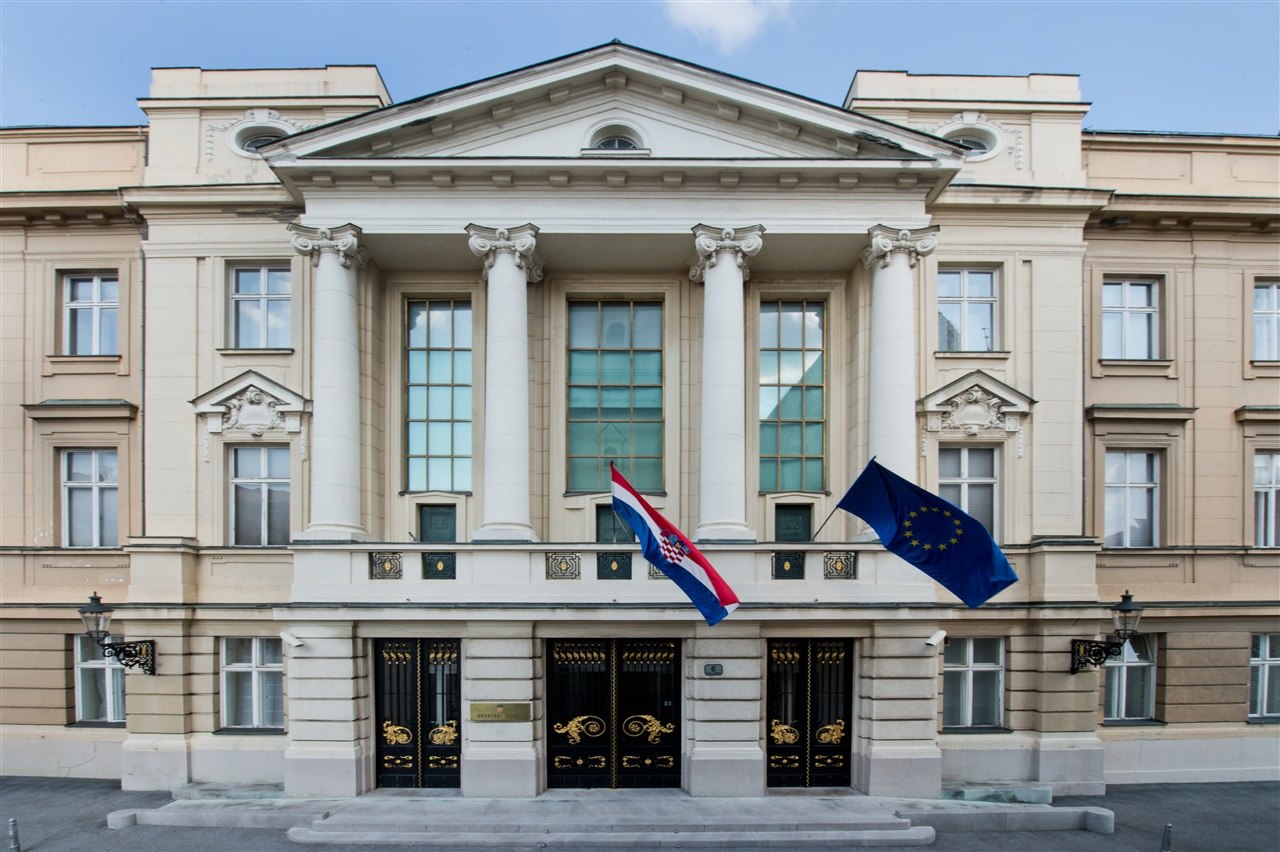
Sabor Palace – Parliament building in Zagreb

Prior to 1737, the joint congregation of Dalmatia, Croatia, and Slavonia within the Habsburg monarchy used various administrative buildings or noble residences for sessions.
The Croatian Parliament is a modern legislative body with 151 members who are elected by popular vote for a four-year term. The parliament has the power to pass laws, approve the national budget, and oversee the work of the government.
The Croatian Parliament has been meeting since the 13th century, but until the late 18th century, sessions were held in various places.
The Croatian Parliament has been meeting since the 13th century, but until the end of the 18th century, there was no building specifically intended for holding sessions. They were held in the houses of dignitaries, in the royal court in Gradec, or at the bishop’s court.
In 1731, a permanent parliament building was established at St. Marko’s Square, which underwent many renovations and expansions over the next 150 years. In 1911, the parliament became the sole owner of the building after extensive construction and renovations, resulting in a mix of Classicism, Neo-Renaissance, and Secession (Art Nouveau) styles.
Location
Zagreb
Zagreb is the capital and largest city of Croatia. It is situated on the slopes of Medvednica mountain, in the Carpathian Basin, and on the banks of the Sava river. Zagreb has a rich and diverse history, culture, and architecture that reflect its long and turbulent past.
ExploreClassicism
The term Classicism refers to two distinct periods in the evolution of European fine art: an earlier period spanning the 16th to 17th centuries, and a later period (also called Neoclassicism) from 1760 to 1830. In the Austrian lands (which included Croatia at the time), it emerged in the early 19th century.
ExploreSecession
Till the end of World War I several art movements and styles coexisted in Croatia, but all avant-garde movements were absent. That is why the greatest artworks of that period were done in the spirit of 19th-century art, including the most important examples of Vienna Secession style: the Ethnographic Museum, Zagreb in 1901, Kallina House in 1903, the National Library in 1912 were built in Zagreb, while Sulphurous Bath in 1903, and the Croatian National Theatre in 1908, were built in Split.
Explore


Reviews
There are no reviews yet.