
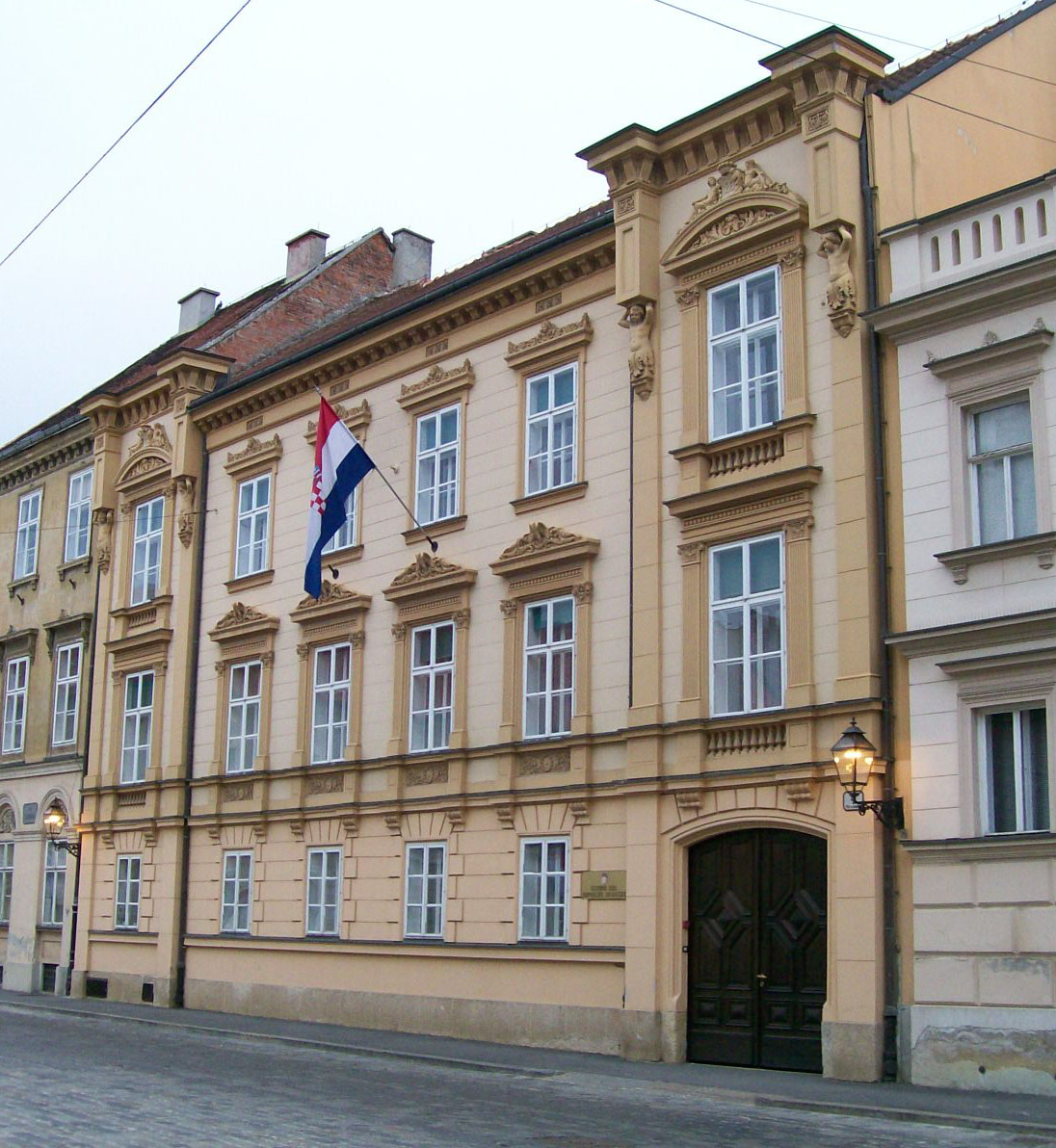
Kušlan Palace – building of the Constitutional Court of the Republic of Croatia
The Constitutional Court is independent of all three branches of government. It doesn’t belong to the executive, legislative, or judicial branches. Some legal theorists consider it a “fourth branch,” while others see it as above the traditional three.
The Constitutional Court of the Republic of Croatia (Croatian: Ustavni sud Republike Hrvatske) is an institution that acts as the interpreter and guardian of the Croatian Constitution and which monitors the conformity of laws with the Constitution as well as protection of human rights and freedoms of citizens that are guaranteed by the Constitution.
It is considered to be de facto the highest judicial authority because it can overturn Supreme Court decisions based on constitutional breaches. It is not considered as being part of the judicial branch of government, but rather a court sui generis, and it is therefore often colloquially referred to as a “fourth branch of government”, alongside the traditional model of tripartite separation of powers into the executive (Government/President of the Republic), legislative (Parliament) and judicial (Supreme Court) branches.
The Kušlan Palace
The Kušlan Palace, which now houses the Constitutional Court, is a two-story building that was built in 1867 after an older house was remodeled. Franjo Klein designed its Neo-Renaissance facade, which is decorated with details produced by the Brausewetter factory in Wagram. The interior underwent several renovations in the 20th century.
Location
Zagreb
Zagreb is the capital and largest city of Croatia. It is situated on the slopes of Medvednica mountain, in the Carpathian Basin, and on the banks of the Sava river. Zagreb has a rich and diverse history, culture, and architecture that reflect its long and turbulent past.
ExploreHistoricism
Historicism is marked with building three large churches: the neo-Romanesque cathedral in Đakovo (K. Roesner and F. Schmidt, 1882), monumental parish church of St Peter and Paul in Osijek (1898) and neo-gothic rebuilding of Zagreb cathedral with glazed roof tiles and 105 m tall towers (Herman Bolle, 1880–1902). At the end of 19th century Herman Bolle undertook one of the largest projects of European historicism, a half-kilometer long neo-Renaissance arcade with twenty domes on Zagreb cemetery Mirogoj.
Explore


Reviews
There are no reviews yet.