
The Column with Blessed Maria and the Fountain with 4 Angels


The Neo-Gothic pillar with Blessed Maria and the fountain with four angels, in front of Zagreb Cathedral, was erected between 1879 and 1881. It was built by Herman Bollé according to a design by Friedrich Schmidt. The statue of the Virgin Mary on top of the pillar is the work of the Viennese sculptor Anton Dominik Fernkorn.
This monument, dedicated to the Immaculate Conception of Mary and featuring angels, was originally intended for St. Mark’s Square in the Upper Town (Gornji Grad).
In the 18th century, St. Mark’s Square was the location of an earlier column with a statue of Mary. This pillar, featuring a gilded depiction of the Immaculate Mary, stood in front of the south portal of St. Mark’s Church. It was created by Claudio Kautz and erected in 1740, funded by city senator Ivan Hyacintha.
This original pillar was removed in 1869 to make way for a fountain planned for the visit of Emperor Franz Joseph I to Zagreb. At its base, the earlier pillar included statues of St. Joseph, St. John of Nepomuk, St. John the Evangelist, and St. John the Baptist, as well as the coats of arms of the Triune Kingdom of Croatia, Slavonia, and Dalmatia, and the city of Zagreb.
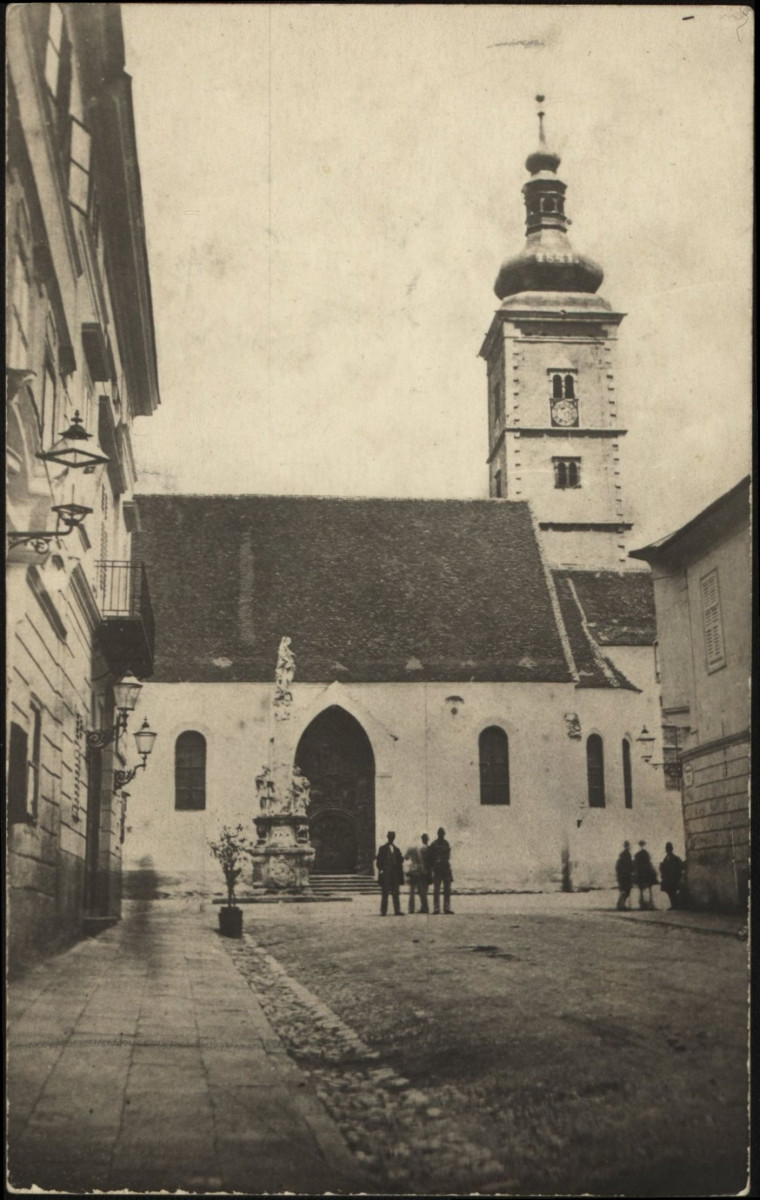
Apart from the emperor’s visit, in 1864, it was decided to remove the pillar due to its dilapidation and to build a new, larger one. The work was awarded to the famous Austrian sculptor Anton Dominik Fernkorn. Today, he is better known for his work on the monument to Ban Josip Jelačić.
Fernkorn completed the new pillar in 1865. However, its size was deemed unsuitable for St. Mark’s Square. Consequently, it was decided to incorporate the pillar into a fountain in front of Zagreb Cathedral.
Unlike the earlier pillar in the Upper Town, this monument is surrounded by angels, representing the four cardinal virtues: Faith, Hope, Purity, and Humility, rather than statues of saints.
Location
Zagreb
Zagreb is the capital and largest city of Croatia. It is situated on the slopes of Medvednica mountain, in the Carpathian Basin, and on the banks of the Sava river. Zagreb has a rich and diverse history, culture, and architecture that reflect its long and turbulent past.
ExploreHistoricism
Historicism is marked with building three large churches: the neo-Romanesque cathedral in Đakovo (K. Roesner and F. Schmidt, 1882), monumental parish church of St Peter and Paul in Osijek (1898) and neo-gothic rebuilding of Zagreb cathedral with glazed roof tiles and 105 m tall towers (Herman Bolle, 1880–1902). At the end of 19th century Herman Bolle undertook one of the largest projects of European historicism, a half-kilometer long neo-Renaissance arcade with twenty domes on Zagreb cemetery Mirogoj.
Explore


Reviews
There are no reviews yet.