
The Monument to King Tomislav for the Thousandth Anniversary of the Croatian Kingdom

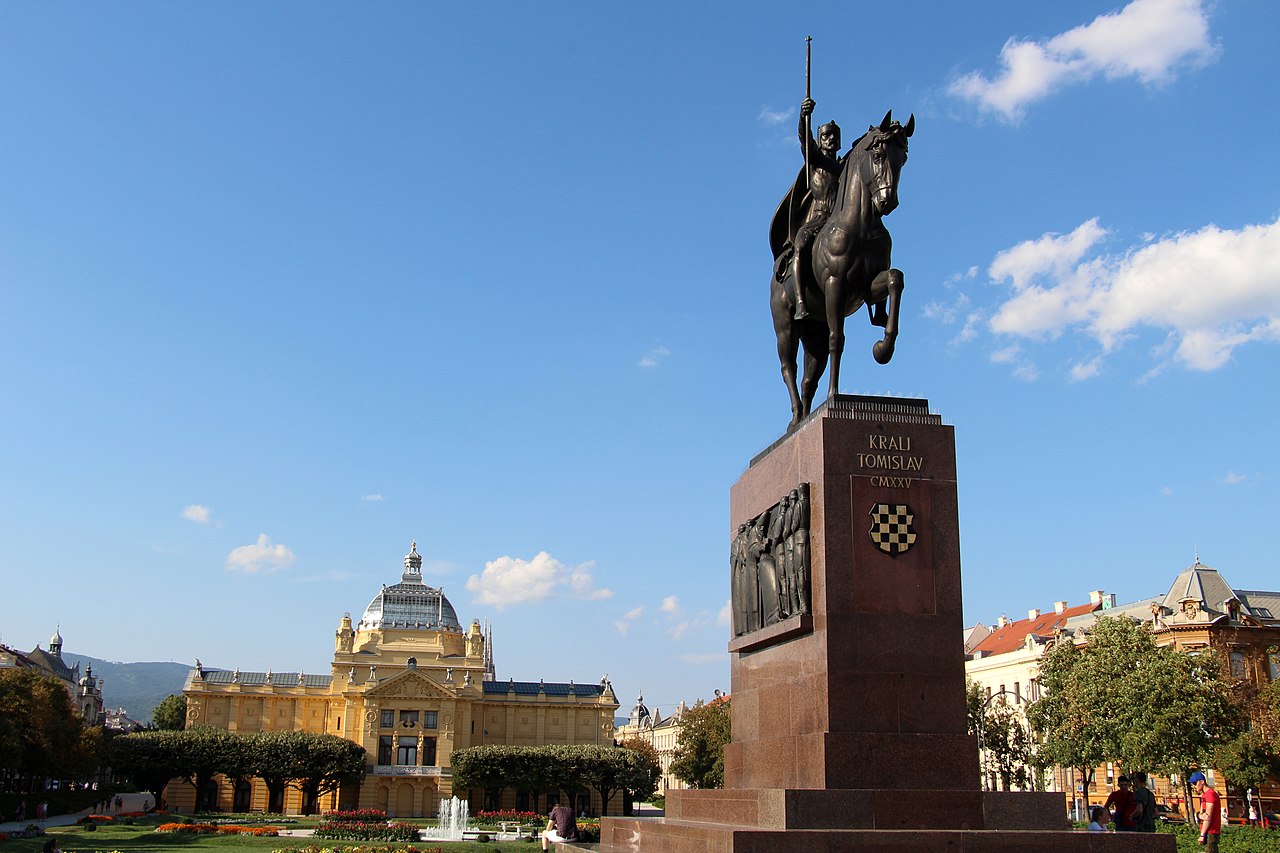


It all begins amid great ambitions and an even greater anniversary. In 1925, Croatia was to celebrate one thousand years since the founding of its kingdom, and the monument to King Tomislav was intended to give that historical narrative a visible, monumental seal.
The main goal was to publicly mark the renewed unification of Dalmatia and northern Croatia within the Kingdom of Serbs, Croats and Slovenes. Organizers aimed to have the unveiling of the monument coincide with the celebration of the millennium of the Croatian Kingdom (925–1925).
The idea of marking the millennium had already been proposed in 1906 by members of the Brotherhood of the Croatian Dragon. They arbitrarily chose the year 925 as the founding year, when Tomislav was referred to as king (dilecto filio Tamisclao, regi Crouatorum) during the church council held in Split, in a letter from Pope John X (914–928).
The Statue of King Tomislav
In August 1924, the Committee for the Erection of the Monument to King Tomislav was founded in order to create a public symbol of the reunification of Dalmatia and northern Croatia within the Kingdom of Serbs, Croats and Slovenes.
The plan was to name the square where the monument would stand after Tomislav, and the organizers hoped to complete this as part of the 1925 millennium celebrations.
The Committee received permission to collect funds throughout the Kingdom. Fundraising began through the sale of brochures and proclamations about the project, and the collected money was deposited in the First Croatian Savings Bank so that interest could generate additional funds.
For the placement of the statue, the artistic department proposed Square I, the location originally intended for a monument to Emperor Franz Joseph I.
Since this would be the first square in Zagreb named after a Croatian prince or king, the initiative gained momentum among nationalist circles.
On 31 December 1925, the cornerstone intended for the statue’s pedestal was blessed by Antun Bauer, then Archbishop of Zagreb. On a black stone plaque, the inscription in golden letters read: Tomislav, the first Croatian king, 925 to 1925.
From 1926 onward, due to the credit and agrarian crises and a new government ministry focused on austerity, fundraising became increasingly difficult.
The following year the Committee was formally transformed into the Society for the Erection of the Monument to King Tomislav, and its work expanded to include the establishment of a “Millennial Museum” and a broader “Forum Croatorum” on Square I.
On 12 November 1927, Square I was renamed King Tomislav Square, and in the same year Robert Frangeš Mihanović completed the first sketches of the statue.
After the assassination of Stjepan Radić in the National Assembly of the Kingdom of Yugoslavia in Belgrade in 1928 and the introduction of the 6 January Dictatorship in 1929, the Committee withdrew completely to avoid provoking the state. During this period it worked only on the reliefs for the base of the statue.
One proposal came from Dubrovnik lawyer Niko Bjelovučić, who suggested depicting Prince Mihajlo Višević, the city of Dubrovnik and the Bay of Kotor — symbols of the extent of Tomislav’s authority.
Completing the Statue
In January 1930, after the dictatorship weakened, the plaster model was completed in a special studio built by Frangeš. A public viewing was organized in Rokov Park in Zagreb, but the cost of casting the bronze was at the time too high.
The Ministry of the Army obtained the king’s permission for old World War I cannons to be melted down for the statue and transported from Kragujevac — in total about 5,000 kilograms of bronze. In gratitude, Zagreb’s mayor Stjepan Srkulj gifted King Alexander the Pongratz Castle. At the annual assembly it was decided that the Committee now had sufficient funds to cast and complete the statue.
In the same year, 1930, the reliefs were revised. The motif of the “Coronation of Tomislav” was retained, but the “Council of Split” was replaced with the motif of the “Reconciliation” of Serbian Prince Zaharija and Bulgarian Tsar Peter I, with Tomislav extending his hands to both as a symbol of Balkan reconciliation. Frangeš would complete the reliefs by autumn 1938 in the same style as the monument.
Meanwhile, in 1931 the casting of the statue began. The plan was to cast the 14-meter-high statue in 26 pieces from 8 tons of bronze, while 3 additional tons would be imported from abroad.
The statue was finally completed in September 1933. However, the Committee and the caster Oblak faced difficulties — the owner of Oblak’s studio terminated his lease, and her lawyer demanded 1,200 dinars in monthly rent plus arrears of 20,975 dinars in order for the statue to remain in the studio, which the Committee was forced to pay.
Then the Society of Zagreb Residents began publicly advocating for the Pavilion to be replaced with a triumphal arch and for a monument to King Alexander I to be erected on King Tomislav Square — further complicating the installation of the statue.
In 1936 it was decided that stone statues of all Tomislav’s predecessors would be placed throughout the square, facing him.
Installing the Statue
In 1939 the City Council granted permission to erect the monument opposite the main entrance to the Central Railway Station.
By this time, the plan for the so-called “Forum Croatorum” — which envisioned the entire square as a unified complex with Tomislav facing north, flanked by statues of Croatia (a symbolic woman with a sickle) and other Croatian rulers — had collapsed. A “Millennial Museum” was also planned at the site of the Pavilion.
Instead, many advocated that Tomislav should face south, toward the station, and some insisted he should face west, toward the Esplanade Hotel.
Because of these disagreements, installation halted in December 1939 in the middle of cementing the foundation.
During the Independent State of Croatia (NDH)
During the fascist regime of the Independent State of Croatia, the statue was still not erected despite intentions, an approved location and available funds. The likely reason was fear of public reaction: the NDH had ceded much of the Dalmatian coast to the Kingdom of Italy, making the original idea — the symbolic reunification of Dalmatia with the Croatian mainland, as in Tomislav’s time — meaningless.
To make matters worse, in May 1941 Ante Pavelić, accompanied by several Croatian envoys, formally asked Italian King Victor Emmanuel III to appoint Prince Aimone of Savoy as King of Croatia (revealing the NDH’s subservience to the Italian Empire). Prince Aimone took the name Tomislav II, in memory of the first Croatian king.
His coronation was planned for Tomislavgrad, but Aimone refused to come to the NDH. He later even refused to accept the throne in protest of Italy’s annexation of Dalmatia, arguing that Dalmatia could never be Italian and that the Rome Treaties hindered Croatian-Italian reconciliation.
In the summer of 1942, the pedestal on the square was completed, but political and financial resources for installing the statue had dried up, and the park was being used for food cultivation.
In Socialist Yugoslavia
From 1945 to 1947 the pedestal was adorned only with a partisan star.
And finally, in an ironic twist, the communists erected the monument to the first Croatian king in 1947 — likely as compensation for the removal that same year of the equestrian statue of Ban Jelačić, deemed politically unsuitable, from the Zagreb main square.
The monument was oriented southward toward the Railway Station, so that visitors arriving in Zagreb would not find themselves “under the horse’s tail.” Instead of the “Reconciliation” relief, the pedestal bore an inscription:
“Tomislav, the first among Croatian rulers, united his tribes into a single state and in the year CMXXV proclaimed himself king. He ruled from the Drava to the Adriatic over the cities of Split, Zadar and Trogir and over the islands from Krk and Rab to Vis, Brač and Korčula. He fought victoriously in Pannonia, on the Drava and in Apulia. Like Ljudevit Posavski a hundred years before him in the struggle against the Franks, Tomislav acted in alliance with the Serbs, symbolically anticipating the unity of the Yugoslav peoples.”
The text was written by Croatian writer Miroslav Krleža, who, under Party orders, was meant to portray King Tomislav as a champion of South Slavic unity.
In 1948 the second relief, “The Coronation,” was removed because of the papal motif. Two new reliefs were added: Želimir Janeš created a new scene of the “Reconciliation of Serbs and Bulgarians,” while Ivan Sabolić depicted “The Fleet of King Tomislav.”
Modern Republic of Croatia
In 1991, after Croatia’s independence, the 1948 reliefs were removed and Frangeš’s original reliefs were restored to the monument, cast from plaster models preserved in the HAZU Glyptotheque. Instead of the 1947 inscription, the Croatian checkerboard coat of arms — also designed by Frangeš — was placed on the front of the monument.
Frangeš’s Reliefs
In the “Reconciliation” relief, Tomislav stands at the center facing the viewer, holding the hands of Serbian Prince Zaharija and Bulgarian Tsar Peter. They and their entourages are shown in profile. The entire scene radiates Tomislav’s composure and dignity, expressing the authority of the most respected ruler in the Balkans of his time.
In the “Coronation” relief, Tomislav is again placed at the center. He appears in profile, cloaked, kneeling and leaning on a sword. To his left stands a cleric wearing a mitre, placing a crown upon Tomislav’s head, with two more clerics behind him — one holding a gospel book, the other the royal symbols of the orb and cross. On the right, behind Tomislav, stand three warriors carrying a banner, a sword and a bow — symbols of King Tomislav’s power.
You can read more about the reliefs in the Virtual Exhibition on King Tomislav.
If there is one sculpture that embodies all the layers of Croatian history in the 20th century — the Kingdom of SHS, the fascist NDH, socialist Yugoslavia and the democratic Republic of Croatia — it is the Monument to King Tomislav.
Location
Zagreb
Zagreb is the capital and largest city of Croatia. It is situated on the slopes of Medvednica mountain, in the Carpathian Basin, and on the banks of the Sava river. Zagreb has a rich and diverse history, culture, and architecture that reflect its long and turbulent past.
Explore


Reviews
There are no reviews yet.