
Zagreb Main Square – Ban Jelačić Square

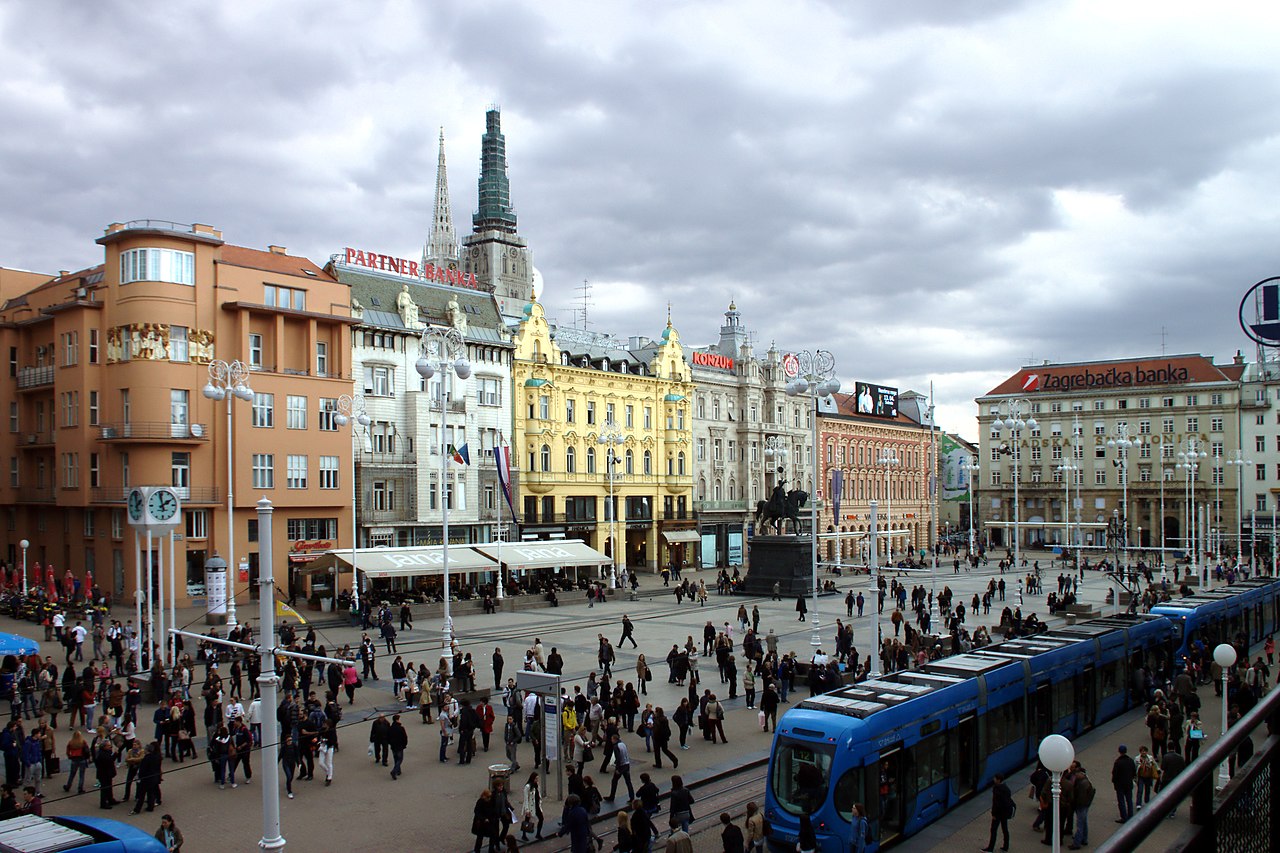


Ban Josip Jelačić Square is the main and largest square in Zagreb. It hosts various social events, and residents meet on the square at popular spots – “under the clock” and “under the tail”.
It is named after Ban Josip Jelačić (1801-1859), in his honor, during his lifetime, due to his significant contributions within the Habsburg Monarchy. Therefore, it’s no surprise that the square’s center features a monument to Ban Josip Jelačić, sculpted by Viennese sculptor Dominik Fernkorn.
Besides the monument, the square is also home to the Manduševac Fountain and numerous buildings from the 19th and 20th centuries. Their facades showcase a variety of architectural styles, from the 19th-century neo-styles, Biedermeier, and Secession (Art Nouveau) to modern and postmodern influences.
Notable buildings include the Kolmar building, Rado House, Hotel Dubrovnik, and the Feller-Stern House, which has been nicknamed Zagreb’s first skyscraper.
Because of its central location, many other points of interest are nearby, such as the Archaeological Museum, the Nama department store, Zagreb Cathedral, the Dolac Market, and Tkalčićeva Street.
From Empty Field to City Center
The Ban Jelačić Square wasn’t always at the heart of the city. It was once an open field outside the walls of Gradec and Kaptol, a gathering place for newcomers who were not allowed to enter the city.
In 1641, the city authorities designated the area near the Manduševac spring for holding fairs. Zagreb’s expansion towards Ilica Street on the west and Stara Vlaška Street on the east has made this area the most crucial part of Zagreb city.
Until 1975, on the square was car traffic, but today it is the main pedestrian promenade, with only trams passing through.
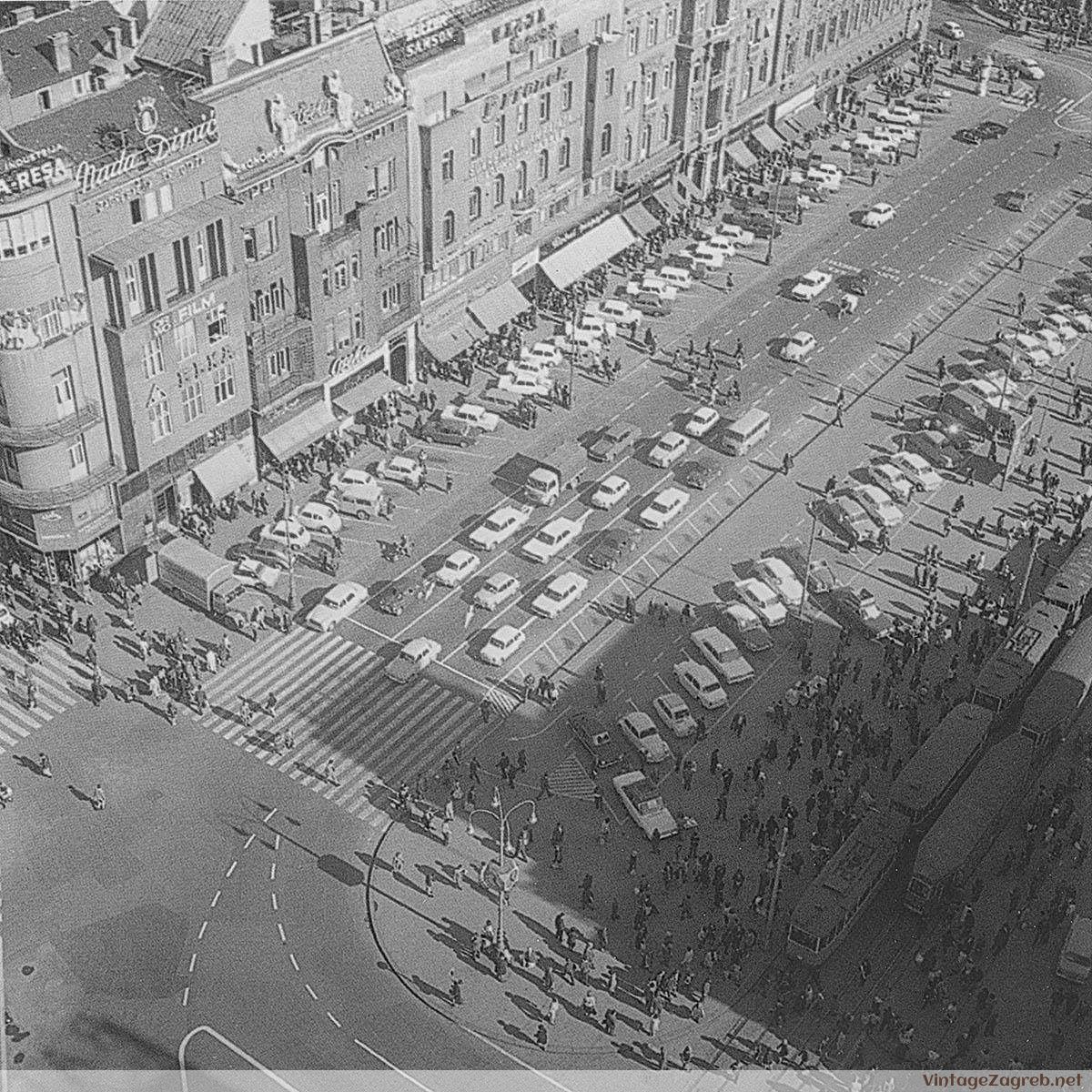
Throughout its history, the square has had different names
- Trg Tridesetnice (Thirtieth Square) and Harmica (Hungarian for “thirty”), a name that persists for the passage towards Dolac, recalling the former customs office where a thirtieth of the goods was levied as tax.
- Jelačić-plac (Jelačić Square), officially from 1848 to 1946.
- Trg Republike (Republic Square) form 1946 to 1990, during the communist regime in SFR Yugoslavia.
- The name Trg bana Josipa Jelačića (Ban Josip Jelačić Square) was reinstated in 1990.
A Site of Historical Events and Fairs
Ban Jelačić Square has always been a stage for significant historical, political, cultural, and sporting events. In the Middle Ages and the Early Modern period, Harmica served as a marketplace. During the 17th century, weekly markets and large annual fairs moved to the vicinity of Manduševac, and the livestock market was relocated to Marvinski trg (present-day Zrinjevac) in 1826.
Nevertheless, the square retained its importance. In 1890, the City Council decided that weekly markets would be held on Wednesdays, as well as on Holy Thursday and the feast of St. Thomas before Christmas. These markets traded meat, fish, milk, eggs, livestock, and game. The main marketplace was moved to Dolac in 1930, but specialized fairs are still occasionally held on Jelačić Square today.
The square has also been the backdrop for turbulent historical moments:
- October 16, 1895: The burning of the Hungarian flag in protest against Ban Khuen-Héderváry.
- December 5, 1918: Supporters of the National Council of the State of Slovenes, Croats and Serbs opened fire on Zagreb residents protesting the inclusion of Croatia into a Kingdom of Yugoslavia without a popular vote. The fifteen fatalities were dubbed the “December Victims.“
- May 7, 1971: A large protest rally of the Croatian Spring movement was held on what was then Republic Square.
- October 17, 1989: The band Prljavo kazalište held a concert titled “To the Beloved City,” which became known as the “Forbidden Concert.” It gathered between 250,000 and 300,000 people. Despite attempts by the militia to cut off the power, the concert took place and symbolized Croatia’s symbolic separation from Yugoslavia, particularly emphasized by the song “Mojoj majci (Ruža Hrvatska)” (To My Mother (Croatian Rose)), a symbolic end to Croatia’s silence.
- July 16, 2018: After winning second place at the 2018 FIFA World Cup, the Croatian national football team was welcomed back by 550,000 people on the square.
Location
Zagreb
Zagreb is the capital and largest city of Croatia. It is situated on the slopes of Medvednica mountain, in the Carpathian Basin, and on the banks of the Sava river. Zagreb has a rich and diverse history, culture, and architecture that reflect its long and turbulent past.
Explore


Reviews
There are no reviews yet.