
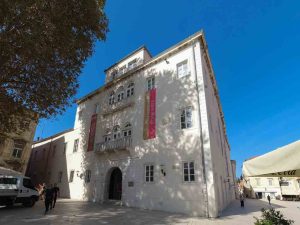
Archaeological Museum Zadar


The museum was founded in 1832. as part of the complex National or Provincial Museum of Dalmatia and is one of the oldest in Croatia.
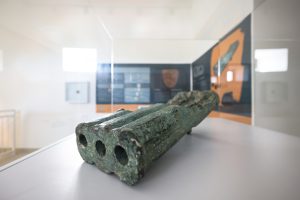
The museum preserves over 100,000 diverse archaeological artifacts from all cultural and historical periods, ranging from the Paleolithic era to the end of the 11th century.
- On the ground floor, archaeological remains representing the material culture of the broader Zadar area are exhibited, specifically from the arrival of the Croats in these lands at the beginning of the 7th century to the fall of the Croatian national dynasty at the beginning of the 12th century.
- The first floor displays numerous objects illustrating life in northern Dalmatia during the Roman period.
- The second floor showcases prehistoric archaeological material from the Stone and Metal Ages (from approximately 10,000 BC until the arrival of the Romans).
History of the Archaeological Museum in Zadar
The history of the Archaeological Museum in Zadar dates back to centuries-old collecting traditions. As early as the late 14th and early 15th centuries, during the Renaissance and Humanism, the first known collectors, such as Juraj Benja and the abbot of St. Chrysogonus Monastery, Petar Kršava, are recorded.
In the 18th century, the collection of Zadar physician Ante Danieli Tommasoni emerged, becoming the most beautiful and numerous collection of ancient sculpture in Dalmatia. The most monumental part of the collection consisted of eight statues of Roman emperors, discovered in 1768 in Josip Đurović’s garden in Nin. The collection contained over 300 sculptural works, mostly stone, numerous ancient inscriptions, ceramic and glass vessels, a coin collection (around 6,000 pieces), a painting collection, and a large library.
The collection was inherited by the Pellegrini-Danieli family, who sold it for 4,200 florins to the nobleman Pietro Cernazai in Udine, who subsequently donated it to the Seminary in Udine. At an auction held in 1900 and 1901, the Archaeological Institute in Vienna purchased about 20 sculptural works from Tommasoni’s collection for the Archaeological Museum in Zadar, while the rest were dispersed among museums in Venice, Aquileia, Milan, Copenhagen, and elsewhere.
The Archaeological Museum Zadar was officially founded on November 30, 1832, as “Il Museo Nazionale,” a general regional museum of Dalmatia. Initially, materials for the museum were housed in a room of the elementary school at the site of St. Thomas Church, opposite St. Chrysogonus Church, and then in the gymnasium located in the former St. Chrysogonus Monastery in Zadar.
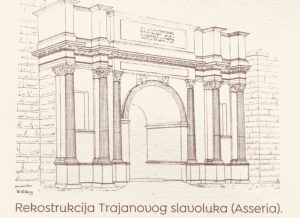
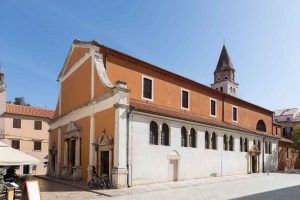
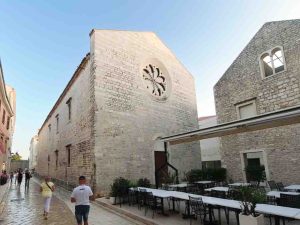
In 1877, the Archaeological Museum was moved to St. Donatus Church, where, under the leadership of Ivan Smirić, the Museum began exhibiting materials from prehistory to the contemporary era. The Museum already held a large quantity of archaeological and cultural-historical material, which rapidly increased, especially from 1892 onwards, through a series of major excavations in Nin, Asseria, Zadar, and other sites, as well as accidental finds and donated collections from families like Borelli and Medović from Nin.
Between the Two World Wars
The period between the two world wars brought challenges as Zadar, by the Treaty of Rapallo (1920), became part of Italy. As a self-contained Italian enclave, Zadar was cut off from its hinterland, and the Museum’s activities were restricted to the city area, while the rest of northern Dalmatia fell under the professional purview of the Archaeological Museum in Split and the Museum of Croatian Antiquities in Knin.
In 1928, four large statues of Roman emperors from Nin were returned from Venice and displayed in front of St. Donatus Church.
World War II
World War II inflicted catastrophic damage. As the Italians withdrew from Zadar in 1943, they took most of the most valuable material, especially smaller and lighter objects. In the bombings of the city in 1943 and 1944, the Museum’s administrative building on Green Square, which housed offices, storage, the library, and all other museum departments, was burned down. Only St. Donatus Church and its exhibited collections were spared during the bombings.
After the War
Despite the devastation, the Museum was rebuilt. After initially being housed in the building of the former Institute of St. Demetrius, the Archaeological Museum received a new building in 1971/72, designed by architect Mladen Kauzlarić, within the complex of the St. Mary Monastery and Church. Here, a modern permanent exhibition was set up, displaying periods of the Middle Ages, Roman era, and prehistory.
Since 1960, the museum has published its annual journal “Diadora” featuring scientific works, and furthermore, the museum is known for producing archaeological copies and and reproductions.
Location
Zadar
Zadar is the oldest continuously inhabited city in Croatia. It is situated on the Adriatic Sea, at the northwestern part of Ravni Kotari region. Zadar serves as the seat of Zadar County and of the wider northern Dalmatian region. The city proper covers 25 km2 (9.7 sq mi) with a population of 71,000 in 2025, making it the second-largest city of the region of Dalmatia and the fifth-largest city in the country.
Explore









Reviews
There are no reviews yet.