
The Church of St Ambrose in Nin

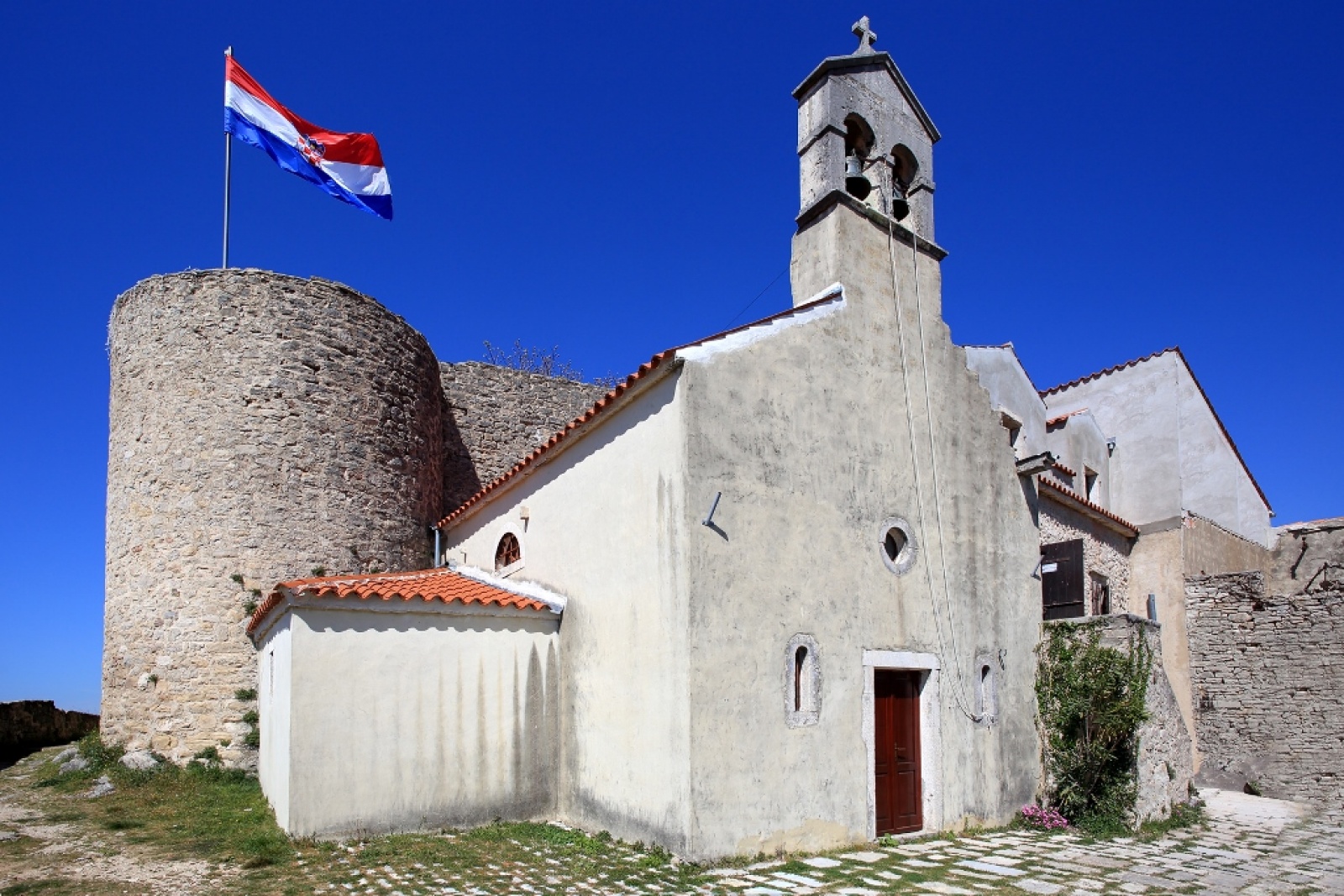
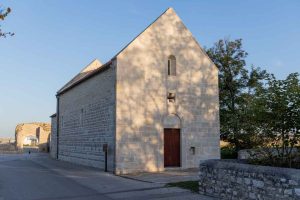
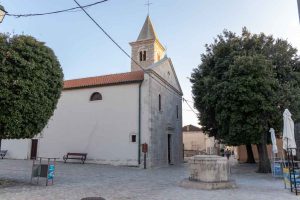
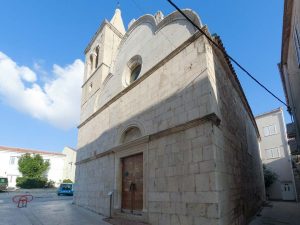
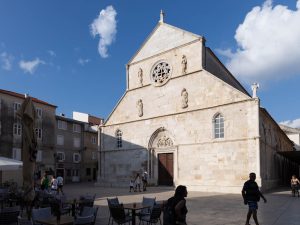
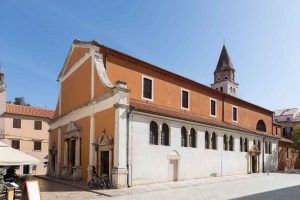
The Church of St. Ambrose, dating back to the 13th or 14th century, is located right next to the upper city gate, adjacent to the medieval city walls.
Built of finely hewn white stone, it has endured numerous destructions and significant alterations due to Nin’s turbulent past.
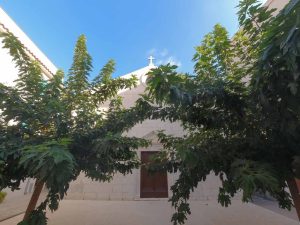
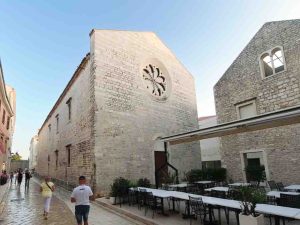
The facade of the Church of St. Ambrose highlights its Romanesque architectural style with a simple entrance portal, above which is a cross-shaped opening. Above that is a narrow Romanesque window. The single-nave interior was vaulted with a semicylindrical tufa vault, reinforced on the inside with two arches. Remains in the foundation show that the church originally had a semicircular apse. The current rectangular apse, measuring 5 x 4 meters, was built later. In the 15th century, the Church of St. Ambrose was renovated and its interior space was expanded.
The church gained its present-day appearance from a renovation in 1992. Today, in addition to religious services, the church is used for classical and spiritual music concerts due to its exceptional acoustics.
St. Ambrose
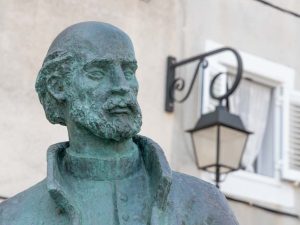
St. Ambrose, along with St. Anselm and St. Marcella, is the third patron saint of Nin. According to tradition, after the resurrection of Jesus, he traveled to Nin via Gaul with Bishop Anselm to spread the gospel. However, according to recent findings, it is most likely that this refers to Ambrose, the Bishop of Milan, who lived in the 4th century.
The Benedictine Monastery
The church once belonged to a men’s Benedictine Monastery, for which there are original documents dating back to the year 941. The Monastery of St. Ambrose in Nin is the second-oldest Benedictine monastery in Croatia, with the oldest being the one at Rižinice near Klis.
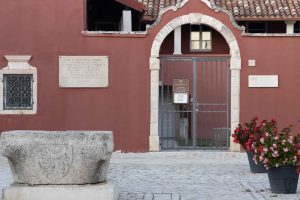
The abbot of the Benedictine monastery was a man named Theodobert. His name is mentioned on a valuable epigraphic monument—a fragment of the architrave of an altar screen decorated with interlace ornamentation and an inscription bearing the name of Duke Branimir (879-892).
The Latin inscription translates to: “In the time of Lord Branimir, Duke of the Slavs, I, Abbot Theodobert, had this altar made for the blessed confessor Ambrose, for the salvation of my soul. Whoever reads this, let him pray for me, a sinner.”
The fragment of the beam with the inscription was found during the demolition of the medieval Church of St. Michael in Nin, at the site of a former Roman temple.
Location
Nin
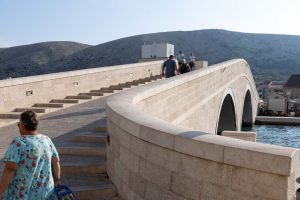
Nin (Aenona or Nona) is a town in the Zadar County of Croatia. Its historical center is located on an islet only 500 meters (yards) in diameter. It is situated in a lagoon on the eastern shore of the Adriatic Sea, surrounded by natural sandy beaches and linked to the mainland by two stone bridges from the 16th century. The present-day town on the islet was founded 3,000 years ago and is one of the oldest towns on the eastern Adriatic. The area of Nin was first colonized by ancient people of the Mediterranean.
ExploreGothic
Gothic appeared relatively late in Croatia. In addition to the 13th and 14th centuries, as long as it lasted in Europe, its influence is also visible in the 15th and 16th centuries – for example, on the Trogir and Sibenik cathedrals. Also on the territory of Croatia, you can often see admixtures of Romanesque and Renaissance in Gothic buildings. Gothic influence from European countries adapted to its possibilities and needs and thus created a “domestic artistic expression”. This mixture of styles is most pronounced in Dalmatia. The northern regions were exposed to the influences of Central Europe, while the coastal regions tied their artistic expression to Italian models.
ExploreRomanesque
In the 11th century, monumental cities were built along the entire Dalmatian coast. Houses were constructed from stone. On the ground floor there were shops or taverns (natively – konoba), seen today in cities such as Poreč, Rab, Zadar, Trogir, and Split. In those cities the most important buildings were churches. They were commonly stone-built basilicas with three naves, three apses, columns, arches, arcades and wooden roofs, and were erected near the monasteries of Benedictine monks who came out of Italy. St. Peter in Supetarska Draga on the island of Rab (11th century) is the best-preserved church of that type in Croatia. On the same island is the Cathedral of Rab (12th century) has a high-Romanesque bell tower, the largest in Dalmatia. It is specific with its openings, which multiply with each level of floor (Latin: mono-fore, bi-fore, tri-fore, quadro-fore). This is typical for Romanesque architecture, but also architecturally innovative, as each floor is slightly lighter than the one below.
Explore








Reviews
There are no reviews yet.