
Rector’s Palace and Pag Lace Gallery – Town of Pag


The Rector’s Palace is a place of rich history and the spirit of Old Pag, where history, art, and culture meet. The east wing of the palace houses the Pag Lace Gallery.
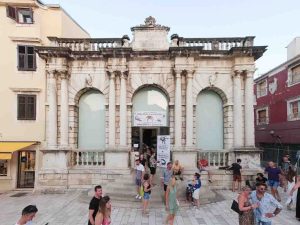
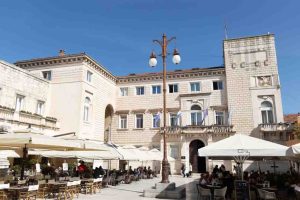
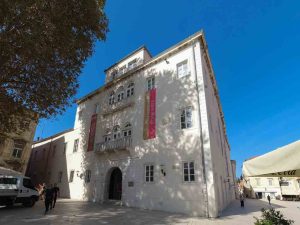
Standing proudly in the heart of Pag’s lively main square is the Rector’s Palace—a 15th-century building that for centuries served as the seat of the city and island administration.
History and Architecture
The construction of the Rector’s Palace began in the 15th century and was completed under the rule of Duke Toma Zorzi. This building was part of the grand “New Pag” project, a planned Renaissance city whose construction started in 1443. The renowned architect and sculptor Giorgio Orsini (Juraj Dalmatinac) was involved in the planning and construction of the palace, along with masters from his circle in Šibenik and Zadar.
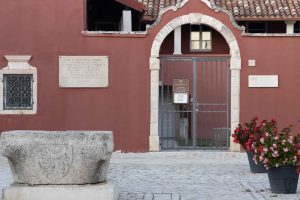
For centuries, the Rector’s Palace was the home of the duke, and later the city’s rector and governor-judge, making it a key symbol of secular power in the city. Its impressive size and the architectural detail of its facade facing the main square and street are particularly striking. In the palace’s atrium, there is a beautiful well with a decorated crown and the coats of arms of the Pag dukes. The entrance to the courtyard (atrium) is a special attraction, adorned with one of Pag’s most beautiful portals, erected in 1467. Its stylistic features clearly show the influence of Juraj Dalmatinac and are attributed to the work of Ivan Pribislavić.
Although it was historically an archaic-type palace with an internal cortile (courtyard), the Rector’s Palace has been transformed into a vibrant cultural center. During the summer months, its atrium becomes a stage for plays and klapa concerts as part of the Pag Cultural Summer.
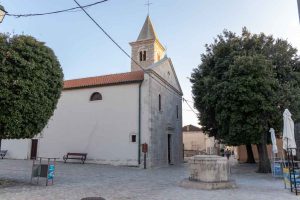
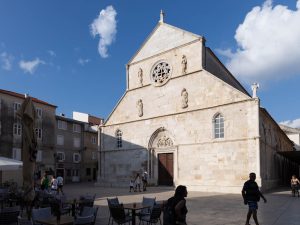
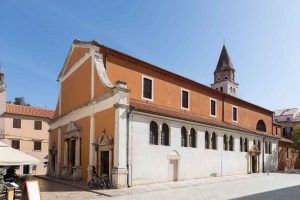
The Rector’s Palace, along with the Collegiate Church of the Assumption and the unfinished bishop’s palace, forms a representative cluster of public buildings on the main square, symbolizing the balance of secular and ecclesiastical authority in the city of Pag.
The Pag Lace Gallery
The Pag Lace Gallery, which opened in 1998, is located in the east wing of the Rector’s Palace.
The gallery is an important cultural hub dedicated to preserving and promoting traditional Pag lace, which has been protected as a UNESCO Intangible Cultural Heritage since 2009.
The gallery exhibits authentic works by Pag lace-makers from various historical periods, replicas of old patterns, traditional textile items, and contemporary creations. Visitors can also watch demonstrations of how the lace is made and learn about the rich history and art of this unique craft.
The History of Pag Lace
Pag lace is a traditional craft from the town of Pag, known for its beauty, quality, and rich history dating back to the 15th century.
It originated in the Benedictine convent of St. Margaret, where nuns passed down the art of lace-making from generation to generation. Pag needle-point lace was originally used to make ecclesiastical garments, tablecloths and ornaments for clothing.
Pag lace is created using a needle, thread, and a firm round or square pillow for support. The process involves embellishing a spider web pattern with geometric motifs.
Lace-making played an important role in the cultural and social life of the island. Pag’s lace-makers were highly esteemed and were even invited to the Viennese court, where they won awards, including a gold plaque at the Paris World Exhibition in 1937.
Beyond being a decoration for clothing and textiles, Pag lace is a symbol of the island’s artistic excellence and rich history, as well as one of its most recognizable souvenirs, attracting visitors from all over the world.
The process of making Pag lace is today taught by older women who offer year-round courses.
Location
Gothic
Gothic appeared relatively late in Croatia. In addition to the 13th and 14th centuries, as long as it lasted in Europe, its influence is also visible in the 15th and 16th centuries – for example, on the Trogir and Sibenik cathedrals. Also on the territory of Croatia, you can often see admixtures of Romanesque and Renaissance in Gothic buildings. Gothic influence from European countries adapted to its possibilities and needs and thus created a “domestic artistic expression”. This mixture of styles is most pronounced in Dalmatia. The northern regions were exposed to the influences of Central Europe, while the coastal regions tied their artistic expression to Italian models.
ExploreRenaissance
In the 15th century, Croatia was divided between three states – northern Croatia was a part of the Austrian Empire, Dalmatia was under the rule of the Venetian Republic (with the exception of Dubrovnik), and Slavonia was under Ottoman occupation. Dalmatia was on the periphery of several influences, equidistant from Italy, Ottoman Bosnia, and Austria, so it drew influence from all. In those circumstances in Dalmatia flourished religious and public architecture with clear influences of the Italian Renaissance, but still original.
Explore








Reviews
There are no reviews yet.