
Gregory of Nin – Sculpture


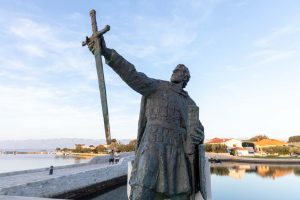
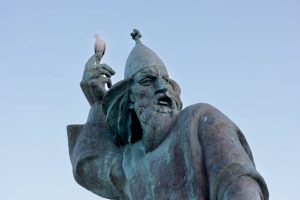
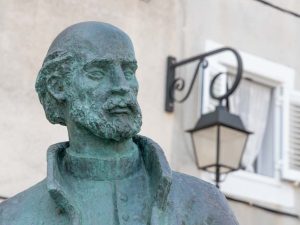
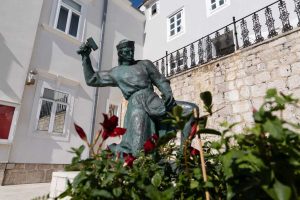
It’s a popular belief that touching the bronze toe of the statue of Grgur Ninski (Gregory of Nin) will bring good luck and grant wishes. It’s no wonder, then, that there are always many people gathered around his statue, filled with hopeful desires.
Grgur Ninski: Champion of the Vernacular Language and Script
Bishop Grgur Ninski presided in Nin from approximately 900 to 929 AD. During his tenure, he was renowned as the primary advocate for the Old Slavonic language, the vernacular Glagolitic script, and the use of the Glagolitic liturgy. In 925, when King Tomislav was proclaimed king, Bishop Grgur Ninski held the leading supreme ecclesiastical authority in the Croatian state.
The First Church Council of 925
The main objective of the First Church Council, held in Split in 925, was to resolve issues of ecclesiastical jurisdiction (legal authority) in Kingdom of Croatia and Dalmatia, and to eradicate “Methodius’s teaching“—specifically, the use of the Slavonic language in liturgy and the Glagolitic script.
All Dalmatian bishops were present at the council, including Ivan of Split, Formin of Zadar, and bishops from Rab, Krk, Osor, Dubrovnik, Kotor, Nin, and Ston. Bishop Grgur, alongside King Tomislav, championed the use of the Croatian (Slavonic) language for liturgy and the Glagolitic script.
The council made several key decisions: celibacy became mandatory, and priests were forbidden from wearing beards. A ruling was also made against the Glagolitic clergy, prohibiting the ordination and promotion of priests who did not know Latin.
The most crucial issue was the seat of the new ecclesiastical province for Dalmatia and Croatia. The archiepiscopal honor was contended by Archbishop Ivan of Split (as the successor to the Church of Salona, purportedly founded by Saint Domnius, a disciple of St. Peter the Apostle), Bishop Formin of Zadar, and Bishop Grgur Ninski of Nin.
The council ultimately decided that metropolitan (archiepiscopal) authority would be granted to the church and city where the holy bones of the blessed Dujam rested—namely, Split. It was specifically emphasized that from then on, the Bishop of Nin would also be subordinate to the Archbishop of Split.
The Second Church Council of 928
As Grgur Ninski appealed the decision of the Split council to the Pope, the Pope ordered the convocation of a Second Church Council to resolve the disputed issues.
At the second council, also held in Split in 928, the original conclusion was reaffirmed: ecclesiastical authority over all of Croatia and Dalmatia belonged to the Archbishop of Split, and everyone was commanded to obey him. The council also decided to abolish the Bishopric of Nin because it lacked an ancient tradition, and Grgur Ninski was assigned the Bishopric of Skradin.
Although Latin officially became the liturgical language, this proved impractical in reality. Due to the small number of clergy who knew Latin, services in Old Croatian with the use of Glagolitic continued despite the prohibitions.
Statues of Grgur Ninski by Ivan Meštrović
Ivan Meštrović created a total of three monuments dedicated to Grgur Ninski.
The first statue was a gift to the city of Split and was unveiled on September 29, 1929.
The second, half the size of the first, was erected two years later, on September 20, 1931, in Franciscan Square in Varaždin.
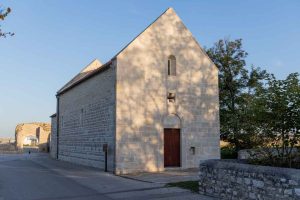
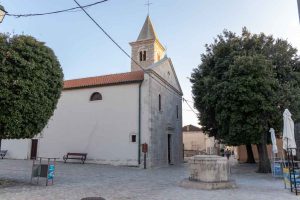
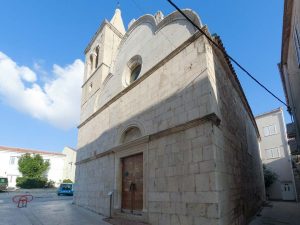
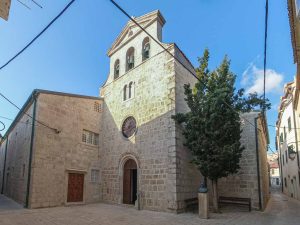
The third monument, a cast of the Varaždin statue, was placed in Nin next to St. Anselm’s Church on September 10, 1969, to commemorate the 900th anniversary of the charter issued by the Croatian King Petar Krešimir IV. This charter is notable for first mentioning the term Mare Nostrum (our sea), signifying the king’s authority over both land and sea.
The Varaždin statue is the first version of the Grgur Ninski monument that Meštrović sketched and modeled in plaster. It was placed next to the Franciscan Church, as Grgur Ninski was an important Croatian historical church figure, and it was deemed appropriate for his statue to be near a sacred object. Meštrović himself accompanied the gift with these words: “May Grgur Ninski, both in the Croatian north and in the south in Split, be a visible testament to our successful struggle for the Church Slavonic language and Croatian Glagolitic script.”
The Split monument originally stood on the Peristyle in Split until November 1941, when Italian occupiers removed it and disassembled it, storing it in the courtyard of municipal warehouses on the coast. It was re-erected in 1954 between the northern (Golden) Gate of Diocletian’s Palace and the City Park.
The bronze toe of the monument is worn smooth due to the local belief that touching the toe while passing by brings good luck and the fulfillment of wishes.
Location
Nin
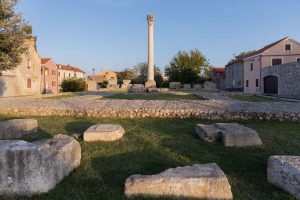
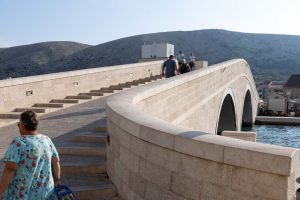
Nin (Aenona or Nona) is a town in the Zadar County of Croatia. Its historical center is located on an islet only 500 meters (yards) in diameter. It is situated in a lagoon on the eastern shore of the Adriatic Sea, surrounded by natural sandy beaches and linked to the mainland by two stone bridges from the 16th century. The present-day town on the islet was founded 3,000 years ago and is one of the oldest towns on the eastern Adriatic. The area of Nin was first colonized by ancient people of the Mediterranean.
Explore







Reviews
There are no reviews yet.