
Salt Magazines: Museum and Permanent Exhibition


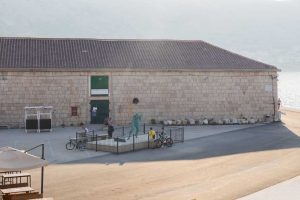
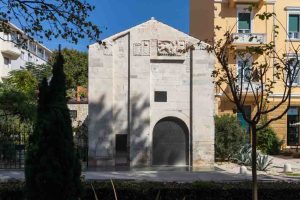
The complex of Salt Magazines is located opposite the historic town center, in the Prosika area. These monumental structures are classified as heritage buildings and are a testament to Pag’s economic power.
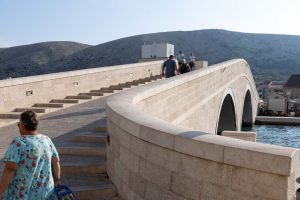
This row of nine monumental warehouses is situated between the Katine Bridge and the town beach.
The first three warehouses were built in the 17th century, and the remaining six were completed by Austria in 1845, modeled after the older Venetian designs. Each building is a significant size (41.50m long, 11.30m wide, and 5.60m high), and the nine magazines together could hold 22,000 tons of salt.
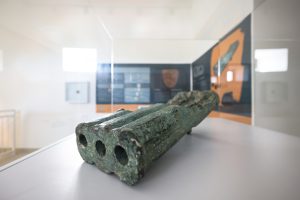
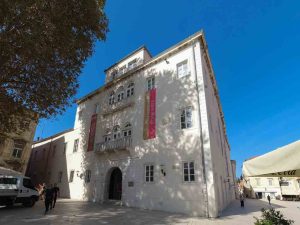
Today, the Salt Magazines have been converted into a museum and permanent exhibition on salt production, where visitors can delve deeper into the thousand-year history of “white gold.”
Pag – The City of Salt: A Thousand Years of “White Gold”
The town of Pag proudly bears the title “The City of Salt.” The Pag Saltworks (Paška solana) is more than just an industrial site; it is the symbol of the island, a must-see tourist destination, and—along with Pag lace, cheese, and lamb—the most crucial part of the town’s and island’s cultural, gastronomic, and economic heritage. Historically, the Pag Saltworks has always been the largest on the eastern Adriatic coast.
A History of Salt Production
While the exact start date of salt production in Pag is unknown, the tradition is ancient. A professor from the University of Naples, in his 1912 book Adriatic Saltworks, noted that the Illyrians from this region (referring to the Liburnians) traveled to the Apennine Peninsula in the 3rd century BC and taught the local population how to produce sea salt.
The first written record specifically mentioning salt production in Pag dates back to a will from the year 999.
The Monopoly on “White Gold”
Salt was historically known as “white gold”—at one point, its value was almost equal to that of gold. In ancient times, salt was traded for gold ounce for ounce, and it is well known that the Romans even paid their soldiers in salt (salarium).
The saltworks saw its greatest development during the 14th century, when the Hungarian-Croatian King Louis I of Anjou invested significant funds in modernizing production.
Before the Venetians arrived in 1409, Dalmatia had dozens of saltworks. However, Venice strategically abolished all of them except Pag’s, aiming to control the Mediterranean salt trade. Interestingly, Venice took 70% of the revenue from the salt, even though it was never the owner. The saltworks actually belonged to the Zadar and Pag nobility, the Benedictine Convent, and the Church, who split their 30% share evenly with the workers.
Austro-Hungary created a state monopoly and launched a unified saltworks operation in 1908.
The Pag Railway
Due to the saltworks, Pag became the only island on the Adriatic with its own railway line and railway for salt transportation. Built around 1950, this line was used to transport salt from the fields to the magazines in Pag town. The railway enabled more efficient and faster transport of sea salt than the previous method of using ships. It remained operational until the early 1980s, when the traditional production method transitioned to more modern practices.
The Secret to Quality
Pag salt is among the highest quality in the world due to its exceptional purity. This quality is achieved through a perfect combination of natural conditions and an ecological process:
- Pure Water: The sea water in Pag Bay is extremely clean because the bottom is rich in shellfish, which act as natural purifiers. This ensures very low heavy metal content.
- Natural Process: Salt is obtained by evaporating seawater in a system of shallow pools, exclusively through the natural action of sunlight and wind. Final crystallization takes place in the factory using boilers, which prevents pieces of clay or stone from the bottom of the pools from contaminating the salt.
Today, Solana Pag d.o.o. proudly boasts that the Croatian Ministry of Agriculture has protected Pag Salt as a national product, and since 2019, it has carried the Protected Designation of Origin (PDO) label.
Fleur de Sel: The “Caviar Among Salts”
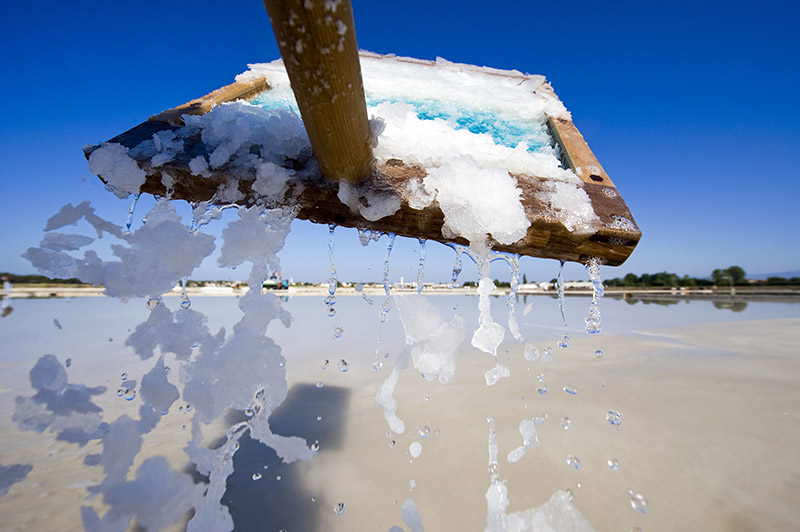
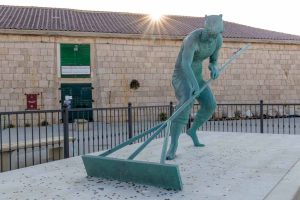
The must-try product is Fleur de Sel (Cvijet soli), considered the healthiest and highest-quality salt. It forms exclusively as a thin layer of flakes on the surface of the sea during evaporation and is named for the delicate, flower-like crystals it forms. It is harvested by hand and is rightly called the “caviar among salts” due to its premium quality.












Reviews
There are no reviews yet.