
Queen Jelena Madijevka Park – Bastion Grimani/Ponton


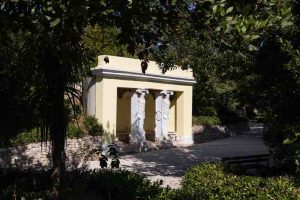
Queen Jelena Madijevka Park holds the distinction of being the first city park not only in Zadar but in all of Dalmatia. It was established on the most crucial city bastion, the Grimani Bastion (or Ponton), which has been part of Zadar’s Venetian defensive system under UNESCO protection since 2017.
Work on Zadar’s fortification system began during the Venetian-Ottoman War of 1537–1540 . In the 16th century, Michele Sanmicheli and Giangirolamo Sanmicheli built a new defensive system with three bastions, aligning with contemporary technical advancements and strategic needs.
The Bastions of Zadar
To the south, a bastion was constructed next to the medieval Citadel. In the middle of the peninsula lies the large central Ponton/Grimani Bastion, which is now home to Queen Jelena Madijevka Park. To the north, near the modern bridge, is the St. Marcella Bastion, where the Museum of Ancient Glass is currently located. The Citadel Bastion was built during the time of General Providur Alvise Grimani and was named after him. However, for reasons unknown, its name eventually transferred to the bastion where the park now stands.
At that time, the main city entrance, which had been located in front of the Providur’s Palace during Roman and medieval times, was moved to the small harbor of Foša. To further strengthen the city’s defenses, the Forte fortress (today’s Vladimir Nazor Park) was also constructed, and two canals were dug: one east of the Forte fortress, in the area of today’s “Ravnice,” and another between the Grimani Ramparts and the Forte fortress.
From Fortress to Public Space
Zadar received its first public city park—today’s Queen Jelena Madijevka Park—while still a fortress city. It was established in 1829 based on the ideas of the Austrian military governor of the city, Baron Franz Ludwig von Welden, a passionate botanist. Enthralled by Dalmatian flora, he designed the park himself. For a full forty years, the park served as a kind of “city balcony,” offering magnificent views of the sea and the surrounding area.
As the City Park became one of the centers of social life in Zadar, newspapers frequently reported on events and happenings there. These often included concerts, plays, pantomimes, exhibitions, and various sports exhibitions like balloon ascensions or demonstrations of strength.
Shifting Centers of Urban Life
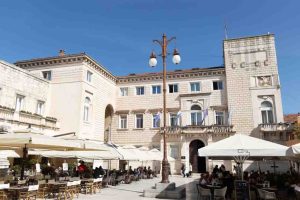
However, in the second half of the 19th and early 20th centuries, Zadar underwent significant changes, and the park ceased to be the focal point of city events. The introduction of city lighting and the installation of the Grand Candelabra in the main city square (then Piazza dei Signori) in 1894 drew the city’s music away from the park, with performances now taking place in the square every other Sunday.
In 1868, Zadar ceased to be a fortress city, as the city walls on the seaward side were demolished. The Austrians then began constructing the New Riva (today’s Obala kralja Petra Krešimira IV) between 1875 and 1906. This new promenade, approximately 800 meters long, featured fourteen grand buildings, a double avenue of trees, and flowerbeds. It also housed a post office, a hotel, three cafes, and a pier where passenger steamboats docked. This was enough to shift the center of city events to the New Riva.
Location
Zadar
Zadar is the oldest continuously inhabited city in Croatia. It is situated on the Adriatic Sea, at the northwestern part of Ravni Kotari region. Zadar serves as the seat of Zadar County and of the wider northern Dalmatian region. The city proper covers 25 km2 (9.7 sq mi) with a population of 71,000 in 2025, making it the second-largest city of the region of Dalmatia and the fifth-largest city in the country.
ExploreRenaissance
In the 15th century, Croatia was divided between three states – northern Croatia was a part of the Austrian Empire, Dalmatia was under the rule of the Venetian Republic (with the exception of Dubrovnik), and Slavonia was under Ottoman occupation. Dalmatia was on the periphery of several influences, equidistant from Italy, Ottoman Bosnia, and Austria, so it drew influence from all. In those circumstances in Dalmatia flourished religious and public architecture with clear influences of the Italian Renaissance, but still original.
ExploreRomantic
The Romantic movement in Croatia was sentimental, gentle and subtle a reflection of the bourgeoisie’s humble and modest virtues. In architecture there were simple decorations made of shallow arch-like niches around windows.
Explore













Reviews
There are no reviews yet.