
Small Harbor Foša and the Land Gate


Zadar’s formidable defensive system, a supreme masterpiece of Renaissance military architecture by Michele Sanmicheli, was inscribed on the UNESCO World Heritage List in 2017.
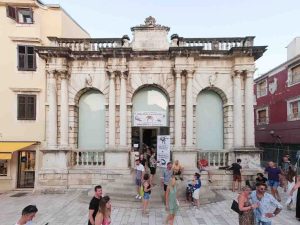
The Land Gate is shaped like a triumphal arch and features three passages. The large central opening was designed for wheeled traffic, while the two narrower side passages were for pedestrians.
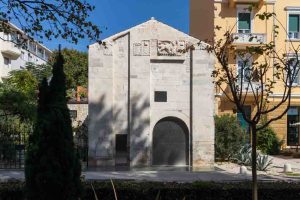
Above the central arch, you can see the iconic winged lion of St. Mark, the patron saint of the Republic of Venice. This prominent symbol served as a constant reminder of Venetian rule over Zadar. Below the Venetian lion is a relief of St. Chrysogonus on horseback, Zadar’s main patron saint.
The development of firearms in the 15th century, coupled with the Ottoman Empire’s advance into Europe, brought the looming threat of Turkish sieges upon cities. The introduction of gunpowder led to significant advancements in military techniques and architecture, reflected in the design of the so-called alla moderna or bastioned fortifications.
Intensive work on Zadar’s new defensive system began during the Venetian-Ottoman War of 1537–1540. Consequently, in the 16th century, Michele Sanmicheli and Giangirolamo Sanmicheli constructed a new defensive system featuring three bastions, in line with the latest technical achievements and circumstances.
Key Defensive Structures
To the south, a bastion was built alongside the medieval Citadel. In the middle of the peninsula, the large central Ponton bastion was strategically placed. To the north, near today’s bridge, stood the St. Marcella bastion. These bastions were interconnected by curtains—straight ramparts—which only in some sections deviated from the route of the medieval wall.
The main city gate, which had previously been located as an extension of the medieval wall and the Captain’s Tower in Petar Zoranić Square, was relocated by Michele Sanmicheli further south to Foša. This site was chosen because it already housed an important city street. The new main Land Gate, completed in 1543, represents a supreme masterpiece of Renaissance architecture in Zadar.
The Venetian Works of Defence: A Transnational UNESCO Site
Between the bastions, ramparts were also erected in the 16th century, and the fortification system designed by Michele Sanmicheli was inscribed on the UNESCO World Heritage List in 2017.
The Defensive Works of the Republic of Venice, which were inscribed on the UNESCO World Heritage List in 2017, encompass six defensive structures across Italy, Croatia, and Montenegro. These structures stretch over 1,000 km, from the Lombardy region in Italy to the eastern Adriatic coast.
The six specific sites included in this UNESCO designation are:
- The fortified city of Bergamo in Italy
- The fortified city of Peschiera del Garda in Italy
- The fortress city of Palmanova in Italy
- The Zadar defensive system in Croatia
- St. Nicholas Fortress in Šibenik, Croatia
- The fortified city of Kotor in Montenegro
The fortifications across the Stato da Terra (mainland territories) protected the Venetian Republic from other European powers to the northwest. Meanwhile, the Stato da Mar (maritime territories) fortifications safeguarded maritime routes and ports in the Adriatic Sea all the way to the Levant. Both were crucial for supporting the expansion and authority of the Serenissima (the Most Serene Republic of Venice).
Location
Zadar
Zadar is the oldest continuously inhabited city in Croatia. It is situated on the Adriatic Sea, at the northwestern part of Ravni Kotari region. Zadar serves as the seat of Zadar County and of the wider northern Dalmatian region. The city proper covers 25 km2 (9.7 sq mi) with a population of 71,000 in 2025, making it the second-largest city of the region of Dalmatia and the fifth-largest city in the country.
ExploreRenaissance
In the 15th century, Croatia was divided between three states – northern Croatia was a part of the Austrian Empire, Dalmatia was under the rule of the Venetian Republic (with the exception of Dubrovnik), and Slavonia was under Ottoman occupation. Dalmatia was on the periphery of several influences, equidistant from Italy, Ottoman Bosnia, and Austria, so it drew influence from all. In those circumstances in Dalmatia flourished religious and public architecture with clear influences of the Italian Renaissance, but still original.
Explore













Reviews
There are no reviews yet.