
Providur’s Palace – Museum II Palaces


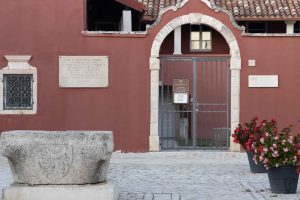
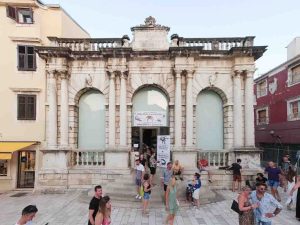
In the modernly renovated space of the Rector’s and Providur’s Palaces are situated the Heritage Museum or the Museum of Two Palaces, various departments of the National Museum Zadar, the Concert Office, and a branch of the Zadar City Library.
If you want to visit an exhibition or some other event in Providur’s Palace, the entrance may be through the Rector’s Palace.
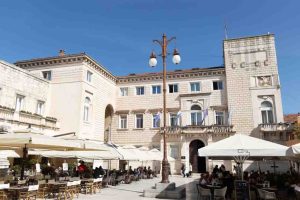
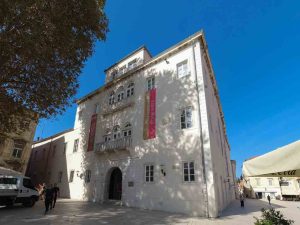
For centuries, the Providur’s Palace, along with the Rector’s Palace and the Captain’s Palace, stood as the most vital administrative and governing seat on the eastern Adriatic coast. This monumental structure is the most significant Baroque palace in Zadar. Completed in 1607, it housed the Providur’s residence, along with buildings for other high-ranking Venetian officials and several internal courtyards.
Architectural Features and Historical Context
The Palace’s Baroque facade faces east, overlooking the ancient and medieval entrances to the city. Remnants of these entrances are visible in Petar Zoranić Square in front of the palace. They are protected by glass panels in the floor, as the original street level—the old city entrances—was below the current square’s elevation.
The Venetian General Providur for Dalmatia and Albania (today’s Montenegrin Littoral) operated from Zadar from 1597 until the fall of the Republic in 1797. Appointed by the Venetian Great Council from among the Venetian nobility, they served terms of two years initially, extended to three years from the 18th century onward.
Role of the General Providur
The General Providur unified both civil and military administration over the territories of Venetian Dalmatia and Venetian Albania. They also acted as an intermediary between Dalmatian communes and the central authority in Venice. From 1610, some judicial powers were transferred to them.
During the first two centuries of Venetian rule, after 1409/20, Dalmatian municipalities/communes maintained their own distinct administration, led by a rector chosen by the Venetian government, to whom he was subordinate. Occasionally, and in exceptional circumstances, the government would send syndic investigators to Dalmatia.
Post-Venetian Era
With the fall of Venice in 1797 and during the First Austrian Rule, the Providur’s Palace continued to serve as an administrative center.
Upon the arrival of French rule in 1806, the Providur’s Palace became the seat of Vincenzo Dandolo, the civil administrator of Dalmatia, while the renowned French general Marmont, military commander for Dalmatia, was quartered in the Rector’s Palace.
Before becoming Ban (governor), Josip Jelačić served in Zadar as an Austrian officer from 1837 to 1841. Later, as Croatian Ban and governor of Dalmatia, he stayed at the Providur’s Palace in 1851 during his travels through Dalmatia.
Modern Transformation
After World War II, numerous city institutions and societies moved into the Providur’s Palace, including the Art Gallery and the Natural History Museum, which would become integral parts of the National Museum Zadar in 1962. These institutions remained there until the palace’s most recent renovation.
The renovated Providur’s Palace, which forms the “Two Palaces” complex with the Rector’s Palace, officially opened in April 2022. This new “Two Palaces” complex spans seven thousand square meters and now houses:
- Exhibition halls
- City Library – City branch
- Art Gallery – National Museum Zadar
- Natural History Department – National Museum Zadar
- Multipurpose hall – Concert Office Zadar
- Bersa Brothers Concert Hall – Concert Office Zadar
- Multimedia hall – Concert Office Zadar
- Creative hall – Concert Office Zadar
This historical complex has thus become not only a Zadar but also a national modern cultural and artistic center.
Location
Zadar
Zadar is the oldest continuously inhabited city in Croatia. It is situated on the Adriatic Sea, at the northwestern part of Ravni Kotari region. Zadar serves as the seat of Zadar County and of the wider northern Dalmatian region. The city proper covers 25 km2 (9.7 sq mi) with a population of 71,000 in 2025, making it the second-largest city of the region of Dalmatia and the fifth-largest city in the country.
ExploreBaroque
One of the most remarkable periods in Croatian art history is the Baroque, which lasted from the 17th to the late 18th century. During this time, Croatia was reunited with the parts of its territory that were occupied by the Venetian Republic and the Ottoman Empire, after centuries of fragmentation and division. This reunification not only brought political stability and economic prosperity but also stimulated a cultural revival and a flourishing of art in every segment.
Explore









Reviews
There are no reviews yet.