
The Church of St. George in Pag: A Renaissance Jewel and Protector of the Town and Island


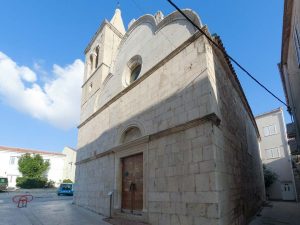
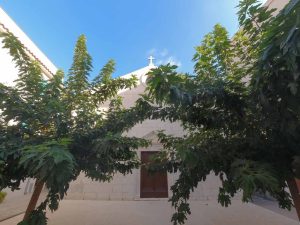
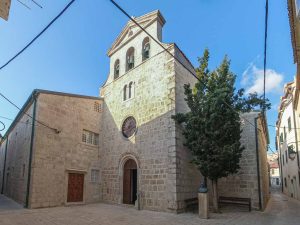
The Church of St. George (Crkva sv. Jurja) is located in the meticulously planned Renaissance heart of “New Pag.” It stands at the end of the Vela Ulica (Great Street, now Juraj Dalmatinac Street), one of the main cross streets, right next to the former town gates.
Construction began before 1465, during the planned building of “New Pag,” and lasted until the end of the 15th century.

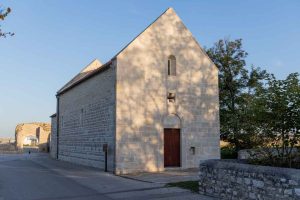
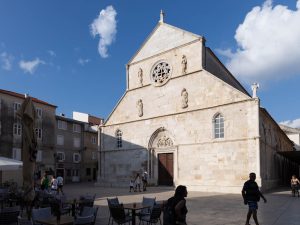
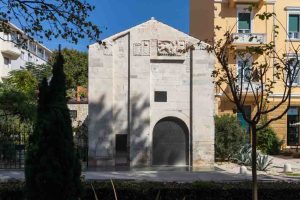
Originally a simple, single-nave building with a rectangular floor plan, it was extended in the late 16th century, when its recognizable Renaissance facade, built from precisely cut white stone blocks, was added.
Architecture and Urban Significance
The church is a single-nave structure with a rectangular apse, which is covered by a pointed barrel vault. Narrow, pointed Gothic windows line the south side wall.
The facade is notable for its Renaissance trefoil gable (shaped like a three-leaf clover) that rises above the roofline, classifying the church as a significant example of Renaissance design in the region.
Above the portal, a lunette once held a relief of the Lion of St. Mark, the symbol of Venice, which attests to the influence of the Venetian Republic.
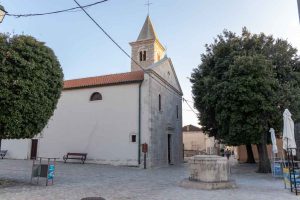
To the north of the facade stands the bell tower, which is preserved to two-thirds of its original height. Interestingly, in the original urban plan for “New Pag,” the bell tower of St. George was designed to be taller than the public clock tower next to the Rector’s Palace.
St. George: The Eternal Guardian of Pag
The church is dedicated to St. George, who is the oldest and most deeply rooted patron (patron) of the town and the entire island.
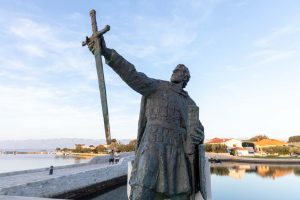
The people of Pag chose St. George as their gonfalonier (standard-bearer) and protector against all evil centuries ago because they were traditionally farmers and herders. They believed the knight St. George watched over their vineyards, pastures, livestock, and even the sea. His likeness is featured on Pag’s coat of arms and flag, symbolizing protection and blessing.
Although Venice politically favored the cult of the Assumption of the Virgin Mary, the worship of St. George has remained strong. The Feast Day of St. George, April 23rd, remains an important day, marked by special liturgical services and prayers for the town’s protection.
Beyond its primary spiritual function, the restored Church of St. George now serves as a key cultural venue. During summer cultural events, such as the Pag Cultural Summer, its space transforms into a gallery hosting art exhibitions.
Location
Renaissance
In the 15th century, Croatia was divided between three states – northern Croatia was a part of the Austrian Empire, Dalmatia was under the rule of the Venetian Republic (with the exception of Dubrovnik), and Slavonia was under Ottoman occupation. Dalmatia was on the periphery of several influences, equidistant from Italy, Ottoman Bosnia, and Austria, so it drew influence from all. In those circumstances in Dalmatia flourished religious and public architecture with clear influences of the Italian Renaissance, but still original.
Explore











Reviews
There are no reviews yet.