
The Roman urban villa


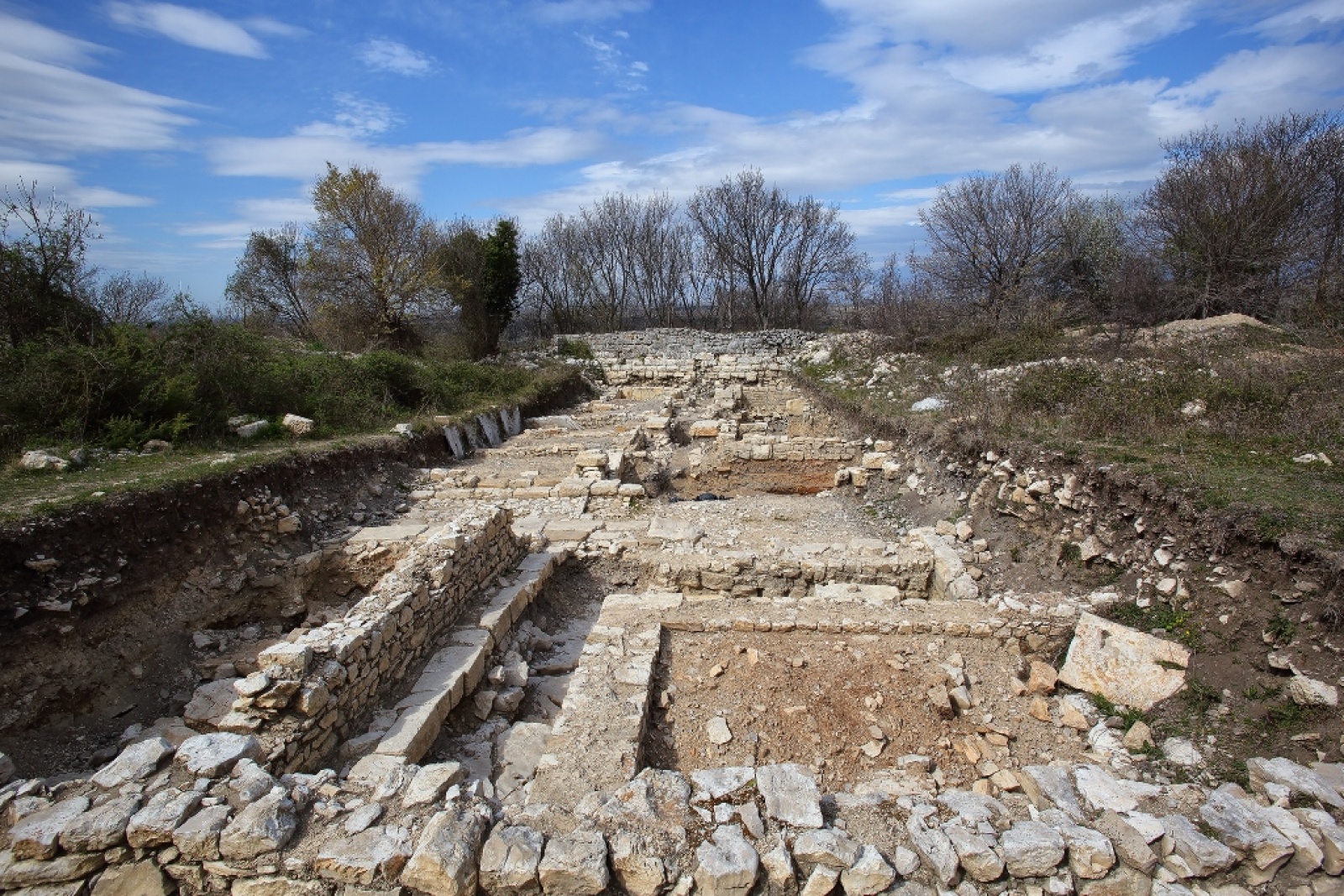
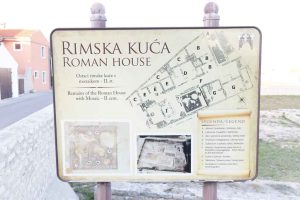
We can get a glimpse into what life was like in Roman city of Aenona at the Banovac site, where the remains of a Roman villa with a richly decorated mosaic from the 2nd century AD are located.
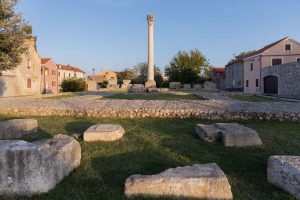
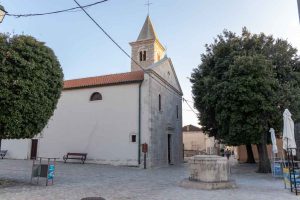
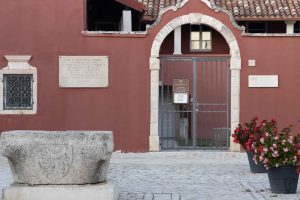
The Roman urban villa is situated right in the historical center of Nin, just east of the former Roman Forum.
It’s one of the most well-preserved Roman villas in Dalmatia. Spanning about 1,100 square meters, it included a large peristyle with a well, a series of rooms, baths, a heating system, kitchens, a dining room, and possibly an atrium.
After the Roman house collapsed in the 8th century, Croats moved within its walls and built their own small homes there.
Small fragments of painted Greek pottery found at the same location, dating back to the 3rd century BC, suggest that a prominent building also stood there during the Liburnian period.
The Mosaic
Black and white floor mosaics have been preserved in several rooms. The most beautiful one is in the villa’s central room, covering an area of 8 x 7 meters. It is considered one of the best-preserved and highest-quality mosaics on the eastern Adriatic coast.
The mosaic features a dense and intricate pattern of geometric and plant decorations, as well as medallions depicting animals such as a dog, wild boar, deer, and wolf.
Location
Nin
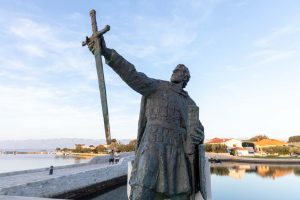
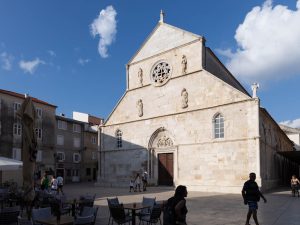
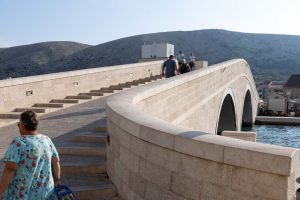
Nin (Aenona or Nona) is a town in the Zadar County of Croatia. Its historical center is located on an islet only 500 meters (yards) in diameter. It is situated in a lagoon on the eastern shore of the Adriatic Sea, surrounded by natural sandy beaches and linked to the mainland by two stone bridges from the 16th century. The present-day town on the islet was founded 3,000 years ago and is one of the oldest towns on the eastern Adriatic. The area of Nin was first colonized by ancient people of the Mediterranean.
ExploreAncient Rome
Romans subdued the Greek colonial cities in the 3rd century BC. They imposed an organization based on a military-economical system. Furthermore, the Romans subdued the Illyrians in the first century BC and organized the entire coastal territory by transforming the citadels into urban cities. After that, the history of these parts is the history of the Illyrian provinces of the Roman Empire. Numerous rustic villas, and new urban settlements (the most impressive are Verige in Brijuni, Pula, and Trogir – formerly Tragurion) demonstrate the high level of Roman urbanization. There were at least thirty urban cities in Istria, Liburnia and Dalmatia with Roman citizenship (civitas). The best-preserved networks of Roman streets (decumanus/cardo) are those in Epetion (Poreč) and Jader (Zadar). The most perfectly preserved Roman monuments are in Pola (Pula); founded in the first century dedicated to Julius Caesar. It is full of classical Roman art such as: stone walls, two city gates, two temples on the Forum, and remains of two theaters, as well as the Arch from the year 30 AD, and the temple of Augustus built in the years 2 to 14 AD, and finally the Fluvian Amphitheater (so called – Arena) from the 2nd century. In the 3rd century AD, the city of Salona became the largest (it had 40,000 inhabitants) and most important city of Dalmatia. Near the city emperor Diocletian, born in Salona, built Diocletian’s Palace around the year 300 AD, which is the largest and most important monument of late antique architecture in the world. On its pathways, cellars, domes, mausoleums, arcades and courtyards we can trace numerous different art influences from the entire Empire. In the 4th century, Salona became the center of Christianity for the entire western Balkans. It had numerous basilicas and necropolises, and even two saints: Domnius (Duje) and Anastasius (Stošija).
Explore








Reviews
There are no reviews yet.