
Zadar – Cathedral of St. Anastasia


The cathedral was badly damaged in 1202 in the Fourth Crusade, when the Venetians destroyed Zadar, and the restoration lasted throughout the 13th century.
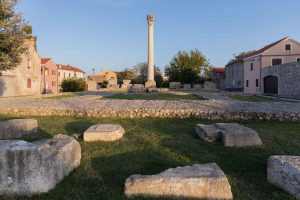
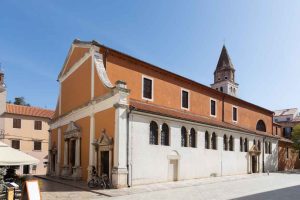
The Cathedral of St. Anastasia is located in the northern part of the Roman Forum. It was built in the Romanesque style in the 12th and 13th centuries.
The beginnings of the construction of the Zadar Cathedral go back to the 4th or 5th century. Originally, the basilica was dedicated to Saint Peter, the apostle.
When Bishop Donatus of Zadar in 804 or 808 received the ashes of Saint Anastasia of Sirmium from Byzantine emperor Nikephoros I, the basilica was named after her. The sarcophagus with remains of Saint Anastasia was made by Bishop Donatus of Zadar and is located on the altar in the northern apse, that is, in its left nave.
The cathedral was badly damaged in 1202 in the Fourth Crusade when the Venetians destroyed Zadar. The renovation lasted throughout the 13th century, and the facade with late Romanesque portals was only completed in 1324.
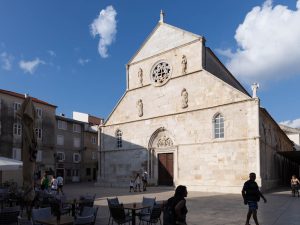
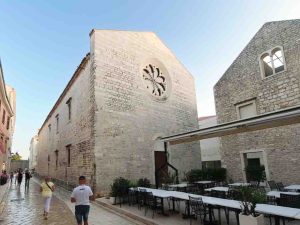
The facade of the cathedral shows a perfect harmony of horizontal and vertical lines with two rose windows. The larger, lower rose window is Romanesque, and the upper one is Gothic. On the edges of the facade, there are statues of a lion on the left and a bull on the right, symbols of the evangelists Mark and Luke.
In the middle of the Gothic lunette of the main portal there is a relief of the Virgin and Child, on the left is Saint Chrysogonus, and on the right is Anastasia of Sirmium. Next to the portal are four figures of the apostles. In the lunettes of the left and the right portals, there are mystical lambs. On the left portal on the corbels next to the arches, there are figures of the Annunciation, the angel Gabriel and Mary.
The interior of the cathedral is monumental. The central nave is three times wider than the side naves and is divided by stone columns and pylons, which are arranged alternately and support high arcades.
Below the elevated presbytery is a crypt from the 12th century, and above the main altar is an early Gothic ciborium from 1322. Behind it is a stone seat, i.e. a throne for the archbishop, and on the sides wooden seats made in the Venetian Gothic style. They were created in the first half of the 15th century by Matej Morozon. The side altars are mostly baroque.
On the south, outside of the church, is located a hexagonal baptistery that dates back to the 6th century. The original baptistery was destroyed in the Allies bombings of Zadar in December 1943 and was facsimile restored in 1989.
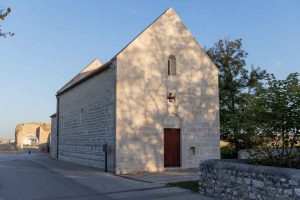
The walls and apse of the sacristy or chapel of Saint Barbara, as it was once called, belong to the oldest parts of the cathedral, as well as the floor mosaic depicting two deer, which dates from the first half of the 5th century.
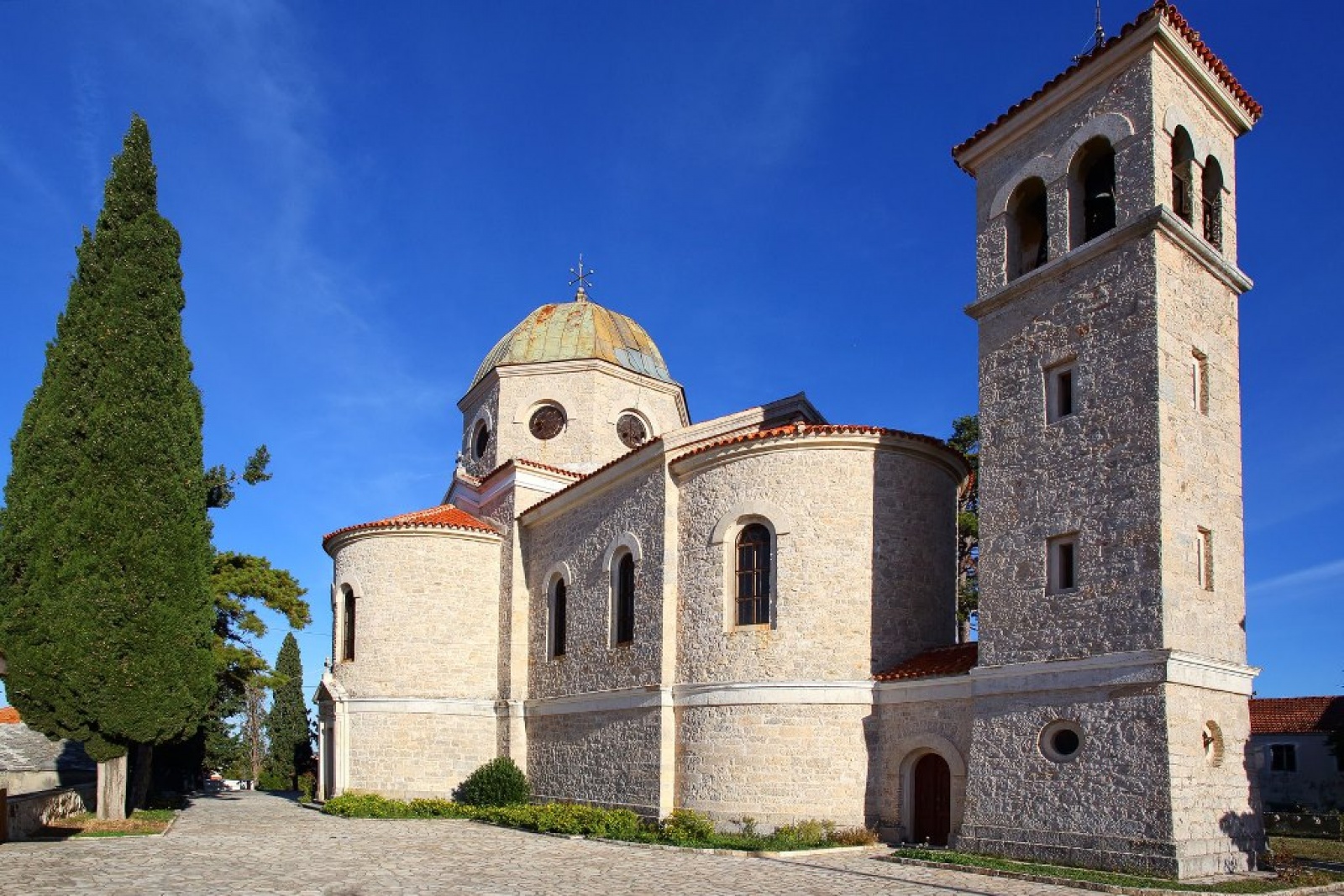
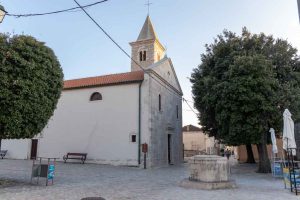
The construction of the bell tower began in 1452. However, it was only completed at the end of the 19th century by the British architect Thomas G. Jackson in the neo-Romanesque style.
Location
Zadar
Zadar is the oldest continuously inhabited city in Croatia. It is situated on the Adriatic Sea, at the northwestern part of Ravni Kotari region. Zadar serves as the seat of Zadar County and of the wider northern Dalmatian region. The city proper covers 25 km2 (9.7 sq mi) with a population of 71,000 in 2025, making it the second-largest city of the region of Dalmatia and the fifth-largest city in the country.
ExploreRomanesque
In the 11th century, monumental cities were built along the entire Dalmatian coast. Houses were constructed from stone. On the ground floor there were shops or taverns (natively – konoba), seen today in cities such as Poreč, Rab, Zadar, Trogir, and Split. In those cities the most important buildings were churches. They were commonly stone-built basilicas with three naves, three apses, columns, arches, arcades and wooden roofs, and were erected near the monasteries of Benedictine monks who came out of Italy. St. Peter in Supetarska Draga on the island of Rab (11th century) is the best-preserved church of that type in Croatia. On the same island is the Cathedral of Rab (12th century) has a high-Romanesque bell tower, the largest in Dalmatia. It is specific with its openings, which multiply with each level of floor (Latin: mono-fore, bi-fore, tri-fore, quadro-fore). This is typical for Romanesque architecture, but also architecturally innovative, as each floor is slightly lighter than the one below.
Explore










Mate –
Very beautiful place ♥️