
Church, monastery and treasury of St. Francis of Assisi in Zadar


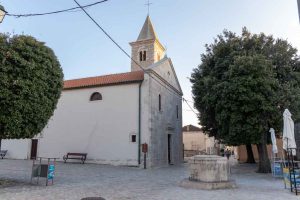
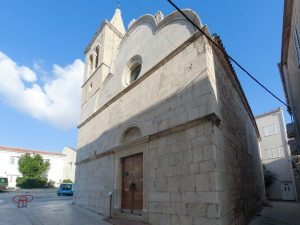
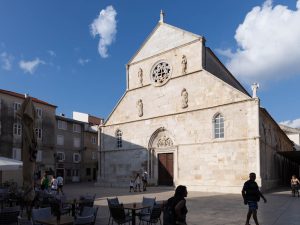
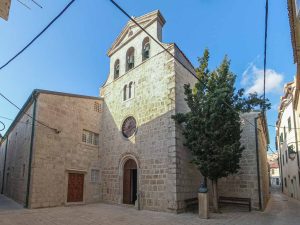
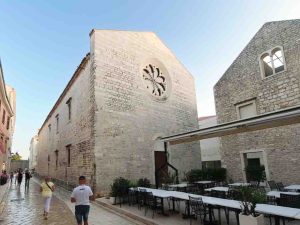
Church of St. Frane is the first Gothic church in Dalmatia and the oldest Franciscan monastery outside Italy. According to legend, Francis of Assisi himself stayed there.
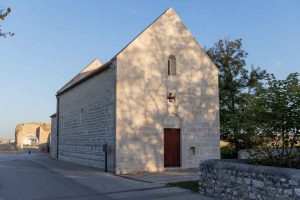
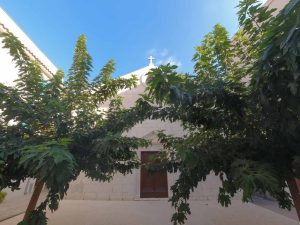
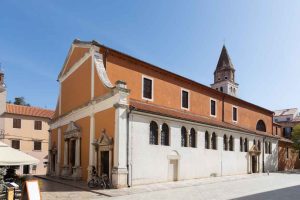
The monastery of St. Francis of Assisi, along with the church of St. Frane, is situated at the western end of the Zadar peninsula. The monastery was built around 1221, and the church was consecrated in 1282 by Archbishop Lovro Periandar.
The interior is simple. The main altar of the church was built in 1672. Behind the altar is a former sanctuary and choir seats richly decorated with carvings in the style of floral Gothic from 1394, the work of Giacomo da Borgo Sansepolcra. The church’s decorated treasury, located next to the vestry, houses an art collection with numerous exhibits. The most valuable piece is a painted crucifix from the 12th century. On the south side of the church is a Renaissance cloister built in 1556.
Entering the vestry from the choir, you’ll find the place where the Treaty of Zadar was concluded in 1358 between the Republic of Venice and the Hungarian-Croatian King Louis I of Hungary. This agreement led to the Venetians renouncing their claims to Dalmatia.
In this monaster James of Sclavonia (1400–1485) received his initial religious education. He died with a reputation for holiness in Bitetto in southern Italy.
Throughout its rich history, the monastery has been the focal point of spiritual life in Zadar. The monastery housed a Franciscan School. Its pinacotheca, collection of codices, and parchments, are also noteworthy.
The treasury also houses the Ugljan polyptych from the 15th century, created by the local painter Dujmo Vučković, along with several artistically valuable crucifixes, a painting of the Dead Christ from the 16th century by Jacopo Bassano, statues of the Annunciation of Mary from 1408, a section of the wooden polyptych by Peter de Riboldis from 1433, and many other historically important items and books.
Recently, attention has been brought to the stolen gilded Gothic patrol cross from 1974. The processional cross, dating back to the 14th century, was specifically crafted for this monastery and is considered one of the most exquisite goldsmith works of Croatian medieval heritage. It is attributed to the renowned goldsmith artist, at the time, Francis of Milan. He is also known for his work on the Chest of Saint Simeon. According to some reports, the cross was presented to the Franciscan monastery in Zadar by Queen Elizabeta Kotromanić during the signing of the Treaty of Zadar in 1358.
The cross and some other works of art were stolen in the night between April 26 and 27, 1974. The treasure was probably loaded onto the ship Zadar-Ancona, which departed, the same night, from the dock about two hundred meters away. The Yugoslav police discovered the perpetrators, and in November 1974 the District Court in Zadar handled a case related to this theft under the name Bruno Nikpalj and the others. There were rumors that the sons of some politicians had been involved. That is probably why there was no trace of the stolen art, and therefore no verdict.
Little was known about the stolen treasure until 2007 when professor Marijana Kovačević published an expert article on the cross. Based on her article, two years later, the cross was recognized by professor Donal Cooper, an expert on medieval art, at the ‘Amadeo Lia‘ museum in the Italian city of La Spezia.
According to Dr. Cooper, from the University of Cambridge, the cross was sold in 1975 at the famous Sotheby’s art auction in London. It was bought quite legally by Amadeo Lia, a collector of medieval art. In 1996, he donated the cross to the city museum in La Spezia, which bears his name.
After making his discovery, Professor Donal Cooper reported it to the University of Zadar, which then reported it to the Croatian Ministry of Culture. This led to an extensive international investigation. After verifying the accuracy of the obtained data, the cross was returned to Croatia in 2023, 14 years after its discovery, by the heirs of Amadeo Lia.
Location
Zadar
Zadar is the oldest continuously inhabited city in Croatia. It is situated on the Adriatic Sea, at the northwestern part of Ravni Kotari region. Zadar serves as the seat of Zadar County and of the wider northern Dalmatian region. The city proper covers 25 km2 (9.7 sq mi) with a population of 71,000 in 2025, making it the second-largest city of the region of Dalmatia and the fifth-largest city in the country.
ExploreGothic
Gothic appeared relatively late in Croatia. In addition to the 13th and 14th centuries, as long as it lasted in Europe, its influence is also visible in the 15th and 16th centuries – for example, on the Trogir and Sibenik cathedrals. Also on the territory of Croatia, you can often see admixtures of Romanesque and Renaissance in Gothic buildings. Gothic influence from European countries adapted to its possibilities and needs and thus created a “domestic artistic expression”. This mixture of styles is most pronounced in Dalmatia. The northern regions were exposed to the influences of Central Europe, while the coastal regions tied their artistic expression to Italian models.
ExploreRenaissance
In the 15th century, Croatia was divided between three states – northern Croatia was a part of the Austrian Empire, Dalmatia was under the rule of the Venetian Republic (with the exception of Dubrovnik), and Slavonia was under Ottoman occupation. Dalmatia was on the periphery of several influences, equidistant from Italy, Ottoman Bosnia, and Austria, so it drew influence from all. In those circumstances in Dalmatia flourished religious and public architecture with clear influences of the Italian Renaissance, but still original.
Explore











Reviews
There are no reviews yet.