
Church of St. Andrew and St. Peter the Old – Zadar


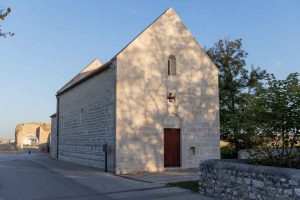
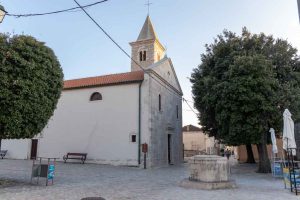
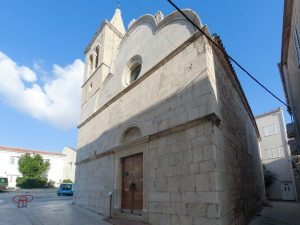
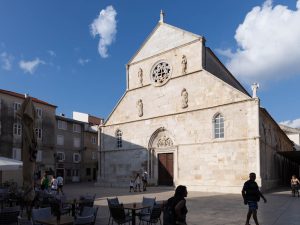
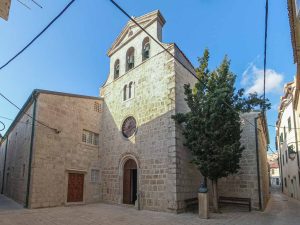
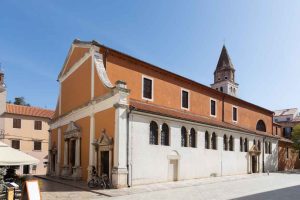
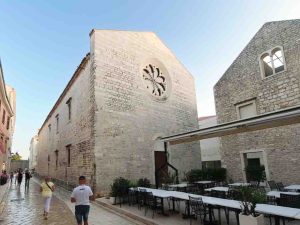
The conjoined Churches of St. Andrew and Old St. Peter, dating from the 5th and 9th centuries respectively and located near the market, are now known as an interesting exhibition space.
The churches are unusually connected; you enter the pre-Romanesque two-aisled Church of Old St. Peter through a doorway in the apse of St. Andrew’s Church. The sole entrance to both churches has always been on what is now the facade of St. Andrew’s.
Until major conservation work in 1961/62, it was believed that the front building was newer. However, it was established that the original little Church of St. Andrew was actually a small oratory, which, along with the one near the cathedral, is the oldest Christian structure in Zadar. About 12 meters of the southern wall and the semicircular apse of the 5th-century church have been preserved.
After the oratory space was converted into the Church of St. Andrew, a pastophorion with an irregular rectangular plan and many incorporated ancient fragments was added to its eastern side in the 9th century.
The space of today’s Church of Old St. Peter was vaulted in the pre-Romanesque period and transformed into a church. The groin vault is supported by two central columns, a central pier, and massive pilasters on the side walls. In the eastern part of this two-aisled church are two rectangular apses covered with semi-domes supported by corner squinches.
Romanesque-Byzantine frescoes from the late 12th century have been preserved in the apses of both churches and on the vaults of Old St. Peter’s.
Location
Zadar
Zadar is the oldest continuously inhabited city in Croatia. It is situated on the Adriatic Sea, at the northwestern part of Ravni Kotari region. Zadar serves as the seat of Zadar County and of the wider northern Dalmatian region. The city proper covers 25 km2 (9.7 sq mi) with a population of 71,000 in 2025, making it the second-largest city of the region of Dalmatia and the fifth-largest city in the country.
ExplorePre-Romanesque
In the 7th century, the Croats, with other Slavs and Avars, came from Northern Europe to the region where they live today. They were on the level of Iron Age nomadic culture, so they did not know how to enjoy the advantages of urban cities. This is why they first inhabited city boundaries on nearby rivers (like Jadro near Roman Salona).
Explore
















Reviews
There are no reviews yet.