
Former tobacco factory and teacher training school in Arbanasi

This area, inhabited since antiquity, has played a crucial role in the development of both schooling and the Croatian language, and it represents valuable and exceptionally well-preserved industrial architecture.
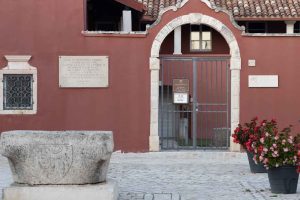
The Preparandija, or teacher’s college, was built during Austrian rule in 1865-1866, based on the design by architect G. Polli. This “Illyrian Preparandija-Convent” in Arbanasi, a suburb of Zadar, was a teacher’s school where instruction was given in the Croatian language, training teachers for public schools.
The first principal of the Teacher’s School in Arbanasi, from 1866 to 1887, was the poet and educator Don Stjepan Buzolić, a staunch advocate against Italianization and for the unification of Dalmatia with the rest of Croatia. Notable alumni of the school include Dinko Šimunović (1893–1933) and Vlaho Paljetak (1893–1944).
From Lazaret to Tobacco Factory
The area encompassing the Preparandija complex and the Tobacco Factory has been inhabited since antiquity. From 1574, this site housed the St. Mark’s Lazaret, a quarantine station for Turkish merchants.
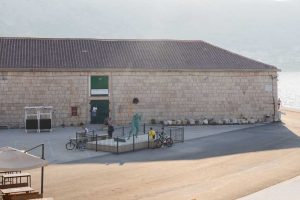
After World War I, with Zadar becoming part of the Kingdom of Italy under the Treaty of Rapallo in 1920, the Preparandija relocated to Dubrovnik. In 1923, its premises were taken over by the Tobacco Factory. Due to the flourishing tobacco industry in the 1930s, three new wings were added around the existing building. In addition to the State Tobacco Factory in Arbanasi, ten private tobacco processors also operated on the peninsula.
Post-War Revival and Eventual Closure
During World War II, three private factories and other processors were destroyed. However, after the war, in 1944, the factory in Arbanasi was repaired, and machinery from other tobacco factories was moved there, bringing about a hundred female workers back to their jobs. The new government at the time would provide lunch to the workers in exchange for forty cigarettes per meal.
In 1974, the Zadar Tobacco Factory moved from this building to Gaženica. In the late 1990s, the Zadar factory was acquired by British American Tobacco, but it eventually closed its doors in 2005.
This site, therefore, not only holds significance for the development of education and the Croatian language but also represents a valuable example of exceptionally well-preserved industrial architecture.
Location
Zadar
Zadar is the oldest continuously inhabited city in Croatia. It is situated on the Adriatic Sea, at the northwestern part of Ravni Kotari region. Zadar serves as the seat of Zadar County and of the wider northern Dalmatian region. The city proper covers 25 km2 (9.7 sq mi) with a population of 71,000 in 2025, making it the second-largest city of the region of Dalmatia and the fifth-largest city in the country.
ExploreClassicism
The term Classicism refers to two distinct periods in the evolution of European fine art: an earlier period spanning the 16th to 17th centuries, and a later period (also called Neoclassicism) from 1760 to 1830. In the Austrian lands (which included Croatia at the time), it emerged in the early 19th century.
ExploreModernism
Yugoslav architecture emerged in the first decades of the 20th century before the establishment of the state; during this period several South Slavic creatives, enthused by the possibility of statehood, organized a series of art exhibitions in Serbia in the name of a shared Slavic identity. Following governmental centralization after the 1918 creation of the Kingdom of Yugoslavia, this initial bottom-up enthusiasm began to fade. Yugoslav architecture became more and more dictated by an increasingly concentrated national authority that sought to establish a unified state identity. Beginning in the 1920s, Yugoslav architects began to advocate for architectural modernism, viewing the style as the logical extension of progressive national narratives.
Explore











Reviews
There are no reviews yet.