
Museum of Ancient Glass – Cosmacendi Palace – Bastion St. Marcele/Moro


The Museum of Ancient Glass in Zadar is a unique archaeological museum specializing in the fascinating world of ancient glass.
Museum of Ancient Glass
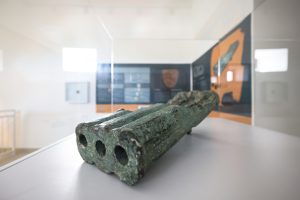
The museum’s permanent display showcases a collection of over 5,000 diverse glass objects from antiquity, spanning the period from the 1st century BC to the 5th century AD. More than 1,500 complete glass items are exhibited in eight thematic sections, offering a comprehensive insight into ancient glassmaking.
Throughout the year, the museum organizes various glass workshops. Visitors can witness the art of glassblowing firsthand in a demo workshop, where replicas of ancient glass are crafted using the free-blowing technique. Other workshops in the museum focus on making glass jewelry with a torch and creating souvenirs using the fusing technique. There’s even a demo workshop for making objects from borosilicate glass with a torch.
The museum also features a well-stocked souvenir shop and two versatile multifunctional halls for occasional exhibitions, lectures, book presentations, and screenings of documentary films about glassmaking.
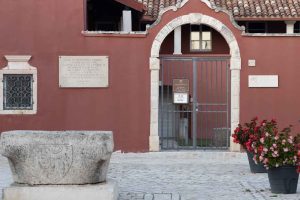
The museum is located on the Renaissance Moro Bastion (St. Marcella Bastion), within the renovated, historicist Cosmacendi family palace, which dates back to the second half of the 19th century.
Due to the demands of the museum’s permanent display concept and daily operations, an annex was added to the northern side of the palace, seamlessly blending with its original architecture.
Moro Bastion / St. Marcella Bastion
Although gunpowder was invented much earlier in China, it’s not entirely clear when and how black powder arrived in Europe. However, historical records describe its use in certain battles in the 14th century, while firearms (and thus black powder) became widely spread across most European countries during the 15th century.
The introduction of gunpowder led to significant advancements in military techniques and defensive architecture, reflected in the design of the so-called alla moderna or bastioned fortifications.
Intensive work on Zadar’s new fortification system began during the Venetian-Ottoman War of 1537–1540. Consequently, in the 16th century, the Veronese master builder and chief engineer of the Venetian Republic, Michele Sanmicheli, and his nephew Giangirolamo Sanmicheli, constructed a new defensive system with three bastions in accordance with new technical achievements and circumstances.
To the south, a bastion was built next to the medieval Citadel. In the middle of the peninsula lies the large central Ponton Bastion. To the north, near today’s bridge, is the Moro Bastion—the last of the three bastions, completed in 1574.
From 1592, it was named St. Marcella Bastion after an unfinished monastery for Benedictine nuns from Nin, which was demolished to make way for the ramparts. In the 18th century, it was renamed Moro Bastion after the Venetian General Providur Benedetto Moro.
Zadar’s fortification system was inscribed on the UNESCO World Heritage List in 2017 as part of the Venetian fortifications built from the 16th to the 17th centuries: Stato da Terra and the western Stato da Mar.
Garden on the Bastion
With the cessation of the Ottoman threat, the ramparts gradually lost their primary defensive function and were repurposed into gardens and parks in the 19th century. The first rbastion converted into a park in 1829 was the Ponton/Grimani Bastion (today Queen Jelena Madijevka Park). Not long after, the Moro Bastion followed, where on May 1, 1864, Antonio Cosmacendi opened a new garden with accompanying music and a small, but well-equipped café.
On the site of the park, Antonio Cosmacendi built the family’s Cosmacendi Palace in 1877, and a little later, in 1891, a residential and business building was built for the Salghetti-Drioli family, famous producers of Zadar’s Maraschino.
Cosmacendi Palace
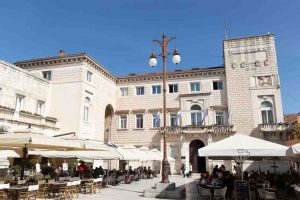
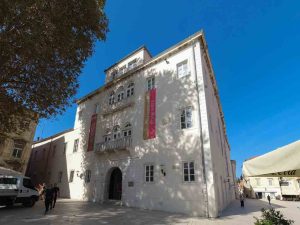
According to 19th-century urbanistic ideals, the Cosmacendi Palace’s main facade, facing the city’s interior, was intended to “beautify” the city.
It stands as a valuable example of stylistically unified Neoclassical architecture, dominated by recognizable elements of classical Greek art. The complete adherence to the canons of Neoclassical architecture is only subtly disrupted by minor decorative details.
Undoubtedly the most impressive part of this two-story building with an attic is its central avan-corpst—a projecting section of the street facade. In its upper part, at the level of the first (main) floor of the Palace – the piano nobile – a loggia opens. It consists of four Ionic columns with a Neoclassical Ionic entablature, above which rises a pediment adorned with consoles and stone vases at the corners, typical decorative details of Neoclassicism.
The piano nobile, typically the first floor of a residential palace, represents the most elite part, containing the owner’s living quarters or drawing-rooms. The importance of this part of the building is regularly highlighted by architectural and decorative elements on the exterior facade.
One of the most common ways to visually separate the ground floor is through the application of horizontal stone profiles along the length of the facade, special decorative treatment of the corresponding window profiles, and finally, diverse designs of balconies, loggias, or terraces.
Cosmacendi Family
According to parish records, the presence of the Cosmacendi family in the city of Zadar can be traced from the very beginning of the 18th century until the last decade of the 19th century.
Contrary to common assumptions about the family’s mercantile roots, the founder of the first generation, Cristoforo Cosmacendi, may have been brought to Dalmatia and Zadar by military service.
The possible origin or connection of the family with the Armenian region is indicated by the nickname Armeno/Armena, which appears in references to Cristoforo’s descendants, his daughter Ellena and son Vicenzo, both confirmed as born in Zadar. Thus, the designation detto Armeno (called the Armenian) should be understood as a trace of memory of their ancestors and some older, original generations.
Already in the next generation of the Cosmacendis, the nickname fell out of use, at least officially.
Location
Zadar
Zadar is the oldest continuously inhabited city in Croatia. It is situated on the Adriatic Sea, at the northwestern part of Ravni Kotari region. Zadar serves as the seat of Zadar County and of the wider northern Dalmatian region. The city proper covers 25 km2 (9.7 sq mi) with a population of 71,000 in 2025, making it the second-largest city of the region of Dalmatia and the fifth-largest city in the country.
ExploreClassicism
The term Classicism refers to two distinct periods in the evolution of European fine art: an earlier period spanning the 16th to 17th centuries, and a later period (also called Neoclassicism) from 1760 to 1830. In the Austrian lands (which included Croatia at the time), it emerged in the early 19th century.
ExploreHistoricism
Historicism is marked with building three large churches: the neo-Romanesque cathedral in Đakovo (K. Roesner and F. Schmidt, 1882), monumental parish church of St Peter and Paul in Osijek (1898) and neo-gothic rebuilding of Zagreb cathedral with glazed roof tiles and 105 m tall towers (Herman Bolle, 1880–1902). At the end of 19th century Herman Bolle undertook one of the largest projects of European historicism, a half-kilometer long neo-Renaissance arcade with twenty domes on Zagreb cemetery Mirogoj.
ExploreRenaissance
In the 15th century, Croatia was divided between three states – northern Croatia was a part of the Austrian Empire, Dalmatia was under the rule of the Venetian Republic (with the exception of Dubrovnik), and Slavonia was under Ottoman occupation. Dalmatia was on the periphery of several influences, equidistant from Italy, Ottoman Bosnia, and Austria, so it drew influence from all. In those circumstances in Dalmatia flourished religious and public architecture with clear influences of the Italian Renaissance, but still original.
Explore











Reviews
There are no reviews yet.