
The Hidden Remains of St. Lawrence Church in Zadar


Tucked away from view in Zadar’s main city square, the remains of St. Lawrence Church offer a glimpse into the city’s early medieval past.
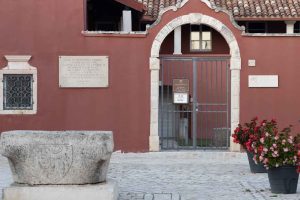
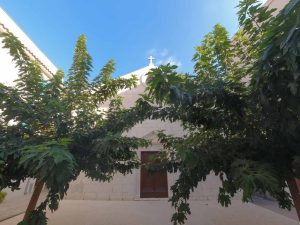
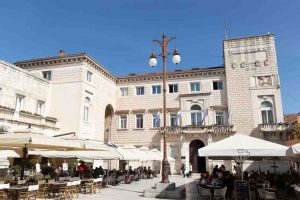
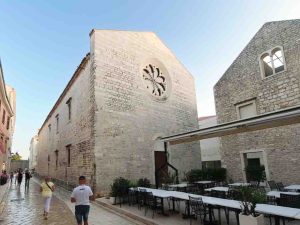
Historically linked to the residence of the garrison commander and even used by Venetian authorities to house those condemned to death, the church is located beside the City Guardhouse and behind the Lovre café, making it easily missed from the square itself. To reach it, one must pass through the café, entering the church through its former sanctuary, essentially its rear end.
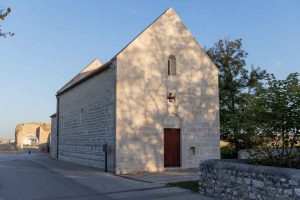
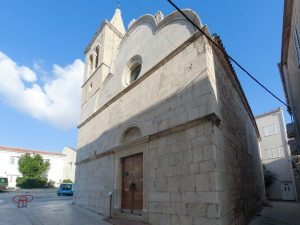
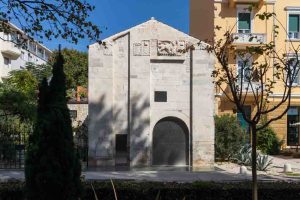
St. Lawrence Church stands as one of the most original architectural monuments of the early Middle Ages, showcasing elements of both pre-Romanesque and Romanesque styles. Its longitudinal form features a pseudo-basilical three-aisled division of the interior space, created by two short colonnades.
The apse is rectangular, contained within the space and vaulted with a semi-dome on squinches, flanked by two small pastophoria (side chapels). The wall surfaces are articulated with lesenes (shallow pilasters) and hanging blind arcades. The center of the small church was once covered by a dome, and the main facade was built as a westwerk – a narthex with a tower-bell tower.
The interior was once adorned with frescoes, which have not survived, although eagles can still be seen on the imposts of the columns. The portal frame from 1886 is preserved in the collection of the Archaeological Museum in Zadar. Several fragments of an altar screen, believed to date from the 11th century, have also been found.
The church fell into disuse for a long period, reportedly due to being hemmed in by surrounding buildings and its past use by Venetian authorities for condemned prisoners. In the 19th century, it was connected to the house occupied by the garrison commander.
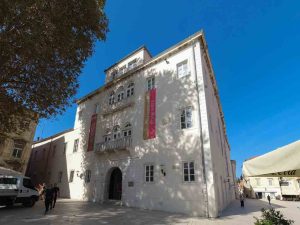
In 1934, with the construction of the new municipal palace, the former 16th-century house with the commander’s residence, despite its historical significance and interesting facade, was demolished. An open wing of the palace was built in its place, making the church more accessible.
Restored and conserved in 1988, St. Lawrence Church now occasionally serves as an intriguing exhibition space, offering a unique journey through Zadar’s architectural history for those who venture to find it.
Location
Zadar
Zadar is the oldest continuously inhabited city in Croatia. It is situated on the Adriatic Sea, at the northwestern part of Ravni Kotari region. Zadar serves as the seat of Zadar County and of the wider northern Dalmatian region. The city proper covers 25 km2 (9.7 sq mi) with a population of 71,000 in 2025, making it the second-largest city of the region of Dalmatia and the fifth-largest city in the country.
ExplorePre-Romanesque
In the 7th century, the Croats, with other Slavs and Avars, came from Northern Europe to the region where they live today. They were on the level of Iron Age nomadic culture, so they did not know how to enjoy the advantages of urban cities. This is why they first inhabited city boundaries on nearby rivers (like Jadro near Roman Salona).
ExploreRomanesque
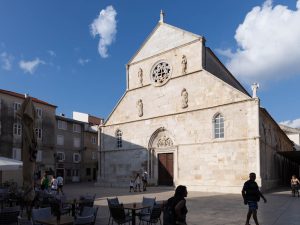
In the 11th century, monumental cities were built along the entire Dalmatian coast. Houses were constructed from stone. On the ground floor there were shops or taverns (natively – konoba), seen today in cities such as Poreč, Rab, Zadar, Trogir, and Split. In those cities the most important buildings were churches. They were commonly stone-built basilicas with three naves, three apses, columns, arches, arcades and wooden roofs, and were erected near the monasteries of Benedictine monks who came out of Italy. St. Peter in Supetarska Draga on the island of Rab (11th century) is the best-preserved church of that type in Croatia. On the same island is the Cathedral of Rab (12th century) has a high-Romanesque bell tower, the largest in Dalmatia. It is specific with its openings, which multiply with each level of floor (Latin: mono-fore, bi-fore, tri-fore, quadro-fore). This is typical for Romanesque architecture, but also architecturally innovative, as each floor is slightly lighter than the one below.
Explore











Reviews
There are no reviews yet.