
Tourist Info Centre – Cedulin Palace – Old Hospital Complex


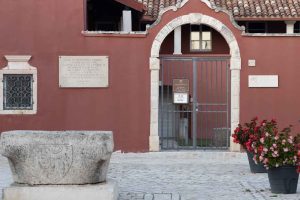
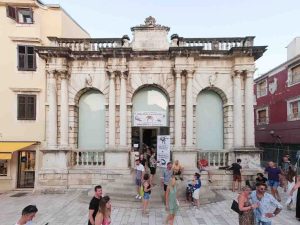
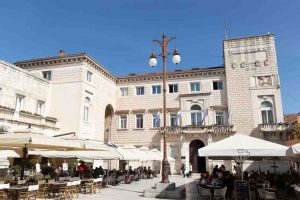
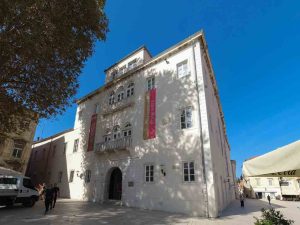
The Cedulin Palace is located at the entrance to the historic center of Zadar and under the UNESCO-listed Walls of the Zadar Uprising.
Since 2017, the Tourist Information Center has been located within the renovated palace. It features modern multimedia equipment and serves as the central point for managing all tourist activities and experiences in the city of Zadar and Zadar County.
Various presentations, exhibitions, concerts, gastronomic events, and other cultural and musical programs are held in the courtyard of the Tourist Information Center.
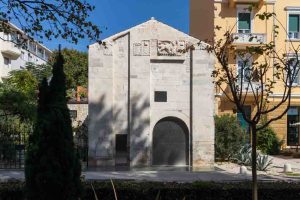
The first house of the Cedulin family, dating from the later 12th or even the 13th century, was destroyed by fire during the 14th century. Later, a new building was constructed, and some of its walls have been preserved to their original height today.
In 1575, the palace was adapted for use as a military hospital. The hospital was expanded in the 17th and 18th centuries, and in 1804, it was converted for civilian purposes. During Napoleon’s rule over the city, the Faculty of Medicine operated here from 1806 to 1811.
A new hospital was built in Kolovare in 1886, but some hospital premises remained at this location until the late 1930s.
The hospital courtyard with a well, now known as the atrium of the Cedulin Palace, was enclosed by buildings on all four sides. When the first Zadar bridge was built in 1928, the southeastern wing of the hospital was removed (between 1929 and 1931) to connect the bridge with People’s Square via a street.
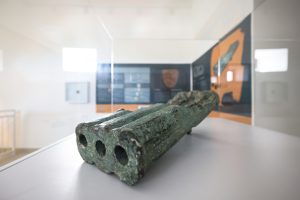
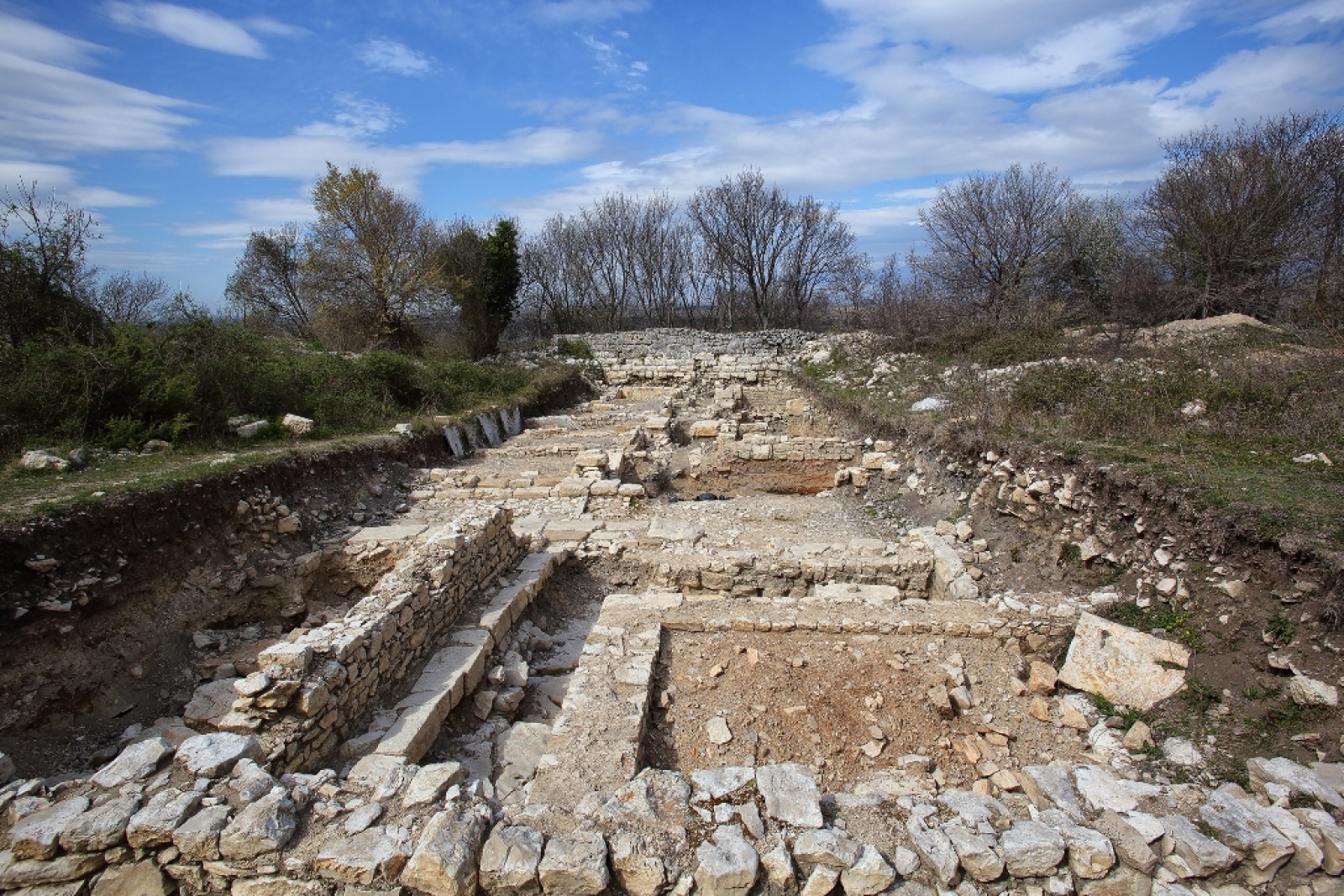
Archaeological excavations in 2014 and 2015 in the area of the southwest and northwest wings of the old hospital uncovered the remains of ancient and late antique buildings, late antique brick tombs, a water supply system from the second half of the 4th century, the coping of an ancient well, as well as two monumental beams decorated with vegetal and geometric motifs, and a significant amount of movable archaeological material (numismatic material, fragments of construction and utilitarian ceramics, fragments of glassware).
The research was conducted by the Museum of Ancient Glass under the supervision of the Conservation Department in Zadar.
Location
Zadar
Zadar is the oldest continuously inhabited city in Croatia. It is situated on the Adriatic Sea, at the northwestern part of Ravni Kotari region. Zadar serves as the seat of Zadar County and of the wider northern Dalmatian region. The city proper covers 25 km2 (9.7 sq mi) with a population of 71,000 in 2025, making it the second-largest city of the region of Dalmatia and the fifth-largest city in the country.
ExploreBaroque
One of the most remarkable periods in Croatian art history is the Baroque, which lasted from the 17th to the late 18th century. During this time, Croatia was reunited with the parts of its territory that were occupied by the Venetian Republic and the Ottoman Empire, after centuries of fragmentation and division. This reunification not only brought political stability and economic prosperity but also stimulated a cultural revival and a flourishing of art in every segment.
ExploreRenaissance
In the 15th century, Croatia was divided between three states – northern Croatia was a part of the Austrian Empire, Dalmatia was under the rule of the Venetian Republic (with the exception of Dubrovnik), and Slavonia was under Ottoman occupation. Dalmatia was on the periphery of several influences, equidistant from Italy, Ottoman Bosnia, and Austria, so it drew influence from all. In those circumstances in Dalmatia flourished religious and public architecture with clear influences of the Italian Renaissance, but still original.
ExploreRomanesque
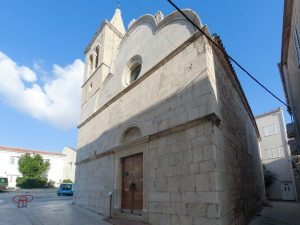
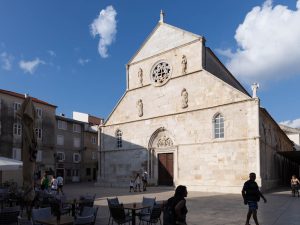
In the 11th century, monumental cities were built along the entire Dalmatian coast. Houses were constructed from stone. On the ground floor there were shops or taverns (natively – konoba), seen today in cities such as Poreč, Rab, Zadar, Trogir, and Split. In those cities the most important buildings were churches. They were commonly stone-built basilicas with three naves, three apses, columns, arches, arcades and wooden roofs, and were erected near the monasteries of Benedictine monks who came out of Italy. St. Peter in Supetarska Draga on the island of Rab (11th century) is the best-preserved church of that type in Croatia. On the same island is the Cathedral of Rab (12th century) has a high-Romanesque bell tower, the largest in Dalmatia. It is specific with its openings, which multiply with each level of floor (Latin: mono-fore, bi-fore, tri-fore, quadro-fore). This is typical for Romanesque architecture, but also architecturally innovative, as each floor is slightly lighter than the one below.
Explore









Aura –
I love everything, I have visited them and I like to enjoy the artistic events.