
Zadar’s City Guardhouse – Ethnographic Department of NMZ


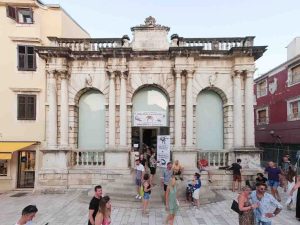
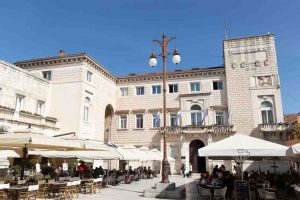
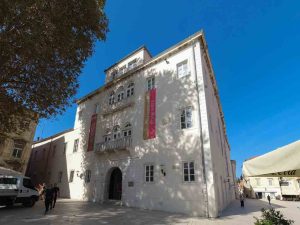
Facing the City Loggia across Zadar’s main square stands the City Guardhouse (Gradska straža), a significant public building erected during the Venetian rule to house the military garrison (Gran Guardia).
Built in 1562 in the Late Renaissance style, it’s believed to have been designed by the Venetian architect Giangirolamo Sanmicheli.
Over the centuries, the building has seen some alterations. Towards the end of the 18th century, the Austrian authorities removed a smaller tower. In 1798, construction began on a larger baroque tower atop the Guardhouse. A new clock, crafted and installed by the city clockmaker Martini, has been ticking away reliably since 1803.
Above the roof terrace, a structure was built to house bells. The larger bell, which strikes the hours, was moved from the Captain’s Tower (Bovo dí Antona), while the smaller bell, chiming the quarter hours, came from the neighboring Church of St. Lawrence. Earlier, in 1783, a perimeter wall with openings for cannons was also constructed.
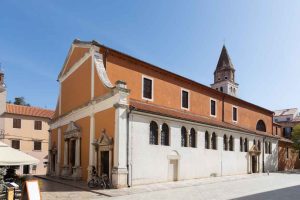
Interestingly, Zadar had a public city clock even earlier, mentioned in 1555 on the bell tower of the Church of the Forty Martyrs or St. Barbara, which stood near today’s Forum café.
Today, the City Guardhouse is home to the Ethnological Department of the National Museum Zadar (Narodni muzej Zadar – NMZ). Within its historic walls, you can explore fascinating collections that offer insights into the region’s cultural heritage. For more information about the Ethnological Department’s exhibits and opening hours, please visit the official website of the National Museum Zadar.
Location
Zadar
Zadar is the oldest continuously inhabited city in Croatia. It is situated on the Adriatic Sea, at the northwestern part of Ravni Kotari region. Zadar serves as the seat of Zadar County and of the wider northern Dalmatian region. The city proper covers 25 km2 (9.7 sq mi) with a population of 71,000 in 2025, making it the second-largest city of the region of Dalmatia and the fifth-largest city in the country.
ExploreBaroque
One of the most remarkable periods in Croatian art history is the Baroque, which lasted from the 17th to the late 18th century. During this time, Croatia was reunited with the parts of its territory that were occupied by the Venetian Republic and the Ottoman Empire, after centuries of fragmentation and division. This reunification not only brought political stability and economic prosperity but also stimulated a cultural revival and a flourishing of art in every segment.
ExploreRenaissance
In the 15th century, Croatia was divided between three states – northern Croatia was a part of the Austrian Empire, Dalmatia was under the rule of the Venetian Republic (with the exception of Dubrovnik), and Slavonia was under Ottoman occupation. Dalmatia was on the periphery of several influences, equidistant from Italy, Ottoman Bosnia, and Austria, so it drew influence from all. In those circumstances in Dalmatia flourished religious and public architecture with clear influences of the Italian Renaissance, but still original.
Explore









Reviews
There are no reviews yet.