
Old town of Pag and the church of St. Mary


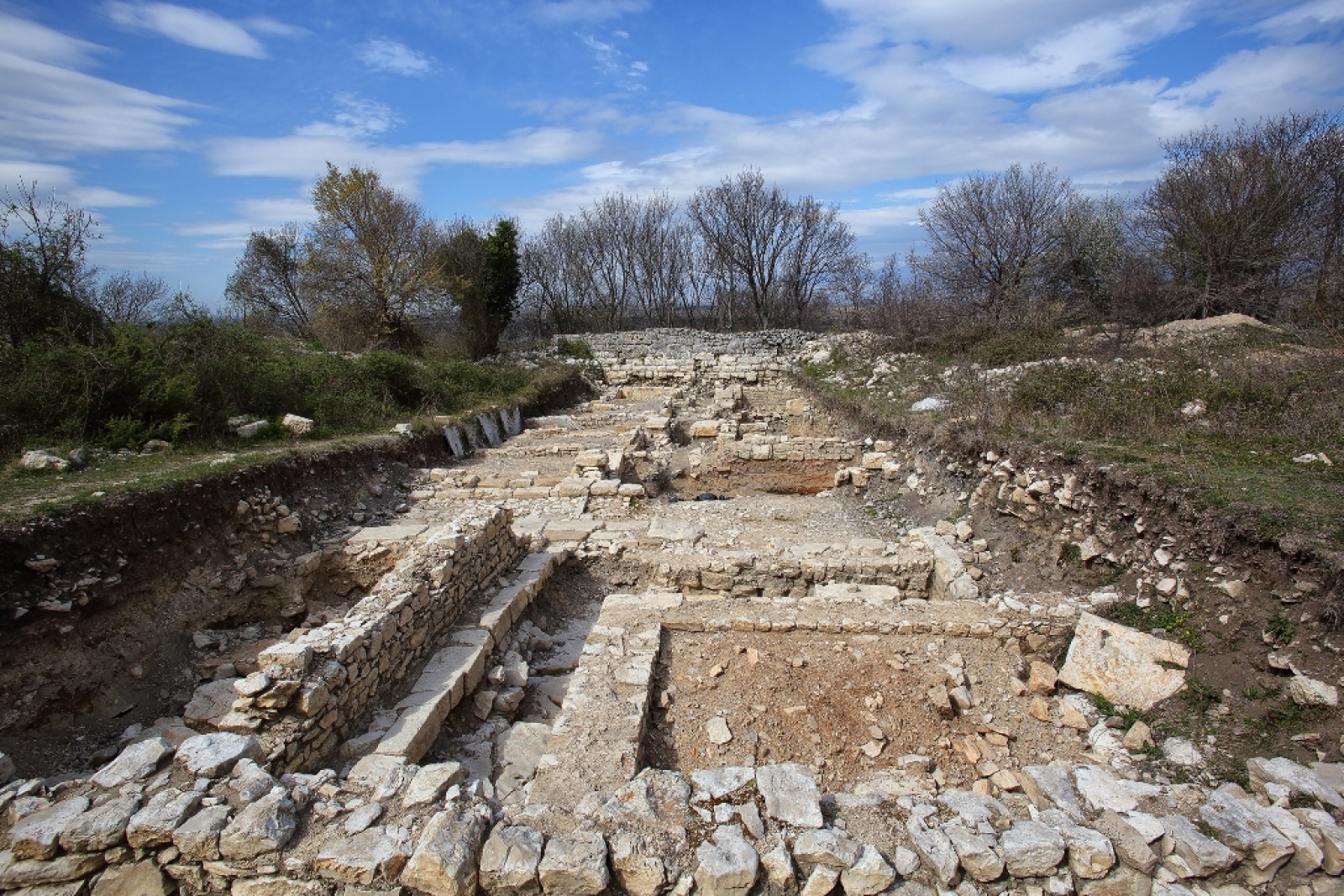
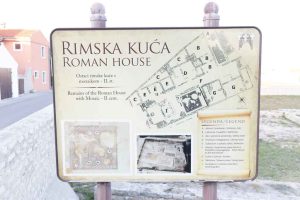
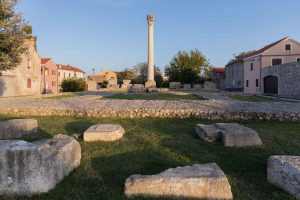
Stari Grad Pag (Old Town Pag) is located just one kilometer south of the present-day city center. This was once a large and wealthy town, with traces of settlement dating back to antiquity.
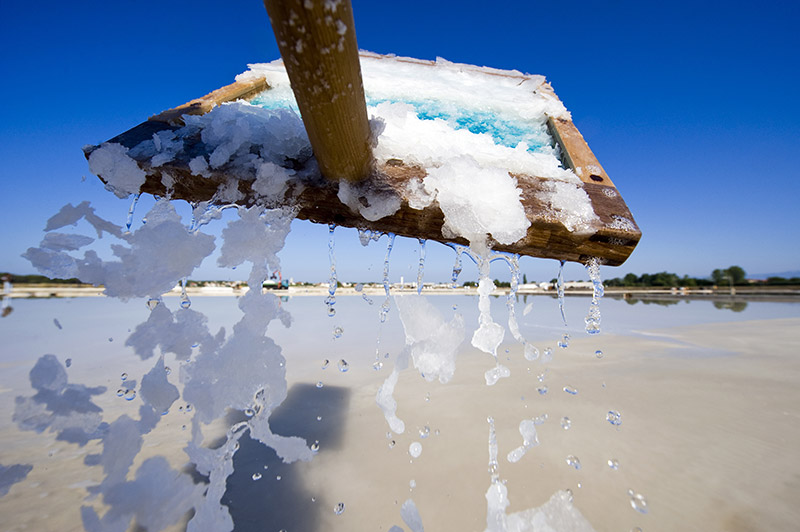
The rapid economic development of Old Pag was founded on salt production from the nearby saltworks. Due to its economic strength, the Hungarian-Croatian King Bela IV granted Pag the status of a Free Royal City on March 30, 1244.
However, Pag was under constant pressure from Zadar for centuries, as Zadar sought to maintain a monopoly over the saltworks.
After the Peace of Zadar in 1358, the Venetian Republic lost the entire area from Kvarner to Durrës, and Zadar recovered its former possessions, including Pag. Pag briefly managed to gain independence from King Louis I in 1376, but after his death, it once again fell under Zadar’s rule.
In a rebellion that erupted in 1393, the people of Pag expelled the duke sent from Zadar and all Zadar citizens. Zadar then attacked Pag, devastating it again and killing and mutilating many islanders. Old Pag was ruined on March 30, 1393, when it was plundered and burned by mercenaries.
The people of Pag sought protection from King Sigismund of Luxembourg. In 1396, a council was convened in Nin, attended by representatives from all Dalmatian cities. It was decided that Pag would no longer be under Zadar’s authority and that its rights would be equalized with those of the other Dalmatian cities. At that council, Stari Pag was granted self-governance by a solemn charter.
Sources indicate that Zadar violently overthrew Venetian rule in Pag as many as fourteen times. Armed attacks often ended with the devastation of Pag, and its inhabitants were forced to provide oarsmen for Zadar’s galleys.
The bloody struggles between Zadar and Pag finally concluded in 1409, when King Ladislaus of Naples sold Zadar, Novigrad, Vrana, and the island of Pag to Venice.
Since the Old Town was in an “unsafe location” that couldn’t be properly fortified, the people of Pag decided to relocate in the mid-15th century. The construction of the new, planned city (Citta Nuova) began on May 18, 1443, and the population moved to the new town by 1467. Stari Grad (until the 1970s) was a separate settlement, but has since become part of the Pag municipality.
Architectural Monuments
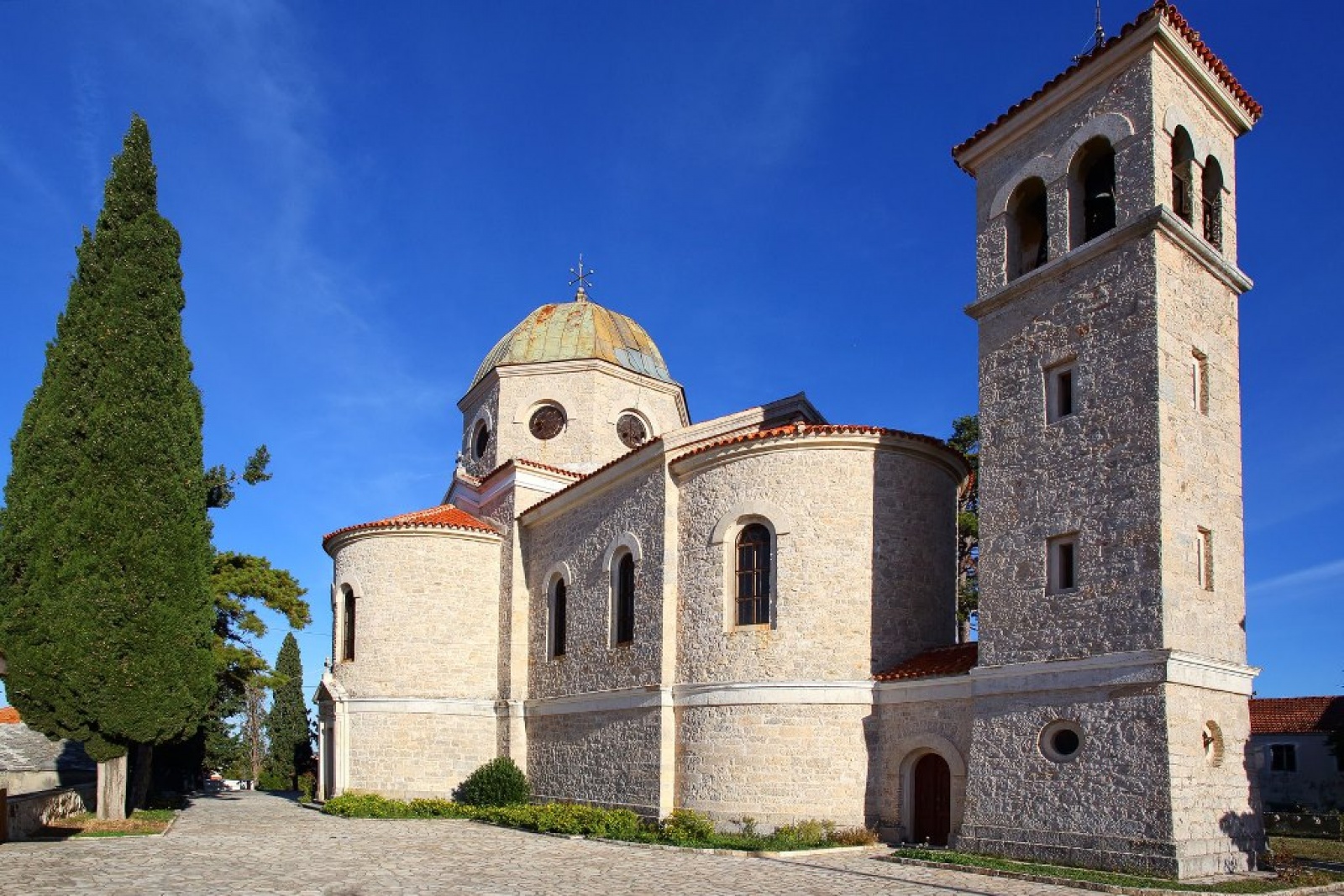
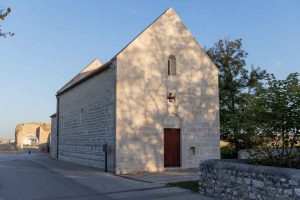
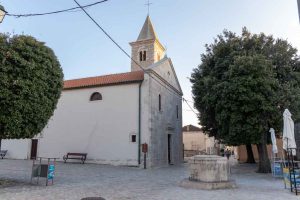
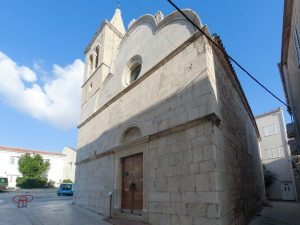
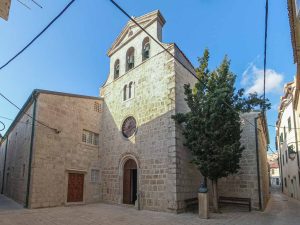
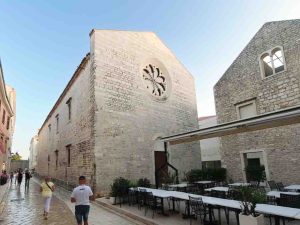
In the ruins of the Old Town, the Church of the Assumption of the Virgin Mary, also known as Our Lady of the Old Town (Gospa od Staroga grada), has been preserved. This is a three-aisled Romanesque basilica whose construction dates to the turn of the 13th to the 14th century. Its erection is connected to the elevation of the Pag church to the rank of a collegiate body in 1316.
The floor plan of the building was directly modeled after the Zadar Cathedral. The interior of the church is divided by five pairs of masonry piers (pilons). The large main apse is semicircular, while the two side apses are inscribed within the wall mass. Although simple in form and poorly constructed (using roughly processed local stone with abundant plaster), this simplicity can be explained by the adoption of the principles of Franciscan and Dominican architecture (purity of geometric volumes and unadorned architecture).
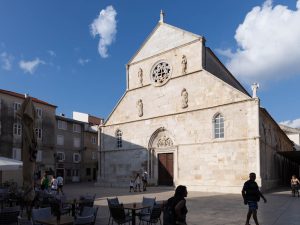
The most striking part of the church is the Romanesque-Gothic facade, which was crafted and decorated with reliefs by the Italian builder and sculptor Pavao of Sulmona in 1392. We know this from an inscription he left on the facade.
The lunette above the portal features a relief of the Virgin Mary protecting the pious people of Pag under her cloak (Gospa od Milosti). This figurative composition is distinctly Gothic. Pavao of Sulmona also created the Gothic rosette with its richly decorated frame, the bust of Christ above the rosette, and the reliefs of the allegories of Day and Night (acting like telamons) on the corners of the facade. On a panel with the relief of the Archangel Gabriel, Pavao also carved the coat of arms of the Pag chapter (a dove).
The church preserves a statue of the Mother of God, as well as valuable Gothic wood carvings, such as a statue of the Virgin and Child from the late 14th century.
Adjacent to the church are the ruins of a Franciscan monastery, which was added after 1589. Within the monastery courtyard, a freshwater well has been preserved, linked to a legend about the Mother of God saving the people of Pag from drought. The Franciscans left the monastery in 1899.
Votive Tradition
Every year on the Feast of the Assumption (Velika Gospa), the people of Pag traditionally make a pilgrimage in procession from the Old Town to the new Pag, carrying the statue of the Blessed Virgin Mary. This votive procession dates back to 1885.
In 1852, cholera appeared in Pag and continued to strike intermittently. To prevent the spread of the disease, all cemeteries were moved out of the city and churches during those years.
On the Feast of the Assumption, August 15, 1885, the people of Pag spontaneously gathered in the Old Town around the statue of the Virgin, praying for her to save them from the deadly disease. They carried the statue to the Collegiate Church in Pag. The last victims of cholera were buried the following day, on the feast of St. Roch (August 16).
At that time, the people of Pag made a vow that every year on the Feast of the Assumption, they would bring the statue to Pag, where it would remain in the Collegiate Church for 22 days until the Nativity of Mary (Mala Gospa), so the faithful could give thanks and pray for salvation, health, peace, and love.
Location
Gothic
Gothic appeared relatively late in Croatia. In addition to the 13th and 14th centuries, as long as it lasted in Europe, its influence is also visible in the 15th and 16th centuries – for example, on the Trogir and Sibenik cathedrals. Also on the territory of Croatia, you can often see admixtures of Romanesque and Renaissance in Gothic buildings. Gothic influence from European countries adapted to its possibilities and needs and thus created a “domestic artistic expression”. This mixture of styles is most pronounced in Dalmatia. The northern regions were exposed to the influences of Central Europe, while the coastal regions tied their artistic expression to Italian models.
ExploreRomanesque
In the 11th century, monumental cities were built along the entire Dalmatian coast. Houses were constructed from stone. On the ground floor there were shops or taverns (natively – konoba), seen today in cities such as Poreč, Rab, Zadar, Trogir, and Split. In those cities the most important buildings were churches. They were commonly stone-built basilicas with three naves, three apses, columns, arches, arcades and wooden roofs, and were erected near the monasteries of Benedictine monks who came out of Italy. St. Peter in Supetarska Draga on the island of Rab (11th century) is the best-preserved church of that type in Croatia. On the same island is the Cathedral of Rab (12th century) has a high-Romanesque bell tower, the largest in Dalmatia. It is specific with its openings, which multiply with each level of floor (Latin: mono-fore, bi-fore, tri-fore, quadro-fore). This is typical for Romanesque architecture, but also architecturally innovative, as each floor is slightly lighter than the one below.
Explore









Reviews
There are no reviews yet.