
The Zadar Sphinx, the largest sphinx in Europe, was built in memory of a beloved wife


According to a romantic legend, the Zadar Sphinx—the largest of its kind in Europe—was built in memory of a beloved wife.
It’s an impressive and mysterious sculpture, located in the garden of Villa Attilia in Zadar, and it was commissioned by Giovanni Smirich to honor his late wife, Attilia, who passed away just a year before its creation.
The Sphinx
At about 5 meters long and nearly 3 meters tall, the Zadar Sphinx was built in 1918. It was modeled after an Egyptian sphinx, but with some fascinating modifications by its creator, the Zadar-based artist and conservator, Giovanni Smirich.
The sphinx has a classic human head and a lion’s body, but its front paws are uniquely shaped like human hands. The sphinx’s face conveys an expression of strictness and dignity, and on its head, it wears a traditional Egyptian nemes headdress, decorated with hieroglyphs.
Legend has it that the sphinx was a tribute to Smirich’s wife, Attilia Spineda de Cataneis, who died prematurely. Some believe the sphinx’s face may even be her portrait.
The entire sculpture is made of stone and concrete, with certain parts, like the head, cast separately and then attached to the body. It was then coated with a fine layer of concrete and originally painted a light brown (ochre) color to make it look even more like the Egyptian sphinxes.
It once had a winged eagle relief on its chest and held a dagger in its hands, but these parts are unfortunately now damaged or missing. The sphinx faces east, just like its Egyptian counterparts, and a small, shell-shaped basin sits in front of it.
This sculpture in the garden of Villa Attilia is more than just an art piece; it’s a keeper of secrets and legends. Some say it grants wishes to lovers, which adds to its mystical reputation. Throughout the 20th century, the sphinx was a symbol of romantic love and the artistic spirit of Giovanni Smirich, a significant conservator who left a lasting legacy in Zadar by restoring numerous monuments.
Villa Attilia
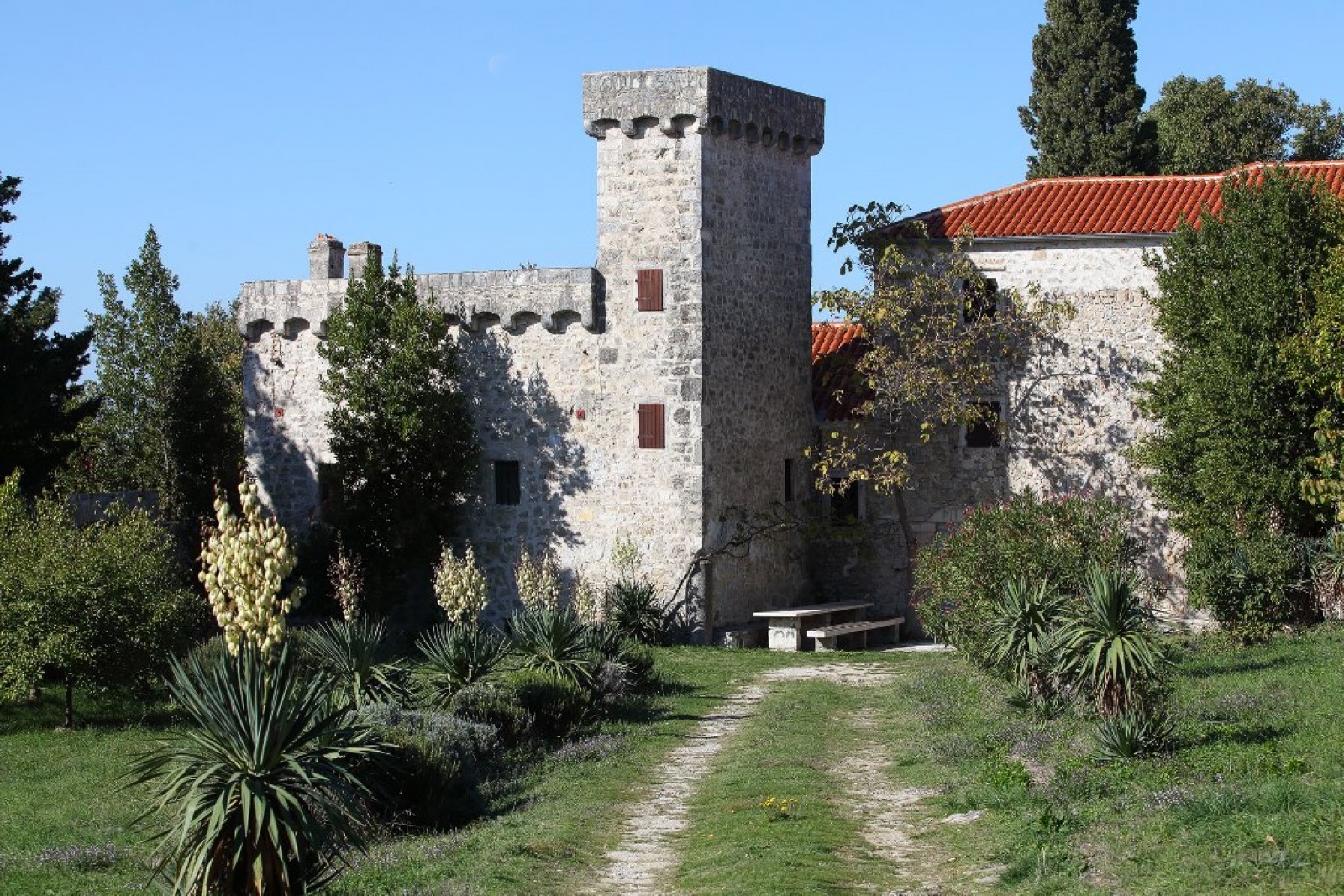
Villa Attilia is one of about twenty summer villas with gardens built in the late 19th and early 20th centuries in the historicist and Art Nouveau styles in the Brodarica neighborhood. It was constructed in 1901 as the first building in the Maestral Bay area (also known as Dražanica Vela). At the time, this area was undeveloped, but Giovanni Smirich saw it as a perfect spot for a family summer house. The family lived in the city during the year and spent their summers here.
The Park of Villa Attilia
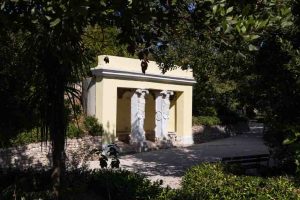
The public park of Villa Attilia owes its existence to Giovanni Smirich, who landscaped it as a private garden around his family home, covering an area of 7,152 square meters. Designed in the style of an English garden, it features an informal layout that mimics a natural landscape, in contrast to the symmetrical French gardens.
The garden has a historicist and romantic flair from the late 19th and early 20th centuries, respecting the natural terrain with distinct upper and lower sections connected by a path and a staircase.
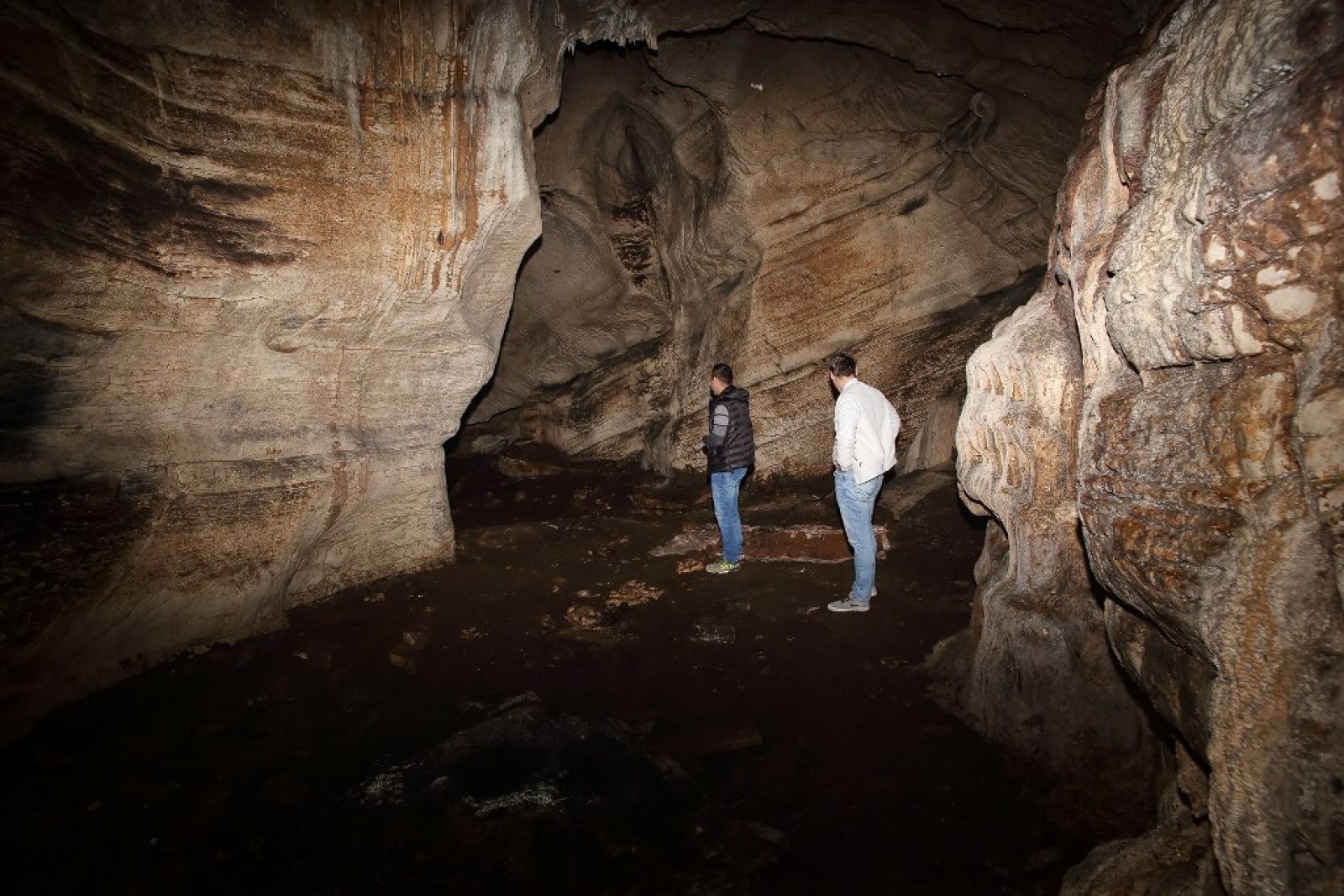
The vegetation includes numerous Mediterranean plants like firs, pines, cypresses, laurels, rosemary, and agave. The garden also features a small pond, benches with reliefs, an artificial cave, and its most intriguing element—the sculpture of the Zadar Sphinx, which Smirich had made in honor of his wife. This garden is a blend of art, nature, and history, and it is now open to the public as a valuable piece of Zadar’s cultural and horticultural heritage.
Location
Zadar
Zadar is the oldest continuously inhabited city in Croatia. It is situated on the Adriatic Sea, at the northwestern part of Ravni Kotari region. Zadar serves as the seat of Zadar County and of the wider northern Dalmatian region. The city proper covers 25 km2 (9.7 sq mi) with a population of 71,000 in 2025, making it the second-largest city of the region of Dalmatia and the fifth-largest city in the country.
ExploreArt déco
Art Deco was a style that emerged in Europe and the USA from 1920 to 1930. It was a continuation of Vienna Secession and was named after the French term ‘art dècoratif’ which means decorative art. The term was coined at the International Exhibition of Modern Decorative and Industrial Arts held in Paris in 1925. Art Deco drew inspiration from Art Nouveau and the Wiener Werkstätte, and it influenced all areas of artistic life.
ExploreHistoricism
Historicism is marked with building three large churches: the neo-Romanesque cathedral in Đakovo (K. Roesner and F. Schmidt, 1882), monumental parish church of St Peter and Paul in Osijek (1898) and neo-gothic rebuilding of Zagreb cathedral with glazed roof tiles and 105 m tall towers (Herman Bolle, 1880–1902). At the end of 19th century Herman Bolle undertook one of the largest projects of European historicism, a half-kilometer long neo-Renaissance arcade with twenty domes on Zagreb cemetery Mirogoj.
Explore












Reviews
There are no reviews yet.