
Kamerlengo Tower – City Hall of the town of Pag


While exploring the historic town of Pag, you might wonder what happened to the former Kamerlengo Tower.
Unfortunately, this defensive tower—once a part of the powerful walls that protected the city—no longer exists in its original form. During the 19th century, many of the city’s walls and towers were torn down.
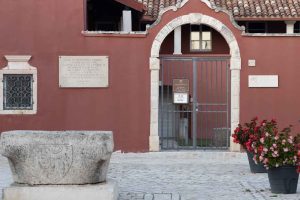
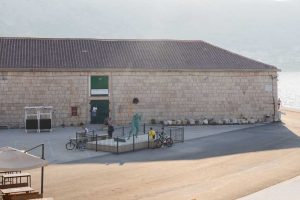
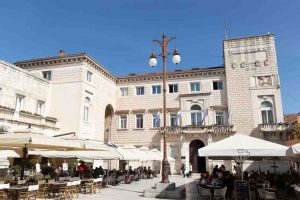
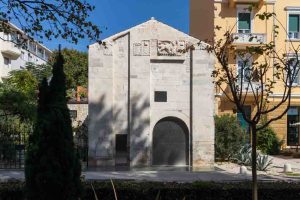
The current city hall was built on the foundations of the former Kamerlengo Tower in 1906. The building was commissioned by the well-known Pag mayor, Frane Budak, for the needs of the then-municipality of Pag. The site where the tower once stood became the new center of secular power.
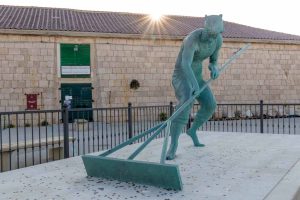
Today, in the space of the former tower, or rather, the City Hall, a vibrant cultural life unfolds during the summer months. It is transformed into an exhibition space for various visual artists, offering visitors a unique opportunity to enjoy art in a historic setting.
The Civil Authority of the City of Pag
The City Council is the representative body of the citizens and the local self-government, responsible for making decisions and enacting laws within the city’s jurisdiction.
Throughout its history, the civil authority in the city of Pag changed its seat and form depending on political circumstances. The most significant administrative centers were associated with the new, planned city of Pag (built from 1443).
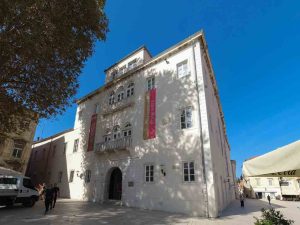
From the 15th century onward, the main seat of civil authority in the new city of Pag was the Rector’s Palace, also built in the 15th century. It is located on the main city square and served as the seat of the city and island administration for centuries. From the Venetian period until the first decades of the 19th century, the palace housed the duke (appointed by the central authority in Venice), and later the city’s rector and governor-judge.
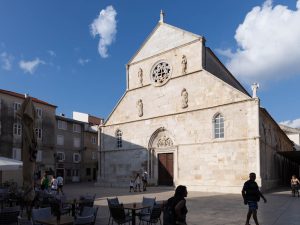
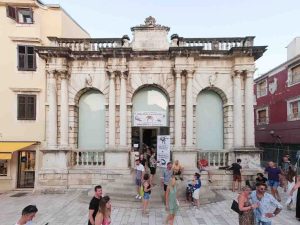
The multi-purpose Loggia, located opposite the Collegiate Church, also played an important role in trade and public life, but it was later destroyed.
In earlier history, in Stari Pag (Old Pag), authority was exercised by a župan (a type of count) or, under Venetian/Zadar rule, by dukes and judges.
Conflicts with Zadar
The people of Pag endured long and tumultuous conflicts with Zadar, which marked their history from the 12th to the early 15th century. These conflicts were driven by Zadar’s desire for dominance and its monopoly over Pag’s possessions and vital saltworks. Historical sources record that Zadar violently overthrew Venetian rule in Pag as many as fourteen times.
These armed attacks often ended with the devastation of Pag, and the people of Pag were forced to supply oarsmen for Zadar’s galleys. The decision to begin constructing the “New Pag” in 1443 was partly motivated by the need for a location that was better protected from Zadar’s assaults.
The bloody struggles between Zadar and Pag finally ended in 1409 when King Ladislaus of Naples sold Zadar, Novigrad, Vrana, and the island of Pag to Venice. Following this sale, Pag formally recognized the authority of the Venetian Republic. With this move, the Pag commune was officially put on the same footing as other Dalmatian communes and was granted limited autonomy.
Historical Notes
- Pag is first mentioned in the 10th century when King Stjepan Držislav appointed a Croatian župan as the city’s administrator in 976, freeing it from Byzantine rule.
- The original settlement, Stari Pag (Old Town), was located a kilometer south of the current city center. It was the seat of the island’s municipality during the Middle Ages. In Stari Pag, authority was exercised by a župan or, under Venetian/Zadar rule, by dukes and judges.
- Pag was granted the status of a Free Royal City by a Bull from King Bela IV on March 30, 1244. However, during the 14th century, the people of Pag repeatedly recognized the authority of the Venetian Republic in an effort to establish an independent municipality.
- After Zadar re-took Pag in 1312, an administration was established where one judge was elected by Zadar and the other by the people of Pag, even though Zadar economically exploited the island.
- In 1376, Pag received the status of a Free Royal City from the Croatian King Louis I, which confirmed its privileges.
- After Pag recognized the authority of the Venetian Republic in 1409, city administration bodies were established. For centuries, the head of the Pag administration was a duke appointed by the central authority in Venice.
- The noble families of Pag played an important role in shaping the cultural and economic life of the town. The rules of governance were regulated by the City Statute of 1433.
- After the fall of Venice in 1797, Pag came under Austrian rule. After a brief period of French rule (1805–1814), it returned to Austria. During French administration, a court was established in Pag.
- The Croatian National Revival strengthened in the second half of the 19th century. When the Croatian People’s Party won the elections in 1882, the Croatian language was introduced into offices and schools. The first Croatian mayor in Pag was Nikola Portada.












Reviews
There are no reviews yet.