
The Great Arsenal in Zadar
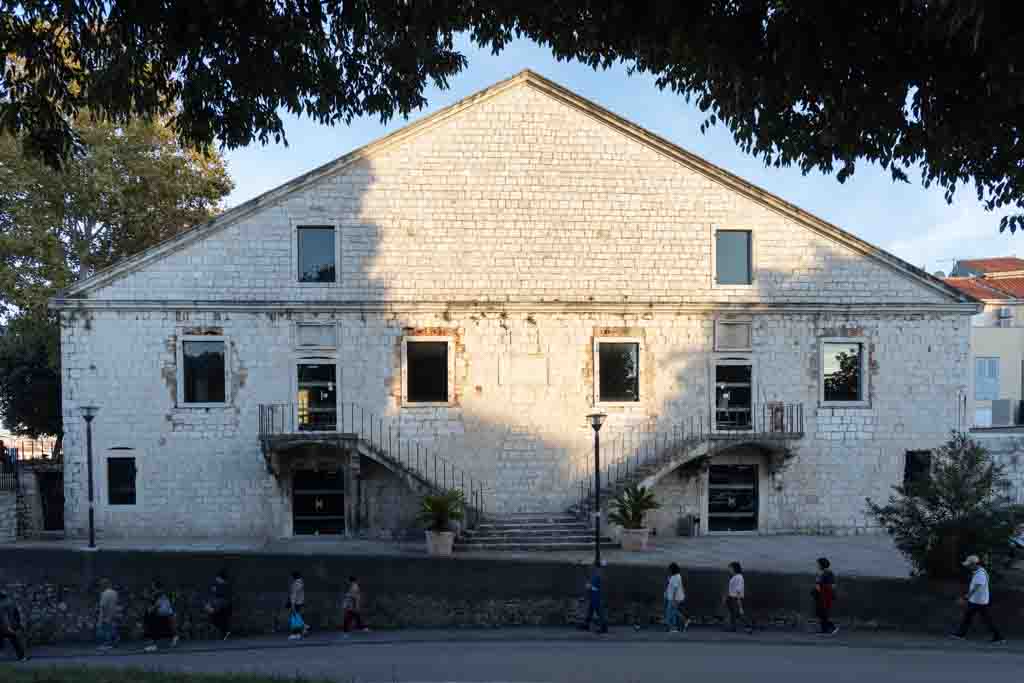
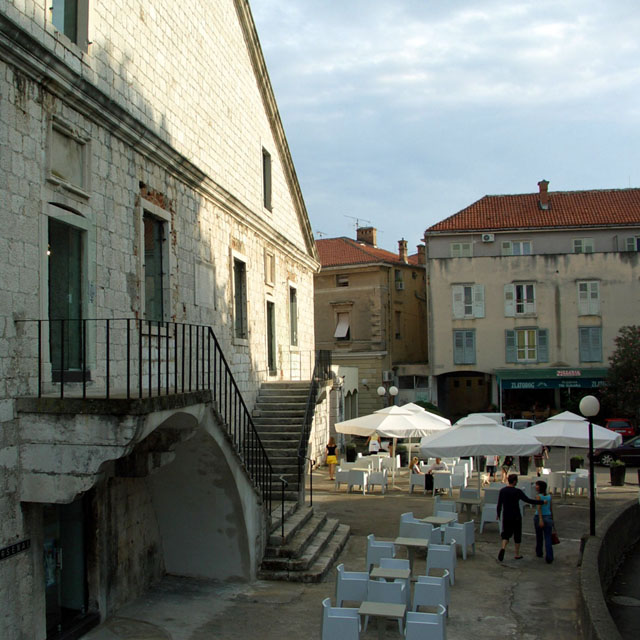

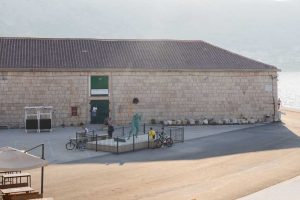
The Arsenal building stands as the largest preserved port facility from the Venetian era in northern Dalmatia.
The Great Arsenal is a port structure, and its purpose was a large warehouse located within the Chain Gate area.
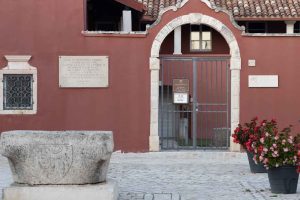
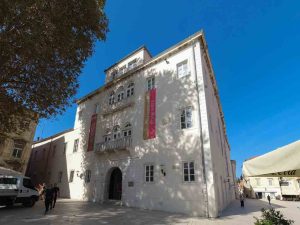
The building was erected as early as the 16th century, before the defensive canal of the citadel was repurposed for cisterns – what’s known today as the Three Wells Square. In 1752, after a major fire, this port warehouse was expanded thanks to the efforts of the provveditore G. M. Balbi. A new stone facade with a symmetrical double staircase was constructed, as evidenced by the inscribed plaque on the building’s front.
During World War II, the Arsenal was heavily damaged in the Allied bombing of Zadar, which completely destroyed its roof. However, in the post-war reconstruction of Zadar, it fared better than the neighboring New Theater (Teatro Verdi), which, despite sustaining less damage, was razed to the ground only after the war. For a short period, the Arsenal’s space served as an exhibition area, while for the most part until its renovation, it was used for commercial purposes.
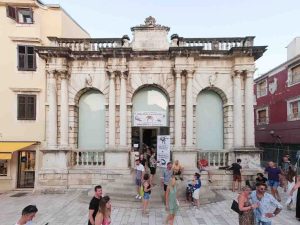
The renovated Arsenal reopened in the summer of 2005 as a Mediterranean-style indoor city square. It’s now a central hub for public, cultural, and entertainment aspects of city life.
Location
Zadar
Zadar is the oldest continuously inhabited city in Croatia. It is situated on the Adriatic Sea, at the northwestern part of Ravni Kotari region. Zadar serves as the seat of Zadar County and of the wider northern Dalmatian region. The city proper covers 25 km2 (9.7 sq mi) with a population of 71,000 in 2025, making it the second-largest city of the region of Dalmatia and the fifth-largest city in the country.
ExploreBaroque
One of the most remarkable periods in Croatian art history is the Baroque, which lasted from the 17th to the late 18th century. During this time, Croatia was reunited with the parts of its territory that were occupied by the Venetian Republic and the Ottoman Empire, after centuries of fragmentation and division. This reunification not only brought political stability and economic prosperity but also stimulated a cultural revival and a flourishing of art in every segment.
ExploreRenaissance
In the 15th century, Croatia was divided between three states – northern Croatia was a part of the Austrian Empire, Dalmatia was under the rule of the Venetian Republic (with the exception of Dubrovnik), and Slavonia was under Ottoman occupation. Dalmatia was on the periphery of several influences, equidistant from Italy, Ottoman Bosnia, and Austria, so it drew influence from all. In those circumstances in Dalmatia flourished religious and public architecture with clear influences of the Italian Renaissance, but still original.
Explore










Reviews
There are no reviews yet.